 Coach
CoachA lunar eclipse happens when the Moon sails into the Earth’s shadow cone: the full moon darkens — often to a deep copper glow — for an hour or more, visible to the whole night half of the world at once. This time we are the blockers, and the Moon stands in our umbra.

Examples
Example 50.6 (Why so rare?)
New moon comes every month — why not a solar eclipse every month? Because the Moon’s orbit is tilted, by about five degrees, against the Earth’s path around the Sun. Most months, the new moon passes above or below the Sun–Earth line, and its shadow spears harmlessly into space. Only when a new moon happens just as the Moon crosses the alignment plane do the three worlds line up — a few times a year somewhere on Earth, and for any particular town, totality is a once-in-lifetimes visitor.
Example 50.7 (The coincidence that makes totality)
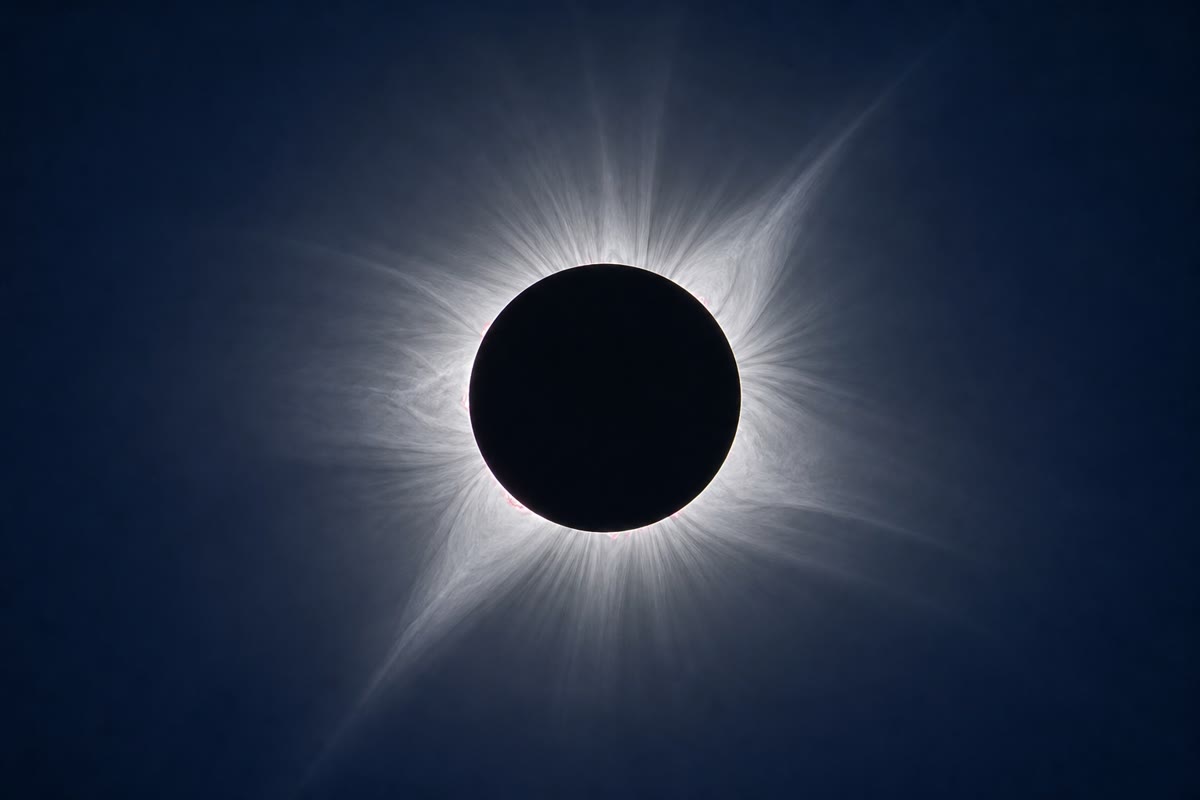
Your sports-field model found it: the Sun is about times wider than the Moon — and stands about times farther. The two discs therefore match in the sky almost exactly, so the Moon can cover the Sun just barely: totality is brief and its umbra-spot small. When the Moon is at the far end of its slightly oval orbit, its disc falls short, and a burning ring of Sun rims the black Moon — an annular eclipse, beautiful and never safe to watch unprotected.