Primary & Middle School Physics · Grades 1–9
50Shadows and Eclipses
Once or twice in a lifetime, for a few minutes, day becomes night: the Sun’s disc goes black behind the Moon and stars appear at noon. Ancient peoples read doom in it; you will read geometry. An eclipse is nothing but a shadow — the largest shadow you will ever stand in — and your ruler-and-ray toolkit is exactly what it obeys.
50.1 Shadows from honest lamps
Proposition 50.1 (Umbra and penumbra)
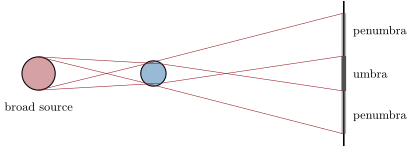
A point-like source throws a single, sharp-edged shadow. A broad source — a frosted globe, the Sun’s whole disc — throws a two-part shadow:
- the umbra: the region reached by light from no part of the source — full darkness;
- the penumbra: the fringe reached by light from part of the source only — half shadow, fading outward.
From inside the umbra, the source is entirely hidden; from the penumbra, partly hidden — peeking over the blocker’s edge.
Method 50.2 (Constructing the two shadows)
For a broad source, rays from its edges rule the map:
- draw rays from the source’s top edge grazing the blocker’s two sides, and the same from the bottom edge;
- the region behind the blocker that both edges’ rays miss is the umbra;
- the flanking regions missed by one edge but reached by the other are the penumbra;
- where all rays arrive, full light.
The umbra of a round blocker is a cone — and whether that cone reaches a given screen decides everything about eclipses.
Example 50.3 (Soft edges everywhere)
Now the smeared shadows of frosted lamps and cloudy skies are accounted for: broad sources wrap every shadow in penumbra, and a big enough source (the whole overcast sky) is all penumbra — shadows washed to nothing. Your own noon shadow’s edge, looked at closely, is a soft penumbral hem a centimetre wide: the Sun is a disc, not a point, and the hem is its confession.
50.2 The Moon steps into the beam
Definition 50.4 (Solar eclipse)
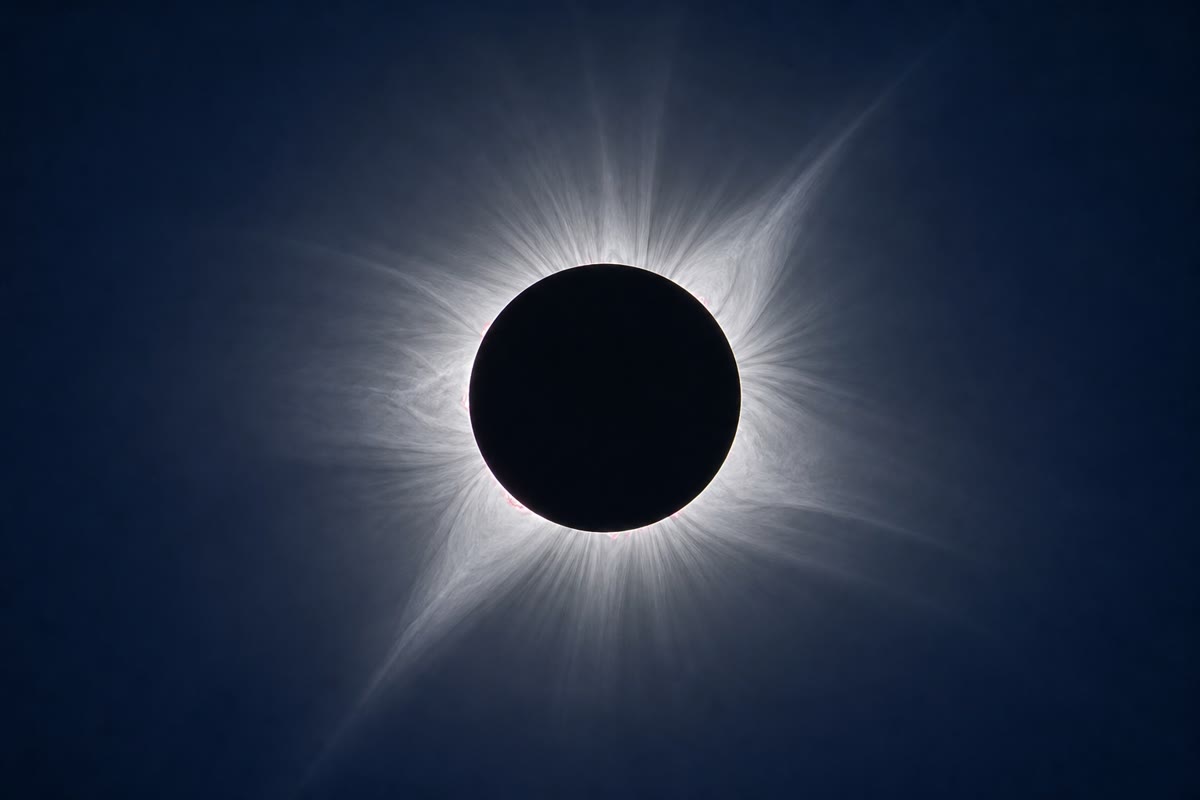
A solar eclipse happens when the Moon passes exactly between Sun and Earth, and its shadow falls on us. Where the Moon’s umbra touches the Earth — a racing spot rarely two hundred kilometres wide — the Sun’s disc is entirely hidden: total eclipse, night at noon, stars out. In the vast surrounding penumbra, the Sun is only partly bitten: partial eclipse.
Definition 50.5 (Lunar eclipse)
A lunar eclipse happens when the Moon sails into the Earth’s shadow cone: the full moon darkens — often to a deep copper glow — for an hour or more, visible to the whole night half of the world at once. This time we are the blockers, and the Moon stands in our umbra.

Example 50.6 (Why so rare?)
New moon comes every month — why not a solar eclipse every month? Because the Moon’s orbit is tilted, by about five degrees, against the Earth’s path around the Sun. Most months, the new moon passes above or below the Sun–Earth line, and its shadow spears harmlessly into space. Only when a new moon happens just as the Moon crosses the alignment plane do the three worlds line up — a few times a year somewhere on Earth, and for any particular town, totality is a once-in-lifetimes visitor.
Example 50.7 (The coincidence that makes totality)
Your sports-field model found it: the Sun is about times wider than the Moon — and stands about times farther. The two discs therefore match in the sky almost exactly, so the Moon can cover the Sun just barely: totality is brief and its umbra-spot small. When the Moon is at the far end of its slightly oval orbit, its disc falls short, and a burning ring of Sun rims the black Moon — an annular eclipse, beautiful and never safe to watch unprotected.
Remark 50.8 (Watching without weeping)
The old law has no eclipse exception: never look at the Sun — eclipsed, ringed or whole — with bare eyes, sunglasses, or any lens. A partly hidden Sun burns retinas as surely as the whole one, and painlessly. The safe instruments are old friends: the pinhole — project the Sun’s image through a small hole onto paper and watch the bite grow at comfort — or a leafy tree, whose thousand leaf-gap pinholes strew the ground with little crescents. Only certified eclipse glasses, inspected and undamaged, may face the Sun directly; during totality’s few minutes alone, the bare corona may be admired — and the first returning sliver ends the truce.
50.3 Exercises
Exercise 50.1 ★
Define umbra and penumbra by what an eye inside each can see of the source.
Exercise 50.2 ★
Why does a point-like lamp throw no penumbra at all? And why does an overcast sky throw almost no shadow?
Exercise 50.3 ★
In the construction method, whose rays draw the shadow map — the source’s center or its edges? What marks the umbra?
Solution
Solution of Exercise 50.3.
The rays from the source’s edges, grazing the blocker’s sides. The umbra is the region both edges’ rays miss.
Exercise 50.4 ★
Solar eclipse: put Sun, Moon and Earth in order, and say what the Moon’s phase must be that day. Lunar eclipse: same questions.
Exercise 50.5 ★
During a solar eclipse, who sees totality, who sees a partial bite, and who sees nothing unusual at all?
Exercise 50.6 ★
Why is a lunar eclipse visible from half the world at once, while totality’s path is a narrow racing stripe?
Solution
Solution of Exercise 50.6.
The lunar eclipse is the Moon itself dimming — a change on an object the whole night side can see at once. Solar totality requires standing inside the Moon’s slender umbra where it touches the ground: a spot, not a sky-wide event.
Exercise 50.7 ★
Why is there no eclipse every month, despite a new moon and a full moon every month?
Solution
Solution of Exercise 50.7.
The Moon’s orbit tilts about five degrees against the Earth–Sun plane: most new and full moons pass above or below the exact line, and the shadows miss. Only when phase and plane-crossing coincide do the three worlds align.
Exercise 50.8 ★
List two safe ways to follow a solar eclipse’s progress, and the one moment when bare eyes are permitted.
Solution
Solution of Exercise 50.8.
The pinhole projection onto paper, and the leafy tree’s ground crescents (or a colander); certified, undamaged eclipse glasses for direct viewing. Bare eyes: only during totality itself, and the first returning sliver ends the permission.
Exercise 50.9 ★★
Explain the -and- coincidence and both of its children: the near-perfect fit of totality, and the ring of the annular eclipse.
Solution
Solution of Exercise 50.9.
The Sun is about times the Moon’s width at about times its distance, so the two discs match in the sky almost exactly. Children of the fit: totality exists but only just — brief, with a tiny umbra-spot; and when the Moon rides the far part of its oval orbit, its slightly smaller disc leaves the Sun’s rim uncovered — the annular ring.
Exercise 50.10 ★★
Look closely at your shadow’s edge at noon: crisp at your feet, softer at your head’s shadow. Explain the gradient with the Sun’s disc and the construction method — why does penumbra widen with distance from the blocker?
Solution
Solution of Exercise 50.10.
Every shadow’s penumbral hem is drawn by the Sun’s edges, and the construction shows the hem widening with the gap between blocker and screen: rays from opposite solar edges spread farther apart the longer they travel past the blocker. Feet stand at zero gap — crisp; the head’s shadow lies two metres of spreading away — soft.
Exercise 50.11 ★★
During a partial solar eclipse, the leafy-tree crescents of two years ago return. Explain them now in full: what is each leaf-gap, what is each ground-patch, and why do all the crescents point the same way?
Solution
Solution of Exercise 50.11.
Each leaf-gap is a natural pinhole camera; each ground-patch is that pinhole’s image of the Sun — round on ordinary days. During the partial eclipse the Sun itself is a crescent, so every faithful little camera projects a crescent — and all point the same way because all copy the one crescent in the sky.
Exercise 50.12 ★★★
During a total lunar eclipse the Moon rarely vanishes: it glows deep copper-red. The light reaching it has grazed the rim of the Earth — passing through our sunset air all around the planet at once. Assemble the explanation from last chapter’s long-path diffusion: what has our atmosphere done to the grazing light, and why is the survivor light red? (You are explaining, in one stroke, why the eclipsed Moon wears the color of every sunset on Earth.)
Solution
Solution of Exercise 50.12.
Sunlight grazing the Earth’s rim crosses the atmosphere along its longest possible roads — sunset-length paths all around the planet at once. The air diffuses away much of the passing light (the share that paints Earth’s skies), and the diffusion robs the short-path colors soonest, so the light that survives the long grazing journey and bends on to the Moon is the sunset’s survivor: red. The eclipsed Moon glows with the light of every sunrise and sunset on Earth falling on it together.
50.4 Problem: The Eclipse Expedition
Problem 50.1
Weekend problem — the class plans its eclipse expedition; geometry chooses the campsite, physics packs the bags; totality, minute by minute
Next spring, a total solar eclipse crosses the continent. The class plans an expedition — with ray diagrams, not brochures.
Part I — Choosing where to stand. The atlas shows the predicted path: a stripe wide running across the map, flanked by a partial-eclipse zone thousands of kilometres broad.
- What shadow region does the stripe trace, and what region flanks it?
- The class’s town sits from the stripe’s centerline. What will the town see on eclipse day?
- Why must the expedition travel to the stripe — why will “ninety-five percent partial” at home not show night at noon, stars, or the corona?
- The stripe’s forecast marks totality at 10:41, lasting minutes seconds at the centerline and less toward the edges. Why is totality longest at the center of the stripe?
Part II — Packing the physics.
- The teacher packs certified eclipse glasses and confiscates two pairs of sunglasses. Justify both acts.
- Each pupil must build a pinhole projector from a shoebox. Recall its architecture, and state which way to stand relative to the Sun.
- One pupil proposes “watching in the reflection of a bucket of water”. Rule on the proposal.
- The group will also carry a colander to hold over a white sheet. Predict, and explain, what its dozens of holes will paint during the partial phases.
Part III — The day, minute by minute.
- 09:30, first contact: through the glasses, a small bite appears at the Sun’s edge. What body is taking the bite, and which of its shadow regions has reached the camp?
- 10:39: the light turns eerie and thin; shadows on the ground grow strangely sharp-edged. Explain the sharpening with umbra-and-penumbra thinking — what is the Sun becoming as its visible sliver narrows?
- 10:41, totality: glasses off, by the rule. For minutes the class stands inside something. Name it precisely, and state what has become visible around the black disc — and why the truce ends at the first returning sliver.
- 12:00, on the bus home, the teacher asks for the one-sentence summary: “An eclipse is…” Complete it worthily, with the chapter’s geometry inside it.
Solution
Solution of Problem 50.1.
1. The stripe is the path of the Moon’s umbra racing across the ground; the broad flanking zone is the penumbra’s footprint. 2. A partial eclipse: the town sits in the penumbra — a bite out of the Sun, watched through proper protection, and no darkness. 3. Even a five-percent sliver of Sun is thousands of times brighter than full moonlight: it keeps the sky lit and the corona invisible. Night-at-noon belongs to the umbra alone — there is no “almost totality”. 4. The umbra-spot is roughly round: a camp on the centerline sits under the spot’s full width as it races past, while camps near the stripe’s edge catch only a chord of the circle — a shorter crossing, a shorter totality. 5. Certified eclipse glasses block the Sun’s burn; sunglasses do not — they dim glare while letting the retina-burning share through, making comfortable staring possible: worse than nothing. 6. Pinhole in one end, tracing-paper screen at the other (or plain paper on the ground): stand with your back to the Sun, hole aimed over your shoulder, and watch the projected disc — never through the hole. 7. Rejected: water’s reflection is a mirror-image of the Sun, nearly as blinding as the Sun itself — a bounced burn is still a burn. 8. Dozens of crescent images on the sheet: each hole is a pinhole camera, and each projects the bitten Sun — a colander full of eclipses. 9. The Moon — invisible against the glare until its disc’s edge starts covering the Sun’s; the camp has entered the penumbra. 10. The visible Sun is shrinking toward a thin sliver — an ever more point-like source. Smaller source, narrower penumbral hems: every shadow’s soft edge tightens, and the world turns strange and sharp. 11. The Moon’s umbra itself — the class stands inside the shadow cone’s tip as it races over the camp. Around the black disc hangs the corona, the Sun’s pearly outer atmosphere, visible only now; the first sliver of returning disc restores full daylight rules — glasses on. 12. For example: “An eclipse is a shadow with worlds for lamp, blocker and screen: the Moon’s umbra brushing our ground, or the Moon sailing through ours — geometry you can draw with two rays and a ruler, staged on the grandest scale in nature.”