Physics · Glossary

What is Natural period and frequency?

Also known as: natural period of an LC circuit · natural frequency of an LC circuit

Definition 31.3 High School Physics · Chapter 31 — Free Electrical Oscillations: RLC

The natural period of an LC circuit is T0=2πLCT_0 = 2\pi\sqrt{LC}; its natural frequency is

f0=1T0=12πLC.f_0 = \frac{1}{T_0} = \frac{1}{2\pi\sqrt{LC}} .

Dimensional check: 1H=1Vs/A1\,\mathrm{H} = 1\,\mathrm{V}\,\mathrm{s}/\mathrm{A} and 1F=1C/V1\,\mathrm{F} = 1\,\mathrm{C}/\mathrm{V}, so LCLC carries s×C/A=s2\mathrm{s} \times \mathrm{C}/\mathrm{A} = \mathrm{s}^{2}LC\sqrt{LC} is a time, as it must be.

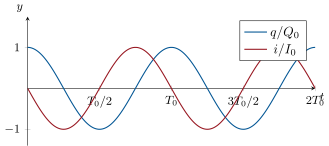
Charge and current of the free LC circuit: the current peaks each time the charge crosses zero, a quarter period out of step.

Examples

Example 31.4 (First numbers)

L=10mHL = 10\,\mathrm{mH} with C=1.0µFC = 1.0\,\text{µ}\mathrm{F}: LC=1.0×10⁴s\sqrt{LC} = 1.0 \times 10^{-4}\,\mathrm{s}, so T0=0.63msT_0 = 0.63\,\mathrm{ms} and f01.6kHzf_0 \approx 1.6\,\mathrm{kHz} — an audible tone. L=1.0mHL = 1.0\,\mathrm{mH} with C=100pFC = 100\,\mathrm{pF}: T0=2.0µsT_0 = 2.0\,\text{µ}\mathrm{s}, f00.50MHzf_0 \approx 0.50\,\mathrm{MHz} — a radio frequency. Only the product LCLC sets the tempo.

Read in context →