Turn the heavy dial of an attic radio and the stations file past the needle: a voice, violins, static, a voice again. Behind the panel there is no motor and no computer — a coil, a capacitor whose interleaved plates the dial rotates, and a length of aerial wire. This chapter connects last chapter’s two energy tanks (Chapter 30) head to head and finds the fastest pendulum ever built: charge swinging back and forth, up to millions of times per second, at a tempo the dial chooses.
31.1 An electrical pendulum: the LC circuit
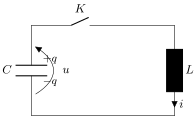
Charge a capacitorC to a voltageU0 — its plates then hold ±Q0 with Q0=CU0 — and at t=0 switch it onto an idealcoilL, of zero resistance. No source anywhere in the loop: whatever happens next, the circuit does on its own.
The LC circuit: a capacitor charged to Q0, a switch, an ideal coil. Closing K lets the charge spill through the coil — and the coil, hating change, will not let it stop.
Proposition 31.1(The LC equation)
In the ideal LC loop the charge q(t) of the upper plate obeys
Proof. Verify by substitution. Differentiating, i=dq/dt=−T02πQ0sin(2πt/T0) — the stated i(t) — and again dt2d2q=−(T02π)2q, which equals −q/(LC) exactly when (2π/T0)2=1/(LC), i.e. T0=2πLC. And q(0)=Q0, i(0)=0. That no other function fits the equation and the start is admitted, exactly as for the spring (Remark 28.9). ∎
Definition 31.3(Natural period and frequency)
The natural period of an LC circuit is T0=2πLC; its natural frequency is
f0=T01=2πLC1.
Dimensional check: 1H=1Vs/A and 1F=1C/V, so LC carries s×C/A=s2 — LC is a time, as it must be.
Example 31.4(First numbers)
L=10mH with C=1.0µF: LC=1.0×10⁻⁴s, so T0=0.63ms and f0≈1.6kHz — an audible tone. L=1.0mH with C=100pF: T0=2.0µs, f0≈0.50MHz — a radio frequency. Only the productLC sets the tempo.
Remark 31.5(A quarter period out of step)
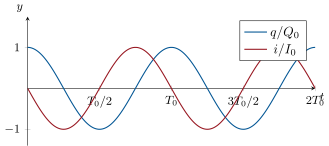
The current is a quarter period out of phase with the charge: i=0 when q=±Q0 (plates full, flow reversing) and i=±I0 when q=0 (plates empty, flow at full tilt) — exactly the pendulum, motionless at the extremes and fastest at the bottom.
Charge and current of the free LC circuit: the current peaks each time the charge crosses zero, a quarter period out of step.
31.2 The energy waltz
Proposition 31.6(Conservation of the stored energy)
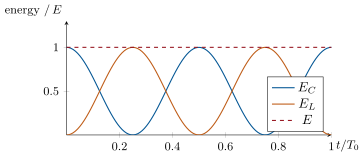
is constant: entirely in the capacitor when q=±Q0, entirely in the coil when i=±I0.
Proof. Differentiate: dtdE=Cqdtdq+Lidtdi=i(Cq+Ldt2d2q)=0 by Proposition 31.1. Its value is read at t=0 (all capacitor), and again at the all-current instant q=0 — whence 21LI02=Q02/2C, recovering I0=Q0/LC by energy alone. ∎
C=1.0µF charged to U0=10V, switched onto L=10mH: energyE=21CU02=5.0×10⁻⁵J, periodT0=0.63ms, and a peak current I0=U0C/L=0.10A reached a quarter period (0.16ms) after the switch closes.
31.3 Real circuits: damped oscillations
Every real coil is wound from resistive wire: the honest loop is a series RLC circuit, and the resistance taxes the waltz.
Definition 31.8(Pseudo-periodic and aperiodic regimes)
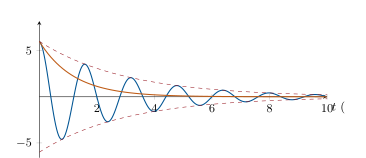
pseudo-periodic (small R): the circuit still oscillates inside a shrinking envelope, with a repeat time — the pseudo-period — close to T0=2πLC when the damping is light;
aperiodic (large R): the charge creeps back to zero without ever overshooting — no oscillation at all.
The two fates of a real RLC circuit: oscillations dying inside an exponential envelope (dashed), or a creep to zero with no oscillation. Lightly damped, the pseudo-period stays ≈T0.
Remark 31.9(Maintaining oscillations)
To keep the amplitude alive, feed the circuit exactly the energy the resistance burns, once per cycle and in step with the swing: an amplifier does for the RLC loop what the escapement’s push does for the pendulum (Chapter 28). Every quartz watch and every radio transmitter is such a maintained oscillator, running at its natural frequencyf0.
Same equation, same solutions: every result about either oscillator translates instantly into the other language.
Proof. Compare Proposition 31.1 with md2x/dt2=−kx: substituting q→x, L→m, 1/C→k turns one into the other, and LC→m/k turns 2πLC into 2πm/k. ∎
Example 31.11(Tuning a radio)
An aerial feeds a whisper of every station into an LC loop, but only the one broadcasting near f0 pushes in step and builds up — resonance (Definition 28.13). The dial rotates the plates of a variable capacitor: changing C moves f0=1/(2πLC), and the needle hands the earphone one station at a time. On the transmitting side, a maintained oscillator (Remark 31.9) sets the broadcast frequency; in a watch, a quartz crystal — a mechanical twin of breathtaking stiffness — plays the same role.
31.5 Exercises
Exercise 31.1★
Compute T0 and f0 for (a) L=10mH, C=1.0µF; (b) L=1.0mH, C=100pF. By what factor do the frequencies differ?
Using 1H=1Vs/A and 1F=1C/V, show unit by unit that LC is a time. Why does the 2π change nothing?
Solution
Solution of Exercise 31.2.
LC: (Vs/A)(C/V)=s×C/A=s×s=s2, so LC is in seconds. 2π is a pure number — no dimension to change.
Exercise 31.3★
A 470nFcapacitor is charged to 6.0V. Compute Q0 and the stored energy; describe, without computation, what follows when it is switched onto an ideal coil.
Solution
Solution of Exercise 31.3.
Q0=CU0=2.8µC; E=21CU02=21×4.7×10−7×36≈8.5µJ. The charge oscillates at f0=1/(2πLC), current a quarter period out of phase, energy sloshing between plates and coil, total constant.
Exercise 31.4★
An LC circuit follows q(t)=2.0cos(2πt/T0) in microcoulombs, with T0=4.0ms. Read off Q0; compute f0, q(T0/2), i(0), and the peak current I0=2πQ0/T0.
Solution
Solution of Exercise 31.4.
Q0=2.0µC; f0=1/T0=250Hz; q(T0/2)=−2.0µC; i(0)=0 (cosine flat at t=0); I0=2π×2.0×10−6/4.0×10−3≈3.1mA.
Exercise 31.5★
At which instants of the cycle is the energy entirely in the capacitor? Entirely in the coil? What is the mechanical counterpart of each moment for a pendulum?
Solution
Solution of Exercise 31.5.
All in the capacitor when q=±Q0, i=0 (t=0, T0/2, T0, …): the pendulum’s extremes. All in the coil when q=0, i=±I0 (t=T0/4, 3T0/4, …): the pendulum’s lowest, fastest point.
Exercise 31.6★★
Verify by substitution that q(t)=Q0cos(2πt/T0) satisfies Ld2q/dt2+q/C=0 exactly when T0=2πLC.
Solution
Solution of Exercise 31.6.
d2q/dt2=−(2π/T0)2Q0cos(2πt/T0)=−(2π/T0)2q, so Ld2q/dt2+q/C=q[1/C−L(2π/T0)2]=0 for all t exactly when (2π/T0)2=1/(LC), i.e. T0=2πLC.
Exercise 31.7★★
A long-wave station broadcasts at 198kHz. With C=220pF, what inductance tunes to it?
Solution
Solution of Exercise 31.7.
L=4π2f02C1=39.5×(1.98×105)2×2.2×10−101≈2.9mH.
Exercise 31.8★★
C=1.0µF charged to 10V discharges into L=10mH. Compute the stored energy, the peak current (by energy conservation), and the instant it is first reached.
Solution
Solution of Exercise 31.8.
E=21CU02=5.0×10⁻⁵J; 21LI02=E gives I0=2E/L=1.0×10−2=0.10A, first reached at T0/4=41×0.63ms≈0.16ms.
Exercise 31.9★★
Explain why EC and EL oscillate at frequency2f0, not f0. Show that at t=T0/8 (started from q=Q0) the energy is split exactly in half.
Solution
Solution of Exercise 31.9.
EC∝cos2(2πt/T0), and cos2 repeats every half turn: two fillings of the capacitor per period, hence 2f0. At t=T0/8 the phase is π/4: cos2(π/4)=21, so EC=EL=E/2.
Exercise 31.10★★
On an oscillogram of a lightly dampedRLC circuit, successive maxima read 4.0V then 3.0V. Assuming the ratio stays constant, predict the sixth maximum after the 4.0V one. What fraction of the energy survives each pseudo-period? What can you say of the pseudo-period itself?
An LC circuit has L=0.50H and C=20µF. Compute T0; then, using the dictionary (Proposition 31.10), find the stiffnessk giving a 0.50kg glider the same period, and check it.
Solution
Solution of Exercise 31.11.
T0=2π0.50×2.0×10−5=2π×3.16×10−3≈20ms. Dictionary: k=m/(LC)=0.50/1.0×10−5=5.0×104N/m; check 2πm/k=2π1.0×10−5 — the same 20ms.
Exercise 31.12★★★
A tuner uses L=0.20mH and a variable capacitor sweeping 50 to 500pF. Compute the two extreme frequencies. Show that f0∝1/C, so tenfold in C gives only 10≈3.2 in frequency.
Solution
Solution of Exercise 31.12.
C=500pF: f0=1/(2π1.0×10−13)≈0.50MHz; C=50pF: f0≈1.6MHz. At fixed L, f0=(2πL)−1C−1/2∝1/C: tenfold C, only 10≈3.2 in f0 — as found.
Exercise 31.13★★★
A real coil makes the circuit lose 5.0% of its energy each pseudo-period. After how many periods has the energy halved? What is the amplitude then, as a fraction of the start? At f0=1.0MHz, how long is that in microseconds?
Solution
Solution of Exercise 31.13.
0.95n=21: n=ln2/∣ln0.95∣≈13.5, so about 14periods. Amplitude∝E: down to 1/2≈0.71 of the start. At 1.0MHz, T0=1.0µs: about 14µs.
Exercise 31.14★★★
A watch oscillator stores E=1.0×10⁻⁹J and loses 2.0% of it per cycle at f0=32768Hz. What average power must the maintaining circuit supply? Why does the push have to arrive in step with the oscillation?
Solution
Solution of Exercise 31.14.
Loss per cycle 0.020×1.0×10−9J=2.0×10⁻¹¹J, at 32768 cycles per second: P=32768×2.0×10−11≈6.6×10⁻⁷W — under a microwatt, years on a button cell. In step, because only a push at the right phaseaddsenergy (resonance); out of step it would brake the swing.
Exercise 31.15★★★
After each edge of a square signal, an experimenter’s wiring “rings” at 25MHz; the stray inductance is about 1.0µH. Estimate the stray capacitance responsible. Which regime should a small added series resistor push the circuit into, and why does that cure the ringing?
Solution
Solution of Exercise 31.15.
C=4π2f02L1=39.5×(2.5×107)2×1.0×10−61≈41pF. The resistor should push the loop into the aperiodic regime: the charge then settles without overshooting — no oscillation, no ringing.
31.6 Problem: Building a crystal radio
Problem 31.1
Weekend problem — building a crystal radio: one coil, one variable capacitor, a diode and an earphone — no battery, no amplifier, and the evening news arrives on the energy of the wave itself
A kit from a grandparent’s attic: a coilL=0.20mH wound on a cardboard tube, a variable capacitor whose plates rotate from 20pF to 480pF, a crystal diode, an earphone, and 20m of aerial wire. The stations to catch broadcast between 530kHz and 1700kHz.
Part I — The tuning loop.
The capacitor, charged, is left to discharge into the coil: write the loop law and turn it into the differential equation for q(t).
Verify by substitution that q(t)=Q0cos(2πt/T0) solves it, provided T0=2πLC.
Check by dimensional analysis that LC is a time.
Dial set to C=330pF: compute T0 and f0. Is the loop tuned inside the band?
Find the capacitance that tunes to exactly 1.00MHz.
Compute the peak current I0, using energy conservation.
The coil’s resistance dissipates 4.0% of the stored energy per cycle: after how many cycles has the energy halved?
How long is that in microseconds? Why can this “ringing” alone not play the evening news?
Explain why the arriving wave keeps the loop swinging only when tuned to that station — and what maintains the oscillation at the transmitter (Remark 31.9).
Part IV — The mechanical twin.
Using the dictionary (Proposition 31.10) with a glider of mass m=0.20kg, compute the stiffnessk of the spring matching the tuned circuit.
A stiff car spring has k≈5×10⁴N/m. Comment: can a bench-top spring–mass system oscillate at megahertz?
Keep a reasonable k=100N/m instead: what mass oscillates at 1.00MHz?
What real object is such a featherweight, ultra-stiff mechanical oscillator, and where did you meet it earlier this year (Chapter 28)?
Spec sheet, one sentence: the band your radio sweeps, the capacitance that picks 1.00MHz, how long a lone ring lasts, and what plays the news anyway.
Solution
Solution of Problem 31.1.
1. Loop law: uL+uC=0, with uC=q/C, uL=Ldi/dt, i=dq/dt: Ld2q/dt2+q/C=0.
2.d2q/dt2=−(2π/T0)2q, so the equation reads q[1/C−L(2π/T0)2]=0, true for all t exactly when T0=2πLC.
3.LC: (Vs/A)(C/V)=s×C/A=s2 — LC is a time.
4.LC=6.6×10⁻¹⁴s2: T0=2π×2.57×10−7≈1.6µs, f0≈620kHz — inside 530 to 1700kHz.
5.C=4π2f02L1=39.5×1.0×1012×2.0×10−41≈127pF.
6. Same formula at 530kHz: C≈451pF.
7. At 1700kHz: C≈44pF.
8.C=480pF: f0≈514kHz; C=20pF: f0≈2.5MHz — the whole band, with margin at both ends.
9.f0=(2πL)−1C−1/2∝1/C; doubling f0 requires dividing C by 4.
10. Since f0∝1/C, equal steps of C move f0 slowly at large C and fast at small C: a given spacing between stations then takes little dial travel — they crowd at the high-frequency (low-C) end.
14. At 1.00MHz, T0=1.0µs: the ring halves in about 17µs. A lone ring dies in microseconds; music needs the loop fed continuously.
15. The wave pushes millions of times per second; only when its frequency matches f0 do the pushes arrive in step and build the swing — resonance; off-tune stations push as often against as with it. At the transmitter, an amplifier returns the dissipatedenergy each cycle: a maintained oscillator.
17. About 108 times the car spring: no bench-top spring–mass system reaches megahertz — everyday stiffnesses and masses are hopelessly slow.
18.m=(2πf0)2k=(6.28×10⁶)2100≈2.5×10⁻¹²kg — a few nanograms, a speck of dust.
19. A quartz crystal: a featherweight, ultra-stiff sliver singing at its natural frequency — the timekeeper met earlier this year.
20. With L=0.20mH and 20 to 480pF the loop sweeps about 0.51 to 2.5MHz, covering the band; C≈127pF picks 1.00MHz; left alone the ring halves in ≈17µs, but the station’s own wave, resonating in step, re-feeds the loop — the news plays on the energy of the wave itself.