
Physics · Glossary

What is Relativistic momentum and energy?

Definition 5.2 University Physics — Year 3 · Chapter 5 — Relativistic Dynamics

A particle of mass mm and velocity v\vect v (γ=1/1v2/c2\gamma = 1/\sqrt{1 - v^2/c^2}) carries the momentum and the energy

p=γmv,E=γmc2.\vect p = \gamma m\vect v , \qquad E = \gamma mc^2 .

At rest, E0=mc2E_0 = mc^2: the rest energy. The kinetic energy is what motion adds, Ek=Emc2=(γ1)mc2E_k = E - mc^2 = (\gamma - 1)mc^2, which for vcv \ll c reduces to the familiar 12mv2\tfrac12 mv^2 (expand γ\gamma). In every isolated process, total p\vect p and total EE — rest energies included — are conserved.
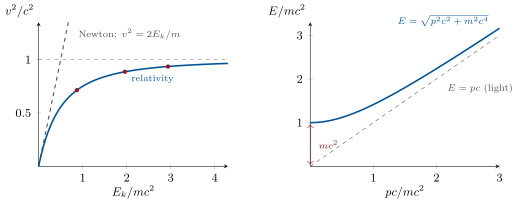
Left: Bertozzi’s “ultimate speed” experiment — measured electron speeds (dots) follow the relativistic curve and saturate at c while Newton’s line sails past it. Right: the energy–momentum hyperbola; its offset at p = 0 is the rest energy, its asymptote the photon’s E = pc.
Left: Bertozzi’s “ultimate speed” experiment — measured electron speeds (dots) follow the relativistic curve and saturate at cc while Newton’s line sails past it. Right: the energy–momentum hyperbola; its offset at p=0p = 0 is the rest energy, its asymptote the photon’s E=pcE = pc.

Examples

Example 5.5 (Orders of magnitude)

Particle physics counts energy in electronvolts and masses in MeV/c2\mathrm{MeV}/c^2: electron 0.5110.511, proton 938.3938.3, muon 105.7105.7, pion 139.6139.6. An electron of kinetic energy 1MeV1\,\mathrm{MeV} has γ=2.96\gamma = 2.96 and v=0.94cv = 0.94c — already fully relativistic, which is why electronics stays classical (eV\mathrm{eV}) and nuclear physics does not (MeV\mathrm{MeV}). A 6.8TeV6.8\,\mathrm{TeV} LHC proton has γ=7250\gamma = 7250 and trails a photon by only 2.9m/s2.9\,\mathrm{m}/\mathrm{s}.

Read in context →