University Physics — Year 3 · Bachelor Year 3
5Relativistic Dynamics
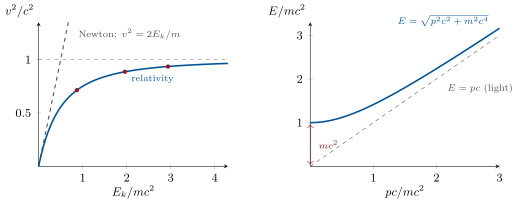
In 1964 William Bertozzi filmed electrons racing down a linear accelerator: each burst was given a measured energy, and its speed was clocked over of flight. Newton predicted that electrons should fly at eight times the speed of light; the stopwatch said and refused to go further, however hard the electrons were pushed. Kinematics told us in the last chapter that is a limit; dynamics must now explain what happens to the pushing — where the work goes when speed no longer grows. The answer reorganises mechanics around a new momentum and a new energy, joined in the most famous equation in physics: energy stored is mass, mass is energy in residence, . This chapter builds the dynamics, then puts it to work where it lives daily — radioactive decays, particle collisions, and the accelerators that turn motion into new matter.
5.1 Momentum and energy, rebuilt
Remark 5.1 (Why had to go)
Classical momentum is conserved in every frame if velocities transform à la Galileo. They do not (Proposition 4.10): a collision that conserves in one frame fails to in another, so the old momentum cannot be a law of nature — at best a slow-speed shadow of one. The repair is to measure the velocity with the particle’s own clock: transforms cleanly, and turns out to be conserved in all frames at once.
Definition 5.2 (Relativistic momentum and energy)
A particle of mass and velocity () carries the momentum and the energy
At rest, : the rest energy. The kinetic energy is what motion adds, , which for reduces to the familiar (expand ). In every isolated process, total and total — rest energies included — are conserved.
Theorem 5.3 (The energy–momentum relation)
For any particle,
the combination has the same value in every frame — it is to energy and momentum what the interval is to time and space. Two regimes: at low speed, ; at high energy (), and : pushing harder adds energy and momentum, almost no speed.
Proof. ; and . Frame invariance follows because and are frame-independent. ∎
Proposition 5.4 (Massless particles)
A particle of zero mass has and moves at exactly in every frame; it cannot be slowed, only redshifted. The photon is the standard case: and — the Planck–Einstein relations of the Year 1 volume, now seen as the corner of mechanics.
Proof. Set in Theorem 5.3: and . ∎
Example 5.5 (Orders of magnitude)
Particle physics counts energy in electronvolts and masses in : electron , proton , muon , pion . An electron of kinetic energy has and — already fully relativistic, which is why electronics stays classical () and nuclear physics does not (). A LHC proton has and trails a photon by only .
5.2 Mass is energy in residence
Theorem 5.6 (Mass–energy equivalence)
The mass of a body is the total energy of its contents, divided by , measured in its rest frame: heat a body, wind its spring, excite its atoms, and it weighs more by ; bind its parts together and it weighs less by the binding energy over — the mass defect. Conversely, rest energy can be released: whenever the final masses total less than the initial ones, the difference emerges as kinetic energy or radiation.
Proof. Admitted at this level. ∎
Example 5.7 (The ledger of )
: one gram of mass difference is , the energy of a small city for a day. Chemical bonds (a few eV per molecule) shift masses by parts in — forever unweighable, which is why chemistry never noticed. Nuclear binding shifts them by nearly : helium weighs less than its four hydrogen ingredients, and that missing fraction, streaming from the Sun as light, costs it every second — four million tonnes of sunshine. Annihilation settles the whole account: an electron meeting a positron leaves nothing but two photons of each, the signal by which PET scanners watch a living brain.
Remark 5.8 (What “conversion” means)
Nothing material “turns into” energy: total energy was conserved all along. What changes is its residence — from rest energy, which weighs, to kinetic energy and radiation, which fly. The deep statement of is that inertia itself is an energy content: a box of hot gas resists acceleration more than the same box cold.
5.3 Collisions and decays
Definition 5.9 (Four-momentum and invariant mass)
Bundle a particle’s energy and momentum into its four-momentum . For a system of particles, sum componentwise: , . The system’s invariant mass is defined by
the same number in every frame, equal to the total energy (over ) in the centre-of-momentum frame where . Note that exceeds the sum of the parts’ masses whenever they move relative to each other — two photons flying apart have though each is massless.
Method 5.10 (Solving a relativistic collision)
(1) Write four-momentum conservation: and together, never one alone. (2) Compute the invariant of whatever bundle is convenient — it can be evaluated in the easiest frame and used in any other. (3) Thresholds: a reaction is possible when the invariant mass of the initial state reaches the summed rest masses of the final one. (4) Decays at rest: momenta of the products are opposite and equal; energies follow from the masses alone. (5) Only at the very end, if asked, convert to speeds via .
Example 5.11 (The pion’s fingerprint)
A charged pion at rest decays, (the neutrino effectively massless). Momentum conservation makes the products back-to-back with equal ; energy conservation reads . Solving:
so every muon from a pion decaying at rest is born with exactly of kinetic energy — a monoenergetic line, and its observation (Powell, 1947) is how the pion’s mass was first weighed. Two-body decays always produce such lines; three-body decays smear them into spectra, which is precisely how the neutrino was first suspected in nuclear decay.
Proposition 5.12 (Thresholds: the tyranny of the fixed target)
To create new particles, only the centre-of-momentum energy is available. A beam of energy striking a target of mass at rest yields
the useful energy grows only as — the rest is wasted on pushing the debris forward. Two identical beams colliding head-on yield : all of it useful. This single formula is why the frontier machines are colliders (Problem 5.1).
Proof. Evaluate in the lab: with the beam momentum; expand and use . For the collider, and . ∎

5.4 Force and the machines
Proposition 5.13 (Relativistic equation of motion)
Newton’s law survives in the form
A magnetic field, forever perpendicular to , changes no energy and bends the trajectory into a circle of radius
— the same formula as in the Year 1 volume, with the relativistic . But the circulation frequency now falls as the particle gains energy: the cyclotron’s fixed-frequency push slips out of step near the MeV scale, and the high-energy machines — the synchrotrons — instead ramp their field and their frequency in synchrony with , holding the beam on one ring.
Partial proof. The force law is the definition of dynamics consistent with the new momentum ( follows from : ). For the circle: with constant means the momentum vector turns at rate , so the radius is . ∎
Example 5.14 (Reading the LHC like an exercise)
Protons of in dipoles of : (ultrarelativistic), so — and indeed the ring’s magnetic bending radius is , the circumference being mostly magnets. Head-on collisions provide ; to reach that on a fixed target would take a beam of — a hundred-fold the reach of any machine ever built. The collider formula, not stronger magnets, is what bought the modern energy frontier.
5.5 Exercises
Exercise 5.1 ★
An electron () moves at . Compute , its momentum in , its total and kinetic energies. Same questions for a proton () of kinetic energy .
Solution
Solution of Exercise 5.1.
Electron: ; , so ; , . Proton: , , , .
Exercise 5.2 ★
(a) How much energy sleeps in one gram of matter? (b) The Hiroshima explosion released about : what mass difference is that? (c) The Sun radiates : how much mass does it shed per second, and what fraction of its in ten billion years? (d) Your phone battery stores : by how much is a charged phone heavier?
Solution
Solution of Exercise 5.2.
(a) . (b) — the bomb converted less than a gram. (c) ; over (): , about of the Sun. (d) — real, and forever unweighable.
Exercise 5.3 ★
(a) What momentum does a laser pointer’s beam carry per second, and what force does the pointer feel? (b) What force does sunlight () exert on a perfectly reflecting solar sail? (c) From rest, how fast is a sail-craft moving after a month? (d) Why does a comet’s dust tail point away from the Sun?
Solution
Solution of Exercise 5.3.
(a) per second: force of recoil. (b) Reflection doubles the transfer: . (c) ; after : — slow to start, but the engine never runs dry. (d) Sunlight’s momentum (with the solar wind) pushes the dust continuously outward: the tail streams away from the Sun, not behind the comet.
Exercise 5.4 ★
Practice with units. (a) Show that is a mass unit and convert the electron mass to kilograms. (b) What is in ? (c) An invariant mass squared comes out as (in units): what centre-of-momentum energy is that? (d) Why do particle physicists set , and what must a reader re-insert to get SI numbers?
Solution
Solution of Exercise 5.4.
(a) : . (b) . (c) of centre-of-momentum energy. (d) With , energy, momentum and mass share one unit and every formula sheds its ’s; to return to SI, reinsert the unique power of that fixes the dimensions.
Exercise 5.5 ★★
Bertozzi’s electrons had kinetic energies , , and . (a) Compute Newton’s prediction for each, in units of . (b) Compute the relativistic . (c) His time-of-flight over at : what did the clock read, and what would Newton have predicted? (d) The electrons’ energy was also measured calorimetrically — by their heat on impact: why was that step the experiment’s real point?
Solution
Solution of Exercise 5.5.
(a) : , , , — absurd beyond the first. (b) : , , , . (c) ; Newton’s would have read . (d) The calorimeter proved the electrons truly carried the full into the target: the energy was all there, and still the speed had ceased to grow — work now buys momentum and energy, not velocity.
Exercise 5.6 ★★
The charged pion decays at rest: , , , . (a) Show and evaluate it. (b) The muon’s kinetic energy and speed. (c) The neutrino’s energy. (d) In flight at , what are the maximum and minimum lab energies of the decay muon (decay forward and backward)?
Solution
Solution of Exercise 5.6.
(a) ; isolate the root and square: . (b) : , . (c) . (d) Boosting: with : between and .
Exercise 5.7 ★★
Invariant mass in action. (a) Two photons of each fly at to one another: compute the invariant mass of the pair. (b) A neutral pion () decays into two photons: what is the invariant mass of the photon pair, in every frame? (c) Explain how an experiment “discovers” a particle as a bump in the invariant-mass distribution of its decay products. (d) Two photons of equal energy fly exactly parallel: invariant mass? What does this say about a light beam’s rest frame?
Solution
Solution of Exercise 5.7.
(a) For two massless quanta, : . (b) Exactly — invariant mass is the particle’s mass, in every frame. (c) Compute for every pair of photons in the event: random pairs spread smoothly, true daughters of a particle pile up at its mass — the bump. (d) : ; a parallel beam of light has no rest frame — it moves at as a whole, like each of its photons.
Exercise 5.8 ★★
LHC bookkeeping ( protons). (a) , and the speed deficit (use ). (b) The revolution frequency on the ring and the number of laps per second. (c) The stored energy of a beam of protons, in kilograms of TNT (). (d) The mass-equivalent of the two beams’ kinetic energy, in micrograms — matter about to be made.
Solution
Solution of Exercise 5.8.
(a) ; . (b) : eleven thousand laps per second. (c) of TNT — in a hair-thin beam. (d) : the working stock of matter-to-be.
Exercise 5.9 ★★
Colliding photons. (a) Show that a single photon in vacuum cannot decay into an electron–positron pair, however energetic (use the invariant). (b) Against a second photon of energy head-on, show pair creation needs . (c) A photon needs what partner? An X-ray of ? (d) The universe is filled with starlight and the cosmic microwave background: what does (b) predict for the reach of TeV -rays across intergalactic space?
Solution
Solution of Exercise 5.9.
(a) A photon’s invariant mass is ; an pair’s is at least . The invariant cannot change in an isolated decay: forbidden. (Equivalently: in no frame can momentum balance.) (b) Head-on, ; pair creation needs , i.e. . (c) Another photon; for , a partner of . (d) A TeV photon meets the threshold on ordinary starlight: the sky itself absorbs TeV -rays over cosmological distances — the universe is not transparent at all energies.
Exercise 5.10 ★★★
Compton, by four-momenta. A photon of wavelength strikes an electron at rest and scatters at angle . (a) Write four-momentum conservation and isolate the final electron’s invariant. (b) Derive
(c) Evaluate and the maximal shift; why is the effect invisible with visible light but decisive for X-rays? (d) What did Compton’s 1923 measurement establish about light that the photoelectric effect had not?
Solution
Solution of Exercise 5.10.
(a) ; square both sides (invariants): . (b) With , and : , which in wavelengths () is the stated shift. (c) , at most : one part in of visible light (invisible), several percent of a X-ray (measured). (d) That a photon collides like a billiard ball — carrying momentum exchanged in individual events, not merely energy in lumps.
Exercise 5.11 ★★★
The end of the cosmic-ray spectrum. The universe bathes in microwave photons of typical energy . A proton of energy hitting one head-on can be excited to the resonance (), losing energy each time. (a) Show the threshold condition is approximately . (b) Compute the threshold . (c) Above it, the universe is opaque to protons beyond some : what does this predict for the observed cosmic-ray spectrum (the Greisen–Zatsepin–Kuzmin cut-off)? (d) Cosmic rays of have been recorded — “Oh-My-God” particles: what does their existence demand of their sources?
Solution
Solution of Exercise 5.11.
(a) head-on (the proton ultrarelativistic); threshold at . (b) for the mean photon — the thermal tail of the microwave background brings the effective cut-off to . (c) Protons above the cut-off lose energy to the within : the spectrum should end near for distant sources — the observed GZK suppression. (d) Their sources must be both extraordinary accelerators and cosmically nearby — within our supercluster — which is part of why their origin is still hunted.
Exercise 5.12 ★★★
The photon rocket. A rocket of initial mass emits its exhaust as a collimated light beam and reaches speed . (a) Conserving energy and momentum between start and end, show
the exponential of the rapidity — the relativistic Tsiolkovsky equation with the best possible exhaust. (b) Mass ratio to reach ? And to reach and stop at destination? (c) The beam must be made somehow: with matter–antimatter annihilation at perfect efficiency, how many kilograms of antimatter per kilogram of payload for the one-way trip? (d) World antiproton production is nanograms per year: conclude, in one sentence, on photon rockets.
Solution
Solution of Exercise 5.12.
(a) Energy: ; momentum: . Eliminate : . (b) ; accelerating and braking squares it: . (c) The consumed mass must be annihilated fuel, half of it antimatter: of antimatter per kilogram delivered (one way, no braking). (d) At nanograms per year of world production, photon rockets remain arithmetic, not engineering.
5.6 Problem: Making matter — the antiproton and the Bevatron
Problem 5.1
Weekend problem — how momentum conservation priced the antiworld
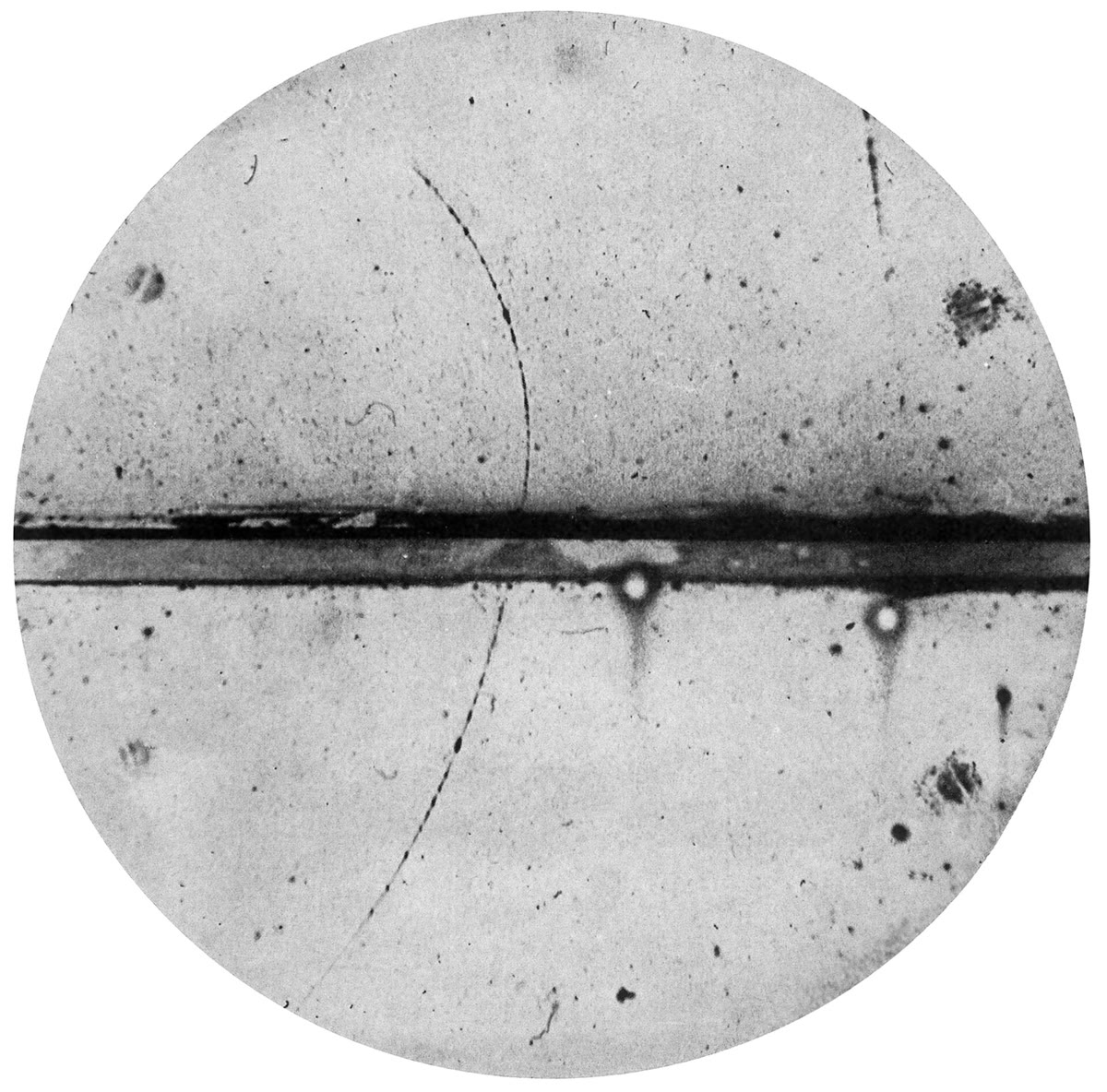
Dirac’s equations demanded, from 1931, that the proton have a mirror twin of opposite charge. Making one meant buying its rest energy with beam energy — and momentum conservation set the price. This problem prices it, designs the machine that paid it, and follows the 1955 discovery. Data: ; charge and baryon number (protons and neutrons , antiprotons ) are conserved in every reaction.
Part I — The four-momentum toolkit.
- For one particle, show from the definitions of and .
- For a system, why is the same in all frames, and what does it equal in the centre-of-momentum frame?
- A proton beam of energy hits a proton at rest: show .
- Check the two limits: at low energy ; at high energy — the square-root law.
- A reaction is allowed only if reaches the summed rest masses of the products, with all products at rest in the centre-of-momentum frame at threshold: justify this last clause.
- Why can the kinetic energy of the products in the lab never be recovered for particle creation on a fixed target?
Part II — Pricing the antiproton.
- In collisions, the cheapest reaction making an antiproton must also make an extra proton: write it, and justify with charge and baryon number.
- Show the threshold requires .
- Deduce the required beam energy and kinetic energy ; evaluate .
- At threshold, what fraction of the beam’s kinetic energy actually became new rest mass ( of it)? Where is the rest?
- In a head-on – collider, what kinetic energy per beam would the same reaction need? Compare the two designs.
- In 1954 no collider existed (beams were too thin to hit each other): what practical fact forced the fixed-target choice, and what did it cost in beam energy?
Part III — Designing the Bevatron. The machine built at Berkeley reached — comfortably above threshold — with dipole fields of .
- Compute the beam’s total energy and momentum at top energy.
- Compute the bending radius and compare with the machine’s .
- Compute the proton’s speed and the revolution frequency on the ring.
- At injection the protons arrive at kinetic: compute their speed, and explain why the accelerating frequency had to sweep during each cycle (which two quantities change as grows?).
- With about gained per turn, how many turns and how long does one acceleration cycle take?
- The name “Bevatron” came from BeV, billions of electronvolts: state in one line what physics fixed the design figure of and a fraction BeV.
Part IV — The discovery, 1955.
- A magnet bends each candidate on a circle: explain why this selects particles by momentum (), not by energy or speed — and why a momentum-selected beam still mixes species.
- The beam on a copper target produced torrents of negative pions () among which a few antiprotons hid. The spectrometer selected negatives of momentum : compute the speed of an antiproton and of a pion at that momentum.
- Over the flight path, compute the two times of flight: what time resolution did the discovery need?
- A second, independent signature used Čerenkov counters, firing only above a speed threshold: which particle was arranged to fire it, and why does redundancy matter for a discovery?
- Chamberlain and Segrè counted about one antiproton per pions: why did the threshold argument guarantee the rate would be tiny even above threshold?
- An antiproton eventually meets a proton and annihilates: how much energy is released per event, and into what, typically?
- Summarise the named result: conservation of four-momentum priced the antiproton at on a fixed target; a , synchrotron paid it, and the antiworld became laboratory fact — the Nobel Prize of 1959.
Solution
Solution of Problem 5.1.
1. . 2. and transform like one particle’s and (they are sums), so the same algebra gives an invariant; where it is the total energy squared: . 3. . 4. gives ; gives . 5. Any relative motion of the products adds kinetic energy in the CM frame on top of their rest masses; the minimum — the threshold — leaves them all at relative rest. 6. The lab momentum must survive the collision: the products are condemned to move, and their kinetic energy is locked away from mass-making. 7. : charge ; baryon number . Making alone, or with anything less than a full extra baryon, breaks one of the two. 8. Four proton masses at relative rest: . 9. : , . 10. New rest mass: out of — one third; the other two thirds fly on as the products’ kinetic energy, protected by momentum conservation. 11. Head-on, : per beam — six times less than the fixed-target beam, twelve times less total kinetic energy. 12. Beams of the 1950s were far too tenuous to collide with each other usefully; a solid target offers protons per cubic centimetre. The price: instead of . 13. ; . 14. : — the machine as built. 15. ; orbit : . 16. At , : . As the energy climbs, the speed (hence ) and the momentum (hence the field needed at fixed radius) both change: field and radio-frequency must ramp together — the defining trick of the synchrotron. 17. turns; at an average megahertz-scale frequency, an acceleration cycle of the order of one to two seconds. 18. The antiproton threshold , plus margin: the accountancy of this problem is literally what the machine’s energy — and name — were chosen for. 19. contains no mass: the magnet bends equal momenta equally, whatever the particle — so the selected beam still mixes pions, kaons and (rarely) antiprotons, all at . 20. : , . : , . 21. ; : the gap demanded nanosecond timing — available, just, in 1955. 22. The counters were set to fire on the fast pions and stay dark for the slow antiprotons (a velocity veto); with a -in- needle, only two independent signatures (time of flight and Čerenkov threshold) could exclude coincidence fakes. 23. Just above threshold the products are born almost at relative rest: the reaction has almost no phase space, while pion production, far above its threshold, is copious — rarity was guaranteed by the same kinematics that set the price. 24. per annihilation, typically into a handful of pions that decay onward to photons, muons and neutrinos. 25. Four-momentum conservation priced the antiproton at on a fixed target; the , Bevatron paid it; time of flight and a Čerenkov veto found one antiworld particle per impostors — and the 1959 Nobel Prize certified the ledger.