 Coach
CoachThe states of a quantum system form a complex vector space with an inner product — a Hilbert space (the mathematics is developed in the Year 3 mathematics volume). A state is a vector, written as a ket , normalised: . The inner product of two states is the complex number , conjugate-linear in the first slot, with . In an orthonormal basis ,
The wave function of the previous chapters is the family of components of along position: ; nothing is lost, and systems with finite state spaces — undreamable as waves — become describable.
Examples
Example 8.2 (The photon’s polarization: a two-dimensional world)
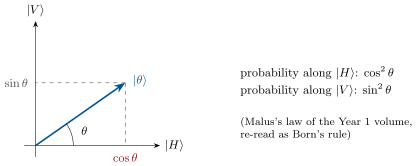
A photon heading down the axis carries a polarization state in a two-dimensional Hilbert space, with basis (horizontal) and (vertical). Light polarized at angle is the superposition
and circular polarization is the complex combination : the coefficients being complex is not decoration but physics. Every quantum two-level system — spin, the ammonia molecule, a superconducting qubit — is this same vector space in different clothing.