Physics · Glossary

What is Step-index fiber?

Definition 2.13 University Physics — Year 1 · Chapter 2 — Geometric Optics: Rays, Reflection, Refraction

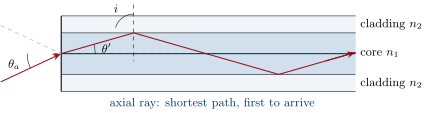
A step-index optical fiber is a cylindrical glass core of index n1n_1 sheathed in a cladding of slightly lower index n2n_2. Light entering the core within a cone of half-angle θa\theta_a around the axis is guided by successive total internal reflections at the core–cladding surface. The numerical aperture is NA=sinθa\mathrm{NA} = \sin\theta_a.

A step-index fiber. A ray entering within the acceptance cone of half-angle _a meets the cladding at incidence i ≥ i_c and is guided by total reflections; the axial ray takes the shortest route, the steepest guided ray the longest — a pulse spreads in time.
A step-index fiber. A ray entering within the acceptance cone of half-angle θa\theta_a meets the cladding at incidence iici \geq i_c and is guided by total reflections; the axial ray takes the shortest route, the steepest guided ray the longest — a pulse spreads in time.

Examples

Example 2.15 (A telecom fiber’s numbers)

n1=1.480n_1 = 1.480, n2=1.465n_2 = 1.465: NA=2.1902.146=0.21\mathrm{NA} = \sqrt{2.190 - 2.146} = 0.21, θa=12\theta_a = 12^\circ; ic=81.8i_c = 81.8^\circ, so guided rays stay within 8.28.2^\circ of the axis. Intermodal spread: Δt/L=(1.48/c)(1.48/1.4651)=51ns/km\Delta t/L = (1.48/c)(1.48/1.465 - 1) = 51\,\mathrm{ns}/\mathrm{km}. Over 2km2\,\mathrm{km} a pulse spreads by 0.1µs0.1\,\text{µ}\mathrm{s}, which caps the bit rate near 5Mbit/s5\,\mathrm{Mbit}/\mathrm{s}: the weekend problem follows this limitation to its remedy, the single-mode fiber.

Read in context →