University Physics — Year 1 · Bachelor Year 1
2Geometric Optics: Rays, Reflection, Refraction
A straw standing in a glass of water looks broken at the surface; a swimmer looking up from the bottom of a pool sees the whole sky squeezed into a bright disk, ringed by a mirror of the pool floor; a hair-thin glass fiber carries a telephone call across an ocean with less loss than a copper wire suffers across a street. Three laws — light travels straight, reflects at equal angles, bends by Snell’s rule — account for all of it, and this chapter states them precisely, marks where they stop being true, and puts them to work.
2.1 The geometric-optics model
Definition 2.1 (Light ray; homogeneous medium)
In the model of geometric optics, light propagates along light rays: oriented curves that are straight lines in a homogeneous medium (same properties at every point) and that carry energy independently of one another. A beam is a bundle of rays; a point source emits rays in every direction.
Definition 2.2 (Refractive index)
A transparent medium lets light through; light travels in it at a speed . Its refractive index is
Vacuum: ; air: ; water: ; ordinary glass: to ; diamond: . A wave of frequency keeps its frequency when it enters a medium, so its wavelength shrinks from in vacuum to .
Remark 2.3 (Dispersion)
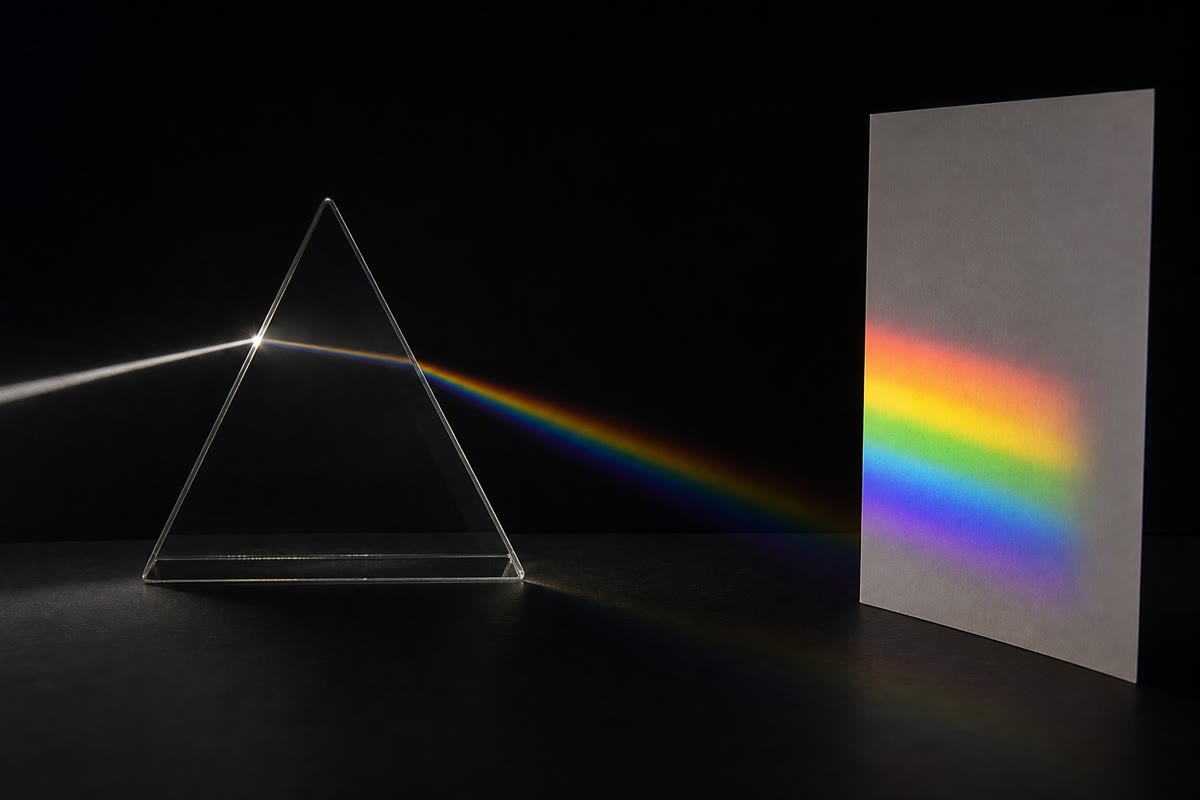
In matter the index depends slightly on the wavelength — the medium is dispersive. For glass in the visible, Cauchy’s empirical law fits well: is larger for blue than for red by about to . The prism and the rainbow, at the end of this chapter, live on that difference.
Remark 2.4 (Limits of the model)
Light is a wave, and a wave passing through an opening of width spreads by an angle of order (diffraction, Chapter 5). Rays are a good description as long as every aperture, lens and obstacle is much larger than the wavelength ( to for visible light): a hole spreads a beam by radians, negligible on a bench; a hole spreads it over the whole half-space, and no ray picture survives. The core of a single-mode telecom fiber is already beyond the model.
Proposition 2.5 (Return of light)
The path of a ray does not depend on the direction in which the light travels it: if light goes from to along a path, light from follows the same path to .
Proof. Admitted at this level. ∎
2.2 Reflection and refraction
Definition 2.6 (Incidence)
A ray meeting the surface separating two media (a diopter) at a point makes with the normal to the surface at the angle of incidence . The plane of incidence contains the incident ray and the normal.
Theorem 2.7 (Laws of reflection and refraction (Snell–Descartes))
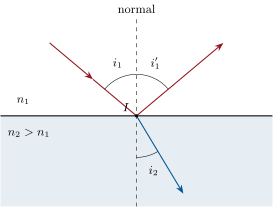
At the surface between media of indices (incident side) and :
- the reflected and refracted rays lie in the plane of incidence;
- the reflected ray makes with the normal the angle , on the other side of the normal;
the refracted ray makes with the normal an angle such that
Proof. Admitted at this level. ∎
Remark 2.8 (Where the laws come from)
Both laws follow from Fermat’s principle: between two points, light follows the path of least travel time. Reflection at equal angles is the shortest broken path touching the mirror; Snell’s law is the path that trades a longer route in the fast medium against a shorter one in the slow medium (Exercise 2.12). In the Year 2 volume both laws are derived from the wave nature of light at an interface.
Proposition 2.9 (Which way the ray bends)
Entering a more refractive medium (), a ray bends toward the normal (); entering a less refractive one, away from it (). A ray along the normal goes through undeviated.
Proof. with increasing on . ∎
Example 2.10 (Apparent depth)
A coin lies at depth under water (), seen from almost straight above. A ray from the coin reaching the surface at small angle (in water) leaves at with ; for small angles . The eye extends the emerging ray back: it seems to come from a depth with and for the same surface point at distance from the vertical, so . A pool deep looks deep; a fish sees the fisherman times higher than he is.
Theorem 2.11 (Total internal reflection)
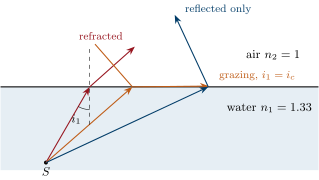
Light going from a medium of index toward a less refractive one () is refracted only if , where the critical angle satisfies
For there is no refracted ray: the surface reflects all the light — total internal reflection.
Proof. Snell’s law asks for ; this exceeds as soon as , and then no angle exists. At the refracted ray grazes the surface (). That all the energy is then reflected is a statement about intensities, which geometric optics does not handle; the wave treatment of the Year 2 volume confirms it. ∎
Example 2.12 (Diamonds and swimmers)
Glass–air: , , which is why a prism reflects totally and replaces a mirror in binoculars. Diamond–air: ; a cut diamond traps light that enters its top and sends almost all of it back out through the top — the brilliance is total reflection, the fire is dispersion. Water–air: ; looking up, a diver sees the entire sky inside a cone of half-angle (“Snell’s window”) and the reflected pool floor outside it.
2.3 The optical fiber
Definition 2.13 (Step-index fiber)
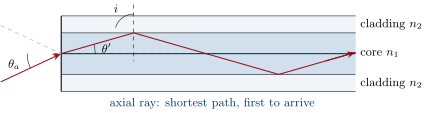
A step-index optical fiber is a cylindrical glass core of index sheathed in a cladding of slightly lower index . Light entering the core within a cone of half-angle around the axis is guided by successive total internal reflections at the core–cladding surface. The numerical aperture is .
Proposition 2.14 (Acceptance cone and intermodal spread)
For a fiber whose entry face is in air,
Over a length , the guided ray along the axis and the steepest guided ray arrive with a delay
between them (intermodal dispersion).
Proof. A ray entering at angle to the axis is refracted to with and meets the cladding at incidence . Guiding requires , i.e. , i.e. ; multiply by . The axial ray travels at speed : . The steepest ray zigzags at angle with ; its path is , so , and . ∎
Example 2.15 (A telecom fiber’s numbers)
, : , ; , so guided rays stay within of the axis. Intermodal spread: . Over a pulse spreads by , which caps the bit rate near : the weekend problem follows this limitation to its remedy, the single-mode fiber.
2.4 The plane mirror
Proposition 2.16 (Image in a plane mirror)
All rays from a point reflected by a plane mirror seem to come from the point symmetric to with respect to the mirror’s plane: is the image of . It is virtual (no light passes through it) and the mirror is rigorously stigmatic: every point has an exact point image.
Proof. A ray from hitting the mirror at with incidence leaves at on the other side of the normal. The reflected line and the normal at make the angle , as does the line ; by symmetry with respect to the mirror plane, the reflected line is the mirror image of line , hence passes through the symmetric point — for every . ∎
Proposition 2.17 (Rotating a mirror)
Turning a plane mirror by an angle about an axis in its plane, perpendicular to the plane of incidence, turns the reflected ray by .
Proof. The normal turns by , so the incidence changes from to ; the reflected ray, at on the other side of the new normal, has moved by (normal) (angle) from its old direction. ∎
Example 2.18 (The galvanometer’s lever)
A tiny mirror glued to the coil of a galvanometer, lit by a lamp and throwing a spot on a scale away: a rotation of of the coil moves the spot by — an optical lever that magnifies without friction, the principle of the mirror galvanometer and of the laser scanner.
2.5 The prism
Proposition 2.19 (Prism formulas)
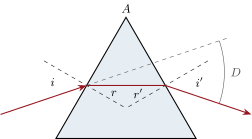
A ray crossing a prism of apex angle and index in air, in the plane perpendicular to the edge, with angles (entry), , (inside) and (exit) measured from the normals, obeys
and is deviated by . The deviation is minimal when the path is symmetric, , ; then
Proof. Snell’s law at each face; because the two normals make the angle (the quadrilateral formed by the apex, the two incidence points and the intersection of the normals). The total deviation is . By the return of light, the deviation is the same function of and of ; if the minimum occurred at it would also occur at the reversed incidence , giving two minima, which the monotonic behavior of on each side of its minimum forbids: the minimum is at . Then and ; substituting into gives the formula. ∎
Example 2.20 (Measuring an index)
A prism turned until the deviation of a yellow beam is smallest: . Then . Minimum deviation is the standard way to measure the index of a glass — the sharp minimum, found by turning the prism back and forth, is insensitive to small misadjustments.
Remark 2.21 (Thin prisms and spectroscopes)
For small and small incidence, the sines equal the angles and , independent of : a thin prism deviates every ray by the same angle — a wedge of glass is a “prism” that bends light, and a lens will turn out to be a stack of such wedges. Because depends on , the deviation does too: a prism spreads white light into a spectrum (blue deviated most), the heart of the prism spectroscope.
2.6 The rainbow
Example 2.22 (Descartes’s rainbow)
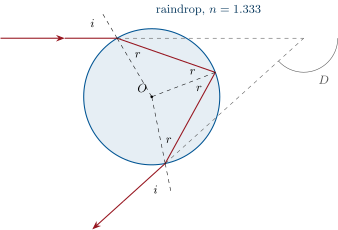
A ray of sunlight enters a spherical raindrop at incidence , is refracted (), reflects once on the back surface, and exits after a second refraction. Each refraction deviates it by , the internal reflection by : total deviation . Rays fill the drop at every ; the observer sees the brightest light where many rays leave in nearly the same direction, i.e. where is stationary: . Differentiating Snell’s law, , so the condition reads ; squaring and using gives
For water, : , , . The light comes back toward the Sun’s side at from the anti-solar direction: the rainbow is a cone of half-angle around the shadow of the observer’s head. Red () sits at , violet () at — red outside, violet inside.
2.7 Exercises
Exercise 2.1 ★
Compute the speed of light in water (), in glass () and in diamond (). How long does light take to cross of a fiber of index ?
Solution
Solution of Exercise 2.1.
: water , glass , diamond . Fiber: .
Exercise 2.2 ★
A ray in air meets water () at , then at from the normal: find the refracted angles. A ray in water meets the surface at : what happens?
Solution
Solution of Exercise 2.2.
: ; . From water at : , no refracted ray — total reflection ().
Exercise 2.3 ★
Compute the critical angle for glass–air (), diamond–air () and water–air (). What is the angular diameter of the disk of sky a diver sees?
Solution
Solution of Exercise 2.3.
: glass , diamond , water . The disk of sky spans .
Exercise 2.4 ★
A person tall, eyes below the top of the head, stands before a vertical wall mirror. Find the smallest mirror (height, and position of its edges above the floor) in which the whole body is visible. Does the answer depend on the distance to the mirror?
Solution
Solution of Exercise 2.4.
Eyes at . The ray from the feet reaches the eye after reflecting at half the eye height, ; the ray from the top of the head reflects midway between top and eyes, at . Mirror from to : height , half the body height — independent of the distance (the midpoint rule holds at any distance).
Exercise 2.5 ★★
A coin lies deep in a pool; at what depth does it appear to someone looking from above? A fisherman’s eyes are above the water: how high do they appear to a fish looking up? Justify both with small-angle rays.
Solution
Solution of Exercise 2.5.
Small angles: the apparent position is when looking from the rarer medium, from the denser one. Coin: . Fisherman: . Justification: for a surface point at horizontal distance , and with .
Exercise 2.6 ★★
A prism has and . Compute the minimum deviation. Show that a ray can emerge from the second face only if , and check this prism qualifies.
Solution
Solution of Exercise 2.6.
, so , . Emergence needs ; also gives ; so . Here , : fine.
Exercise 2.7 ★★
A step-index fiber has , . Compute its numerical aperture, its acceptance angle, the intermodal delay per kilometer, and the resulting maximum bit rate over (take ).
Solution
Solution of Exercise 2.7.
, . . Over : .
Exercise 2.8 ★★
A thin prism of apex has for red and for blue. Compute the deviation of each color and the angular width of the spectrum it produces.
Solution
Solution of Exercise 2.8.
: red , blue ; spectrum width .
Exercise 2.9 ★★
A ray meets a parallel-faced glass plate (, thickness ) at . Show that it emerges parallel to its incident direction, shifted sideways by , and compute .
Solution
Solution of Exercise 2.9.
Entry: , . The two faces are parallel, so the incidence on the second face is and : , the emerging ray is parallel to the incident one. Along the inside path of length , the perpendicular offset is : .
Exercise 2.10 ★★★
The secondary rainbow comes from rays reflected twice inside the drop. Show that , that the stationary deviation satisfies , and compute the angle of the secondary bow from the anti-solar direction for . Where is it relative to the primary, and in which order are its colors?
Solution
Solution of Exercise 2.10.
Two refractions () and two reflections (): . gives , , . : , , , , : the bow is at from the anti-solar point, outside the primary (). Red () at , violet () at : the colors are reversed, violet outside.
Exercise 2.11 ★★★
On a hot road the air just above the asphalt has index , the cooler air above it . Model the layers as a sharp interface: find the critical grazing angle (measured from the road) below which a ray from the sky is totally reflected upward. A driver’s eye is above the road: beyond what distance does the road look like water?
Solution
Solution of Exercise 2.11.
, : rays within of the road surface are totally reflected (generally, grazing angle ). From up, the line of sight grazes at this angle beyond : the road there reflects the sky — the “puddle”.
Exercise 2.12 ★★★
Points (height above an interface) and (depth below it) are separated horizontally by ; light travels at above and below. Write the travel time of the broken path through the interface point at horizontal position , and show that the time is stationary exactly when — Snell’s law.
Solution
Solution of Exercise 2.12.
; , zero exactly when , i.e. with .

2.8 Problem: The optical fiber link
Problem 2.1
Weekend problem — a glass thread under the sea: how far and how fast can a pulse of light carry a bit before geometry, glass and dispersion blur it away
A link uses a step-index fiber with core , cladding , core radius , at the wavelength . Data: .
Part I — Light in glass.
- Define the index and compute the speed of light in the core.
- How long does a pulse take to travel along the axis?
- Compute the frequency of the light and its wavelength inside the core.
- Why is the core clad in glass of lower index rather than left bare in air, which would give a larger index step?
Part II — Guiding.
- Compute the critical angle at the core–cladding surface.
- Deduce the largest angle a guided ray can make with the axis.
- A ray enters the flat end face from air at angle to the axis. Show that it is guided if , and compute the acceptance angle .
- Give the numerical aperture. Why does a larger index step make the fiber easier to feed with light?
- The fiber is bent along a circle of radius . Consider a ray travelling parallel to the axis along the inner edge of the core: show that it meets the outer wall at incidence with , and find the smallest for which it is still guided.
Part III — Intermodal dispersion.
- Express the travel times of the axial ray and of the steepest guided ray over a length .
- Deduce the spread per kilometer, and its value over .
- A bit is a short pulse; two successive pulses must stay separated by at least to be told apart. Estimate the maximum bit rate over .
- Show that the product (bit rate) (length) is a constant for this fiber, and compute it in .
- In a graded-index fiber the index decreases smoothly from the axis outward. Explain qualitatively why this reduces the intermodal spread.
- A single-mode fiber has a core diameter of about . Compare with and explain why the ray model cannot describe it; what is gained?
Part IV — Attenuation and chromatic dispersion. The fiber attenuates the power by at : . The transmitter launches ; the receiver needs at least . Because depends on , two wavelengths travel at slightly different speeds: a source of spectral width gives a pulse spread with .
- What fraction of the power survives ?
- Find the maximum length before an amplifier is needed.
- Amplifiers are placed every : what margin, in dB and as a power ratio, does this leave for connectors and splices?
- Compute over for an LED source () and for a laser (); deduce the maximum bit rate of each over that length (same criterion as above).
- At silica attenuates . What distance would the same power budget allow there? Why is the telecom wavelength?
- Copper coaxial cable attenuates about at the frequencies needed for . Compare the amplifier spacing with the fiber’s.
Part V — The whole link.
- For the step-index fiber over , which effect limits the bit rate: intermodal spread, chromatic spread (laser source) or attenuation? Give the limiting bit rate.
- For a single-mode fiber over with the laser source: which effect limits, and at what bit rate?
- The single-mode link carries lasers at wavelengths apart (wavelength multiplexing), each at the bit rate of the previous question. Total capacity?
- Form the bit-rate–length product of the step-index link and of one single-mode channel; by what factor does the single-mode fiber win, and which single physical fact is responsible?
Solution
Solution of Problem 2.1.
1. ; .
2. .
3. , unchanged in glass; .
4. A bare core guides only while its surface is perfectly clean and untouched: dust, water or a grip locally replaces air by a higher index and light escapes, and scratches scatter it. The cladding is a sealed, controlled interface with an index step chosen on purpose.
5. , .
6. .
7. ; guided iff , i.e. , i.e. : .
8. . A larger step widens the cone, so more of a diverging source’s light (an LED) is captured.
9. The ray is tangent to the circle of radius (inner edge) and meets the circle of radius (outer edge); in the right triangle center–tangent point–impact point, the angle at the impact point between the ray and the radius (the normal) satisfies . Guided iff : . Tighter bends leak.
10. ; steepest ray path , so .
11. ; over : .
12. .
13. .
14. Rays far from the axis travel longer paths but in lower index, hence faster; with a well-chosen profile the two effects cancel and all rays arrive together.
15. : the core is not large compared with the wavelength, so diffraction dominates and rays have no meaning. The wave treatment shows a single guided pattern: no intermodal spread at all; only chromatic dispersion and attenuation remain.
16. : , one percent.
17. , so .
18. costs : margin , a factor in power.
19. LED: , . Laser: , .
20. , ten times less. Silica is most transparent near (its attenuation minimum), and optical amplifiers exist there.
21. between amplifiers, against : the fiber wins by a factor .
22. Intermodal: ( ); chromatic (laser): ; attenuation , negligible. The intermodal spread limits: .
23. No intermodal spread; chromatic ; attenuation , within budget. Chromatic dispersion limits, at about .
24. .
25. Step index: ; single-mode channel: — a factor of about . One fact: a single guided path, hence no geometric (intermodal) spread of arrival times.