সব বই

পেশাদার

1 Markets I: The Ecosystem and Exchange-Traded Marketsবাজার অনলাইন 2 Markets II: Rates, FX and Creditবাজার অনলাইন 3 Markets III: Commodities, Energy and Cryptoবাজার অনলাইন 4 Quantitative Methodsপদ্ধতি অনলাইন 5 Derivatives and Volatilityডেরিভেটিভস অনলাইন 6 Rates, Credit, XVA and Riskসুদহার, ঋণ ও ঝুঁকি অনলাইন 7 Research Craft: Predictors, Backtests, Measurement, Portfoliosগবেষণা অনলাইন 8 Strategies I: Equities and Futuresকৌশল অনলাইন 9 Strategies II: Volatility, Relative Value, Macro and the Bank Desksকৌশল অনলাইন 10 Microstructure and Executionএক্সিকিউশন অনলাইন 11 Market Making and High-Frequency Tradingমার্কেট মেকিং অনলাইন 12 Machine Learning for Marketsমেশিন লার্নিং অনলাইন 13 Low-Latency Softwareপ্রযুক্তি অনলাইন 14 Networks, Hardware and Trading Infrastructureপ্রযুক্তি অনলাইন 15 Research, Data and Risk Platformsপ্রযুক্তি অনলাইন 16 The Desk and the Firmপ্রতিষ্ঠান অনলাইন 17 The Industry: Firms, Roles and Careersক্যারিয়ার অনলাইন 18 Interviews I: Maths, Probability and Speedক্যারিয়ার অনলাইন 19 Interviews II: Markets, Trading Games and the Final Roundক্যারিয়ার অনলাইন 20 Interviews III: Codeক্যারিয়ার অনলাইন
অ্যাপ পরিচিতি Coach সাইন ইন পড়া শুরু করো

বইগুলো এখনো বাংলা ভাষায় পাওয়া যায় না — ইংরেজি সংস্করণ দেখানো হচ্ছে।

Physics · পরিভাষা

Step-index fiber কী?

Definition 2.13 University Physics — Year 1 · অধ্যায় 2 — Geometric Optics: Rays, Reflection, Refraction

A step-index optical fiber is a cylindrical glass core of index n1n_1 sheathed in a cladding of slightly lower index n2n_2. Light entering the core within a cone of half-angle θa\theta_a around the axis is guided by successive total internal reflections at the core–cladding surface. The numerical aperture is NA=sin⁡θa\mathrm{NA} = \sin\theta_a.

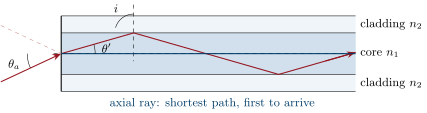
A step-index fiber. A ray entering within the acceptance cone of half-angle _a meets the cladding at incidence i ≥ i_c and is guided by total reflections; the axial ray takes the shortest route, the steepest guided ray the longest — a pulse spreads in time.
A step-index fiber. A ray entering within the acceptance cone of half-angle θa\theta_a meets the cladding at incidence i≥ici \geq i_c and is guided by total reflections; the axial ray takes the shortest route, the steepest guided ray the longest — a pulse spreads in time.

উদাহরণ

Example 2.15 (A telecom fiber’s numbers)

n1=1.480n_1 = 1.480, n2=1.465n_2 = 1.465: NA=2.190−2.146=0.21\mathrm{NA} = \sqrt{2.190 - 2.146} = 0.21, θa=12∘\theta_a = 12^\circ; ic=81.8∘i_c = 81.8^\circ, so guided rays stay within 8.2∘8.2^\circ of the axis. Intermodal spread: Δt/L=(1.48/c)(1.48/1.465−1)=51 ns/km\Delta t/L = (1.48/c)(1.48/1.465 - 1) = 51\,\mathrm{ns}/\mathrm{km}. Over 2 km2\,\mathrm{km} a pulse spreads by 0.1 µs0.1\,\text{µ}\mathrm{s}, which caps the bit rate near 5 Mbit/s5\,\mathrm{Mbit}/\mathrm{s}: the weekend problem follows this limitation to its remedy, the single-mode fiber.

প্রসঙ্গসহ পড়ো →