
Physics · Glossary

What is The kilowatt-hour?

Also known as: kilowatt-hour

Definition 68.6 Primary & Middle School Physics · Chapter 68 — Electric Power and Energy

Household energies make ungainly joule-counts, so the meter speaks kilowatt-hours (kWh\mathrm{kWh}): the energy of one kilowatt sustained for one hour,

1kWh=1000×3600=3.6×10⁶J1\,\mathrm{kWh} = 1000 \times 3600 = 3.6 \times 10^{6}\,\mathrm{J}

— three point six million joules per unit on the bill. With PP in kilowatts and tt in hours, E=P×tE = P \times t delivers kilowatt-hours directly: the formula the meter lives by.
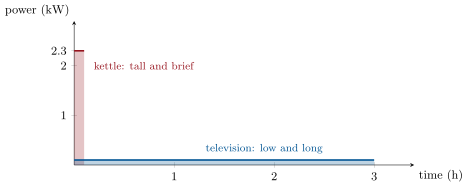
Energy as area: power times time. The kettle’s tall sliver and the television evening’s long strip can enclose comparable areas — comparable kilowatt-hours.

Examples

Example 68.8 (Reading the bill)

The meter by the front door counts every kilowatt-hour that enters the house; the bill is its month’s difference times the tariff. A typical family’s 250250 monthly units decompose by audit: water heating and radiators first (the kilowatt club), then the cold appliances — modest watts, but running always — then cooking, washing, light and electronics. The audit’s power: it finds the real levers. Replacing ten old 60W60\,\mathrm{W} bulbs with 5W5\,\mathrm{W} ones saves more than unplugging every charger in the house a thousand times over.
Read in context →
Definition 9.17 High School Physics · Chapter 9 — Energy: Forms and Conservation

The kilowatt-hour (kWh\mathrm{kW}\,\mathrm{h}) is the energy of a 1kW1\,\mathrm{kW} flow running for one hour: 1kWh=1000×3600J=3.6MJ1\,\mathrm{kW}\,\mathrm{h} = 1000 \times 3600\,\mathrm{J} = 3.6\,\mathrm{MJ} — the unit electricity meters count: power in kW\mathrm{kW} times hours.

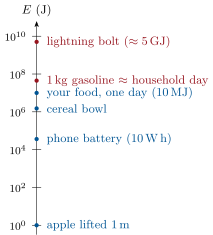
An energy ladder: each rung is a factor of 100. Everyday life spans ten orders of magnitude.
An energy ladder: each rung is a factor of 100100. Everyday life spans ten orders of magnitude.

Examples

Example 9.18 (Reading the bill)

A bill is a subtraction and a multiplication: new meter reading minus old gives the kilowatt-hours; times the unit price (about 0.250.25 euros per kWh\mathrm{kW}\,\mathrm{h}), plus a fixed subscription, gives the total. A 2kW2\,\mathrm{kW} heater running 2.5h2.5\,\mathrm{h} nightly uses 5kWh5\,\mathrm{kW}\,\mathrm{h} a day: 3838 euros a month on its own.

Example 9.19 (Orders of magnitude)

Worth knowing by heart: lifting an apple one metre, about 1J1\,\mathrm{J}; a phone battery, 10Wh4×104J10\,\mathrm{W}\,\mathrm{h} \approx 4 \times 10^{4}\,\mathrm{J}; a cereal bowl, 1.5MJ1.5\,\mathrm{MJ}; your food for a day, 10MJ10\,\mathrm{MJ}; a kilogram of gasoline, 45MJ45\,\mathrm{MJ} — almost exactly a household’s daily electricity (12kWh\approx 12\,\mathrm{kW}\,\mathrm{h}); a lightning bolt, 5GJ5\,\mathrm{GJ}: a hundred household-days, delivered in a flash.

Read in context →