High School Physics · Grades 10–12
9Energy: Forms and Conservation
A moving car, a charged phone, a hot oven and a raised hammer share one property: each can make something happen. Physics measures that capacity with a single number — energy — and keeps its accounts under one iron rule: the total never changes, it only moves and changes costume. This chapter opens the ledger: the forms energy takes, the chains it travels, and what a kilowatt-hour buys.
9.1 Energy: the common currency
Definition 9.1 (Energy and the joule)
Energy measures a system’s capacity to produce changes: set matter in motion, lift it, heat it, light it. Its unit is the joule (). Stored, transferred, converted — every branch of physics counts in this one currency.
Definition 9.2 (Kinetic energy)
A body of mass (in ) moving at speed (in ) carries the kinetic energy : doubling the mass doubles it, doubling the speed quadruples it.
Example 9.3 (Car versus pedestrian)
A car at carries ; a pedestrian at , — six thousand times less. Speed is expensive: the square sees to it.
Definition 9.4 (Gravitational potential energy)
A body of mass at height (in ) above a chosen reference level stores the gravitational potential energy , with — valid near the ground, where is effectively constant. Only differences of height matter: the level where is chosen freely.
Example 9.5 (Water tower)
Each cubic metre () of water stored up a water tower holds — about six tenths of the car’s kinetic energy above. Cities stockpile energy overhead.
Definition 9.6 (The other forms)
Energy also hides in less visible costumes: thermal energy, the disordered agitation of a body’s molecules (the hotter, the more); chemical energy, stored in molecular bonds — food, wood, gasoline, batteries; electrical energy, carried by currents from plant to socket; radiative energy, carried by light even across empty space — how the Sun’s energy reaches us; nuclear energy, stored inside atomic nuclei, released in stars (Chapter 33).
9.2 Transfers and conversion chains
Definition 9.7 (Transfer, conversion, chain)
An energy transfer moves energy between systems — reservoirs; an energy conversion changes its form. A device doing either (turbine, motor, lamp, muscle) is a converter. A conversion chain pictures the journey: boxes for reservoirs and forms, labeled arrows for transfers.
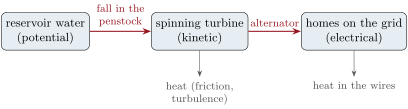
Method 9.8 (Drawing a conversion chain)
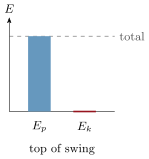
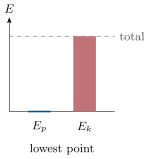
A pendulum runs the simplest chain of all — all potential at the top of the swing, all kinetic through the lowest point (taking there):
9.3 Conservation of energy
Theorem 9.9 (Conservation of energy)
The total energy of an isolated system — one exchanging nothing with the outside — is constant. Energy is never created and never destroyed: it only changes form and place, and what one reservoir loses, the others gain, joule for joule.
Proof. Admitted at this level. ∎
Remark 9.10
No experiment has ever caught this principle failing; here we take it as given and use it numerically. Chapter 29 derives its mechanical part () from Newton’s laws; the full accounting waits for the university volumes.
Example 9.11 (Free fall, priced in joules)
A ball drops from (air resistance negligible): it starts with , lands with , so . No forces, no stopwatch: conservation alone prices the impact.
9.4 Efficiency
Definition 9.12 (Efficiency)
A converter consumes and delivers the wanted form ; its efficiency is
Conservation forbids , and real converters never reach : the missing energy is not destroyed — it leaves as heat.
Example 9.13 (Where the gasoline goes)
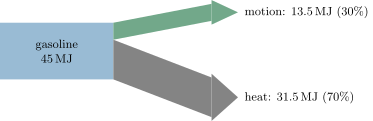
A kilogram of gasoline stores of chemical energy; a car engine converts it with : of motion, heating the exhaust, the radiator and the street. Two thirds of every tank warms the atmosphere.
Remark 9.14 (Efficiencies multiply)
Chained converters multiply their efficiencies: a power plant () feeding the grid () feeding a charger () delivers . Long chains are leaky pipes: each arrow taxes the flow.
9.5 Power, the watt and the kilowatt-hour
Definition 9.15 (Power)
Power is the rate at which energy flows, , measured in watts (), with . Energy is an amount, power a flow — a bathtub versus its tap.
Example 9.16 (Kettle versus human)
A kettle running uses . A human runs on about of food per day, an average : you idle like a bright old light bulb.
Definition 9.17 (The kilowatt-hour)
The kilowatt-hour () is the energy of a flow running for one hour: — the unit electricity meters count: power in times hours.
Example 9.18 (Reading the bill)
A bill is a subtraction and a multiplication: new meter reading minus old gives the kilowatt-hours; times the unit price (about euros per ), plus a fixed subscription, gives the total. A heater running nightly uses a day: euros a month on its own.
Example 9.19 (Orders of magnitude)
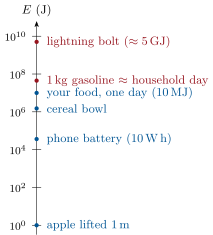
Worth knowing by heart: lifting an apple one metre, about ; a phone battery, ; a cereal bowl, ; your food for a day, ; a kilogram of gasoline, — almost exactly a household’s daily electricity (); a lightning bolt, : a hundred household-days, delivered in a flash.
9.6 Exercises
Exercise 9.1 ★
A car drives at , i.e. : compute its kinetic energy. Redo it at (): what did more speed do to ?
Solution
Solution of Exercise 9.1.
. At : — more speed, times the kinetic energy: the square at work.
Exercise 9.2 ★
A hiker of mass climbs from altitude to . Compute the potential energy gained, convert it to kilowatt-hours, and price it at euros per .
Solution
Solution of Exercise 9.2.
: , worth about euros. A day’s climbing is two cents of electricity.
Exercise 9.3 ★
Convert: to joules; a phone battery to kilojoules; (one kilogram of gasoline) to kilowatt-hours; your food day to kilowatt-hours.
Solution
Solution of Exercise 9.3.
; ; ; .
Exercise 9.4 ★
A kettle runs for . Compute the energy used, in joules and in kilowatt-hours. Then compute the average power of a human running on per day.
Solution
Solution of Exercise 9.4.
. Human: .
Exercise 9.5 ★
Write the conversion chain (Method 9.8) of: a bicycle dynamo powering a lamp; a gas water heater; a solar panel charging a phone. Mark the heat leaks.
Solution
Solution of Exercise 9.5.
Dynamo: chemical (cyclist’s food) kinetic (wheel) electrical (dynamo) radiative thermal (lamp); heat leaks at muscles, tire contact, dynamo, lamp. Gas heater: chemical (gas) thermal (water), leak in the flue gases. Panel: radiative (Sun) electrical (panel) chemical (battery), heat leaks at panel and charger.
Exercise 9.6 ★★
An engine burns of gasoline () and delivers of motion. Compute its efficiency and the energy released as heat. Where does that heat go?
Solution
Solution of Exercise 9.6.
Consumed ; . Heat: , carried off by the exhaust gases and the radiator into the surrounding air.
Exercise 9.7 ★★
A cliff diver steps off a cliff (air resistance negligible). Using conservation, compute the kinetic energy at the water and the entry speed, in and .
Solution
Solution of Exercise 9.7.
; .
Exercise 9.8 ★★
A meter read on 1 March, 30 days later: energy used, daily average, bill at euros per plus euros fixed, and average power in watts?
Exercise 9.9 ★★
An old bulb turns only of its consumption into light; an LED gives the same light from . Compute the bulb’s light power and the LED’s efficiency; then, at per day, each one’s yearly consumption and the saving at euros per .
Solution
Solution of Exercise 9.9.
1. Light: ; LED: . 2. Yearly (): bulb , LED ; saving euros per bulb per year.
Exercise 9.10 ★★
A dam passes of water () per second down a drop. Compute the potential energy released each second — the available power — then the electrical power at , and how many -average households it supplies.
Solution
Solution of Exercise 9.10.
1. . 2. ; households.
Exercise 9.11 ★★
A pendulum is released above its lowest point: compute its speed there. After a few minutes it hangs still: where did its energy go, and why does this not contradict Theorem 9.9?
Solution
Solution of Exercise 9.11.
(the mass cancels: ). The initial ends as thermal energy in the air and the pivot: the pendulum is not isolated, and the total — swing plus heat — is exactly conserved.
Exercise 9.12 ★★★
A coal plant (), the grid () and a charger () recharge a phone battery. Compute the overall efficiency; the chemical energy consumed at the plant, in and kilojoules; and the coal () per charge, then per year of daily charges.
Solution
Solution of Exercise 9.12.
1. ; consumed . 2. of coal per charge; per year.
Exercise 9.13 ★★★
A lightning bolt carries about . Convert to kilowatt-hours and to days of a -per-day household. It is delivered in about : compute the power, compare it with humanity’s average electric power (), and explain why nobody harvests lightning.
Exercise 9.14 ★★★
A car brakes from () to rest. Compute the kinetic energy dissipated; what form does it take, and where? An electric car recovers into its battery: energy per stop, and stops needed to refill one kilowatt-hour?
Solution
Solution of Exercise 9.14.
1. , converted to thermal energy in the brake discs and pads (then the air). 2. per stop; stops per kilowatt-hour.
Exercise 9.15 ★★★
A cyclist and bicycle ( in all) climb a mountain pass, gaining of altitude; muscles convert food with . Compute the mechanical energy of the climb, the food energy it demands, the equivalent in cereal bowls, and the gasoline mass () storing the same energy. Comment.
Solution
Solution of Exercise 9.15.
; food: , i.e. cereal bowls — or of gasoline. A whole morning of honest effort fits in a coffee cup of fuel: chemical energy is absurdly concentrated.
9.7 Problem: Powering a house for a day
Problem 9.1
Weekend problem — from cereal bowl to rooftop panels: a full energy audit of one ordinary day at home, and what a joule costs depending on who sells it
One ordinary Tuesday, a family sets out to find where its electricity goes, armed with this chapter, the hallway meter and the back of the bill. Tonight’s verdict: their day equals one kilogram of gasoline, sixteen square metres of sunshine — or five cyclists pedaling around the clock.
Part I — The audit. The day’s inventory: fridge for ; water heater for ; oven for ; washing machine for ; lighting for ; screens for .
- Compute each appliance’s energy for the day, in .
- Total the day in kilowatt-hours, then in megajoules; compare with one kilogram of gasoline ().
- Compute the house’s average power over the ; what fraction of a running kettle is that?
- Which single appliance dominates? Recompute the daily total if the heater ran only .
- Standby lights draw a permanent : daily energy, share of the total, yearly cost at euros per ?
Part II — The bill.
- In 30 days the meter went from to : consumption, and daily average checked against the audit?
- Compute the bill: euros per plus a fixed euros subscription.
- Price of a megajoule from the grid? From gasoline, at euros per litre storing ?
- A cereal bowl costs about euros: its megajoule price? Rank the three sellers of joules.
Part III — The rooftop.
- Full sunlight delivers about per square metre; panels convert it with : electrical power of in full sun?
- The region averages the equivalent of of full sun per day: daily yield of ?
- What panel area covers the family’s day? The south roof offers : does it fit?
- In December the equivalent drops to : the panels’ production, its share of the need, and what fills the gap?
- Manufacturing the panels cost about per square metre: energy payback time, using question 11?
Part IV — The cereal bowl.
- A generator bicycle yields of electricity: how many pedaling hours make — how many people pedaling non-stop?
- Muscles run at : the food energy behind those , in megajoules and in cereal bowls?
- Cost of the pedaled day (bowls at euros), against what the grid charges for the same day?
- A lightning bolt equals how many house-days? Given its duration, why can it still not power the house?
- Joules are never lost, yet grid, gasoline and food joules sell at very different prices: what do you actually pay for?
- Finale: state the day’s verdict in one sentence — one kilogram of gasoline, sixteen square metres of sunny roof or five round-the-clock cyclists — and name the two quantities (one stock, one flow) never to confuse again.
Solution
Solution of Problem 9.1.
1. Fridge ; heater ; oven ; washing machine ; lighting ; screens . 2. Total : one kilogram of gasoline, to the joule. 3. — the house idles at a quarter of a kettle. 4. The water heater (, nearly half). At : heater , total . 5. per day, about of the metered total; yearly euros — for lights nobody watches. 6. ; per day: the audit’s plus the of standby — confirmed. 7. euros. 8. Grid: euros per megajoule. Gasoline: euros per megajoule. 9. Bowl: euros per megajoule — five times the grid. Cheapest first: gasoline, grid, then food, far behind. 10. per square metre. 11. per square metre per day. 12. : it fits the roof. 13. : about of the need; the grid (or a battery charged in better months) must supply the rest. 14. One square metre yields per year; payback years — short against a 25-year panel lifetime. 15. : more than five people () pedaling day and night. 16. Food , i.e. cereal bowls. 17. euros, against euros from the grid: pedal power costs about times more — before paying the cyclists. 18. house-days. But for , at a random place: no converter or battery can drink from that hose. A house needs a steady flow, not a spike. 19. Not joules — they are conserved and identical. You pay for their form and availability: energy that is concentrated, storable and on demand costs the whole conversion chain that made it so. 20. One family day : one kilogram of gasoline, sixteen square metres of sunny roof, or five round-the-clock cyclists. The stock is energy (joules, kilowatt-hours); the flow is power (watts) — the bathtub and the tap, never again confused.