Primary & Middle School Physics · Grades 1–9
68Electric Power and Energy
The electricity bill does not charge for volts, nor for amperes — it charges for something your family’s appliances have been quietly multiplying together all month. This chapter weds the two electrical quantities into a third, gives fast and slow spending their proper names, and ends at the meter by the front door: physics you can audit against real money.
68.1 Power: the rate of delivery
Definition 68.1 (Power and the watt)
The power of a device is the rate at which it converts energy — joules per second. Its unit is the watt (): one joule each second, honoring the engineer of the steam age; the kilowatt ( ) serves the kitchen’s heavyweights. Power is not an amount of energy but a pace of spending — a tap’s flow, not a bucket’s content.
Proposition 68.2 (Electric power)
A device fed voltage and drawing current receives electric power
watts from volts times amperes. The formula computes in all three directions, and its second recipe runs the fuse box: tells what current an appliance’s rated power will pull from the mains.
Example 68.3 (The household ladder)
Read the plates on the family’s machines: an indicator light, ; a modern lamp, (its glowing ancestor spent sixty for the same light — the difference was heat); a laptop, ; a television, ; a washing machine heating its water, ; the kettle, ; an instant water heater, up to . The pattern of the ladder: anything whose job is heating climbs to the kilowatts — warmth is the costliest form of energy to supply.
Example 68.4 (The fuse box arithmetic)
The kettle on the mains: — the ten-ampere appliance of the old chapters, now derived. The water heater: nearly , demanding its own stout branch and breaker. And the overloaded multi-socket of the fire investigation: kettle, heater and fryer summing their currents past the branch’s rating — three innocents, one arithmetic crime, exactly as charged.
68.2 Energy: the amount delivered
Proposition 68.5 (Energy from power and time)
A device of power running for a time converts the energy
joules from watts times seconds. Fast tap or long trickle, the bucket fills by the product: a kettle’s three minutes () spends more than a lamp’s whole day () — almost exactly a tie, in fact: one boiling matches one day of good light.
Definition 68.6 (The kilowatt-hour)
Household energies make ungainly joule-counts, so the meter speaks kilowatt-hours (): the energy of one kilowatt sustained for one hour,
— three point six million joules per unit on the bill. With in kilowatts and in hours, delivers kilowatt-hours directly: the formula the meter lives by.
Method 68.7 (Auditing an appliance)
For any machine and month:
- read its power on the plate (or compute );
- honestly estimate its running time — per day, then per month;
- in kilowatt-hours ( in , in hours);
- multiply by the tariff (take about currency units per ) for the month’s cost.
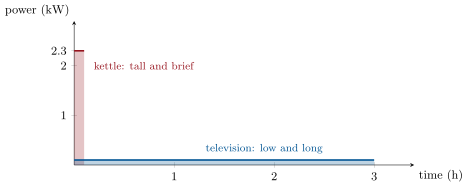
The kettle, six minutes daily: a month. The television, three hours daily: . Small powers with long hours rival big powers with short ones — the audit’s recurring lesson.
68.3 The meter and the bill
Example 68.8 (Reading the bill)
The meter by the front door counts every kilowatt-hour that enters the house; the bill is its month’s difference times the tariff. A typical family’s monthly units decompose by audit: water heating and radiators first (the kilowatt club), then the cold appliances — modest watts, but running always — then cooking, washing, light and electronics. The audit’s power: it finds the real levers. Replacing ten old bulbs with ones saves more than unplugging every charger in the house a thousand times over.
Example 68.9 (The standby vampires)
Small print, long hours: a television’s standby light sips — but for all hours of the month: . One vampire is harmless; a house with twenty sippers at a watt each pays monthly for nothing. Power times time forgives no term: the second factor bites when the first one hides.
Remark 68.10 (Power in the wider world)
The watt, born electric here, measures every energy pace. Your resting body idles near — a glowing ancestor-bulb of warmth (recall the crowded classroom’s stuffiness: thirty pupils, three kilowatts of biology). A cyclist sustains ; a car’s engine unleashes tens of kilowatts; the town’s power station, hundreds of millions of watts; the sunlight falling on the town, comfortably more — the ceiling under which all the other paces work. Next chapter follows the grid’s watts to their spinning source.
68.4 Exercises
Exercise 68.1 ★
Define power and its unit — tap or bucket? Write both formulas of the chapter.
Exercise 68.2 ★
Compute powers: a lamp at drawing ; a starter motor at drawing .
Solution
Solution of Exercise 68.2.
Lamp: . Starter: .
Exercise 68.3 ★
The fuse-box recipe: what currents do a kettle and a microwave pull at ?
Solution
Solution of Exercise 68.3.
Kettle: ; microwave: .
Exercise 68.4 ★
Why do heating appliances crowd the top of the household power ladder?
Solution
Solution of Exercise 68.4.
Because warmth is the costliest form of energy to supply: raising water’s or a room’s temperature devours joules at a pace lamps and electronics never approach — so every heater’s plate reads in kilowatts.
Exercise 68.5 ★
Convert: to joules (show the two factors). Why did the meter’s makers abandon the joule?
Exercise 68.6 ★
Energy check: which spends more, a heater for half an hour or a television for a whole evening of five hours?
Solution
Solution of Exercise 68.6.
Heater: . Television: . The half-hour heater outspends the whole television evening, twofold.
Exercise 68.7 ★
Audit one machine: a laptop used four hours daily, for a thirty-day month, at per . Energy and cost?
Solution
Solution of Exercise 68.7.
; cost currency units — a month of homework for the price of a pastry.
Exercise 68.8 ★
What does the front-door meter count, and how does the bill turn its count into money?
Solution
Solution of Exercise 68.8.
Every kilowatt-hour entering the house. The bill subtracts last month’s reading from this month’s and multiplies the difference by the tariff.
Exercise 68.9 ★★
The bulb swap: ten ancestors versus ten moderns, four hours nightly, thirty nights. Compute both monthly energies and the saving — in kilowatt-hours and at each.
Solution
Solution of Exercise 68.9.
Ancestors: . Moderns: . Saving: — currency units monthly, from one afternoon on a stepladder.
Exercise 68.10 ★★
A hair dryer’s plate reads “230 V, 2000 W”. Its current? May it share a branch with the kettle, both running? Show the sum.
Solution
Solution of Exercise 68.10.
Dryer: . With the kettle’s : — past the branch’s rating: the breaker will (rightly) end the experiment.
Exercise 68.11 ★★
An electric car’s battery stores . How long could that run the kettle? The lamp? And what does the pair of answers teach about the size of transport’s energy appetite?
Exercise 68.12 ★★★
The kettle test, end to end: of water from to the boil needs about of heat. Time the family kettle (): predict its boiling time from , then explain why the real kettle takes a little longer — where do the missing joules go, by the oldest law of the energy chapters?
Solution
Solution of Exercise 68.12.
Prediction: — about three and a half minutes. The real kettle runs longer: part of its joules leak past the water — warming the kettle’s own body, the air, escaping as early steam. Energy is never destroyed, but neither is it all delivered where intended: the chain’s leak, timed at last in your own kitchen.
68.5 Problem: The Home Energy Audit
Problem 68.1
Weekend problem — the family energy audit; plates, meters and the month’s bill; finding the real levers
Armed with the two formulas and the tariff ( per ), the family audits a month (30 days). The inventory: kettle , minutes daily; television , hours daily; refrigerator — special case below; ten lamps each, hours daily; washing machine , one -hour hot cycle every other day; water heater , hours daily; standby sippers totaling , always on.
Part I — Machine by machine.
- The kettle’s month, in .
- The television’s and the ten lamps’ months.
- The washing machine’s ( cycles) and the water heater’s months.
- The standby sippers’ month — the second factor at work.
Part II — The refrigerator and the sum. The refrigerator’s compressor runs at , but only a third of the time, cycling day and night.
- Its effective average power, and its month in .
- Total the audit’s seven lines. Which three lines dominate?
- The month’s bill at the tariff — and the water heater’s share of it in currency.
- The meter read units at the month’s start. Predict its end-of-month reading.
Part III — The levers.
- Proposal one: shorter showers — the heater drops to daily. Monthly saving, energy and money?
- Proposal two: a public campaign urges unplugging phone chargers ( each when idle). Audit one charger’s idle month and compare with proposal one; what does the contrast teach about audits versus slogans?
- Proposal three: grandmother suggests the old habit of filling the kettle only as needed — half the water, half the energy. New kettle line, and the month’s saving?
- Write the audit’s conclusions: three sentences — where the kilowatt-hours truly live, which formula factor the standby case teaches, and which single household change pays best.
Solution
Solution of Problem 68.1.
1. . 2. Television: ; lamps: . 3. Washer: ; heater: . 4. — ten hidden watts, a kettle’s whole month. 5. Average ; month: . 6. Total . Dominant: the water heater (), the washer (), the refrigerator () — heating and always-on. 7. units; the heater’s share: — well over half the bill. 8. units. 9. New heater line: : saving , about units of currency monthly. 10. One idle charger: — about four hundredths of a currency unit: proposal one outsaves it two-hundredfold per charger. Audits find levers; slogans find chargers. 11. Kettle line halves to : saving , under one currency unit — grandmother’s habit is right, and modest. 12. For example: “The kilowatt-hours live where water gets hot and where machines never sleep. The standby line teaches the time factor: tiny powers grow bills when is always. And the best-paying change is the shorter shower — the heater owns the bill, so its hours own the savings.”