Primary & Middle School Physics · Grades 1–9
8Measuring Time
“Just five more minutes!” — but how long is that, really? Time cannot be seen, held, or laid along a ruler. And yet we measure it every day: races have winners, cakes come out neither raw nor burnt, and school ends at the right moment. Let us learn how time is tamed.
8.1 Moments and durations
Example 8.1 (The order of the day)
A day is a parade of events, always in order: wake up, breakfast, school, lunch, afternoon, dinner, bed. “Breakfast comes before school” and “dinner comes after lunch” — before and after are the first words of time, just as longer and shorter were the first words of length.

Definition 8.2 (Duration)
A moment is one point of the day: the moment the bell rings. A duration is the stretch of time between two moments: from the bell to the end of the lesson. Moments answer when?; durations answer how long?
Example 8.3 (When or how long?)
“The film starts after dinner” talks about a moment. “The film lasts as long as two lunch breaks” talks about a duration. “My birthday is in spring”: moment. “The holidays felt so short”: duration — and this chapter is mostly about durations.
8.2 Comparing durations
Method 8.4 (A fair race of durations)
To find which of two things lasts longer:
- start both at the same moment — “ready, set, go!”;
- watch which one finishes first;
- the one still going when the other has finished lasts longer.
If they cannot run together (today’s bath and yesterday’s dinner), race each of them against the same third thing — a sand timer.
Example 8.5 (The sand timer)
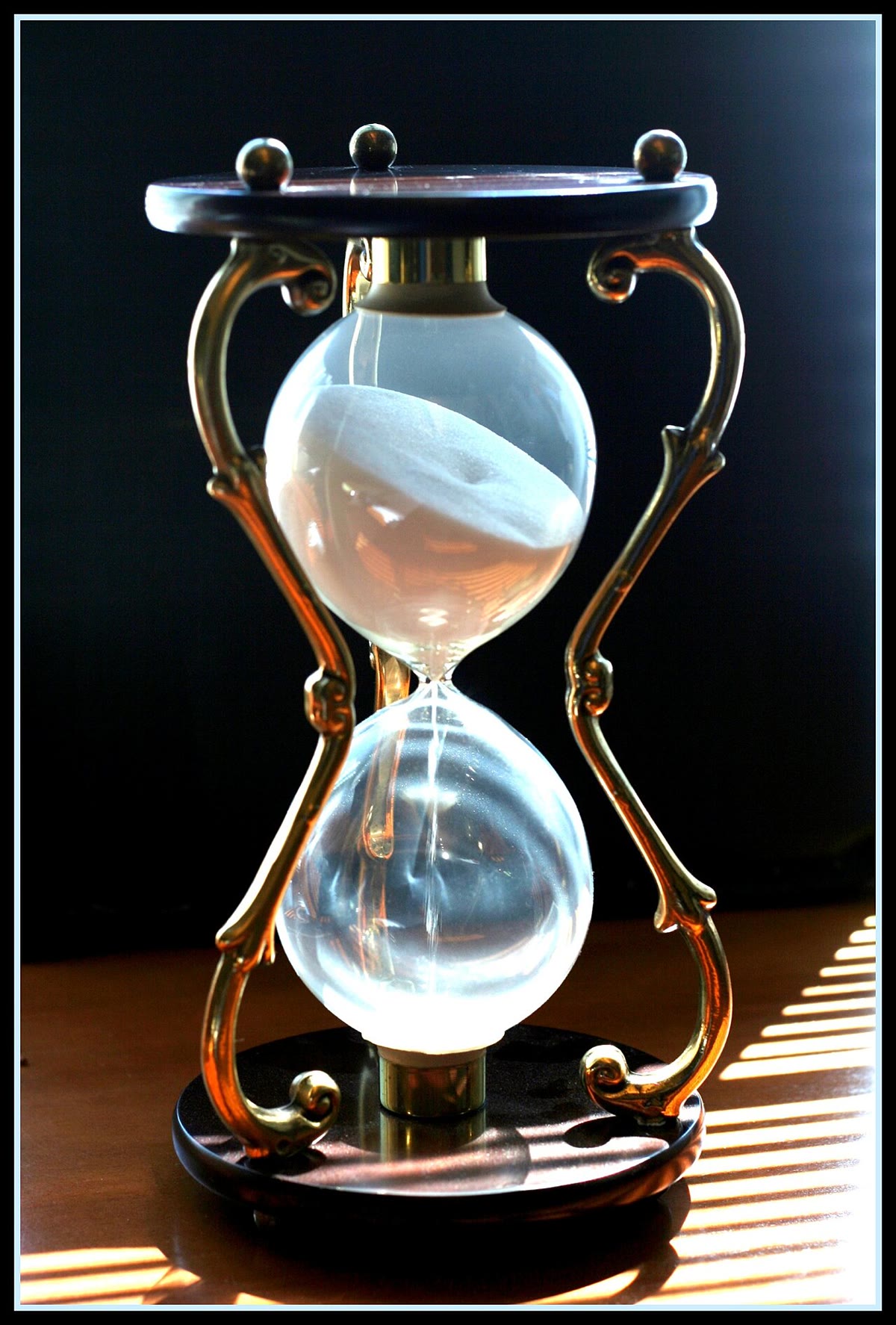
A sand timer is a little glass with a narrow waist: the sand always takes the same duration to pour through. That makes it a referee. Brushing your teeth against the timer: the sand ran out first — brush longer! A song against the timer: the song won. So the song lasts longer than the tooth-brushing, though they never raced each other directly.
Remark 8.6 (Feelings are bad clocks)
A fun afternoon flies; a boring queue crawls — yet the clock may count the same for both. Our sense of time is easily fooled, just as touch was fooled about hot and cold. That is exactly why referees like the sand timer matter: sand does not get bored.
8.3 Counting steady beats
Definition 8.7 (The second)
The second is the unit of time used all over the world, written . One second is about one calm heartbeat, or the steady tick of a big clock. Saying “one little crocodile, two little crocodiles” at a calm pace counts roughly one second per crocodile.
Example 8.8 (Try it: how many seconds?)
Count seconds steadily while: you hold your breath comfortably; the tap fills a glass; a friend runs to the fence and back. The glass might take seconds, the run . Now the tooth-brushing and the song from before can get numbers — and numbers, as with lengths, can travel and be checked.
Example 8.9 (Hours on the clock)
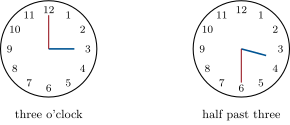
Seconds are for short things. Long stretches are counted in hours: school mornings last hours, a night of sleep too. The clock’s short hand points to the hour: straight at the , it is three o’clock; between and with the long hand pointing straight down, it is half past three. A whole day and night together hold hours — while the Earth, remember, makes one full turn.
8.4 Exercises
Exercise 8.1 ★
Put in order: dinner; wake up; afternoon playtime; breakfast; bed.
Solution
Solution of Exercise 8.1.
Wake up, breakfast, afternoon playtime, dinner, bed.
Exercise 8.2 ★
Moment or duration? “The bell rings at noon”; “the cake bakes for half an hour”; “we left after lunch”; “the trip felt endless”.
Exercise 8.3 ★
Two candles are lit at the same moment; the red one goes out while the blue one still burns. Which candle lasted longer? Which rule of Method 8.4 did the candles follow?
Solution
Solution of Exercise 8.3.
The blue candle lasted longer. The candles started at the same moment, and the one still burning when the other finished is the longer-lasting one — exactly the fair-race rule.
Exercise 8.4 ★
Why is a sand timer a fair referee for durations? What is always the same about it, every time it is turned?
Solution
Solution of Exercise 8.4.
Every time it is turned, the sand takes the same duration to pour through the narrow waist. A referee that never changes is fair to everyone.
Exercise 8.5 ★
Ben says his boring wait at the dentist lasted “forever”. His watch says it lasted less than his favorite cartoon. How is this possible? (See Remark 8.6.)
Solution
Solution of Exercise 8.5.
Our feeling of time is a bad clock: boring waits crawl and fun flies. The watch counts steadily whatever Ben feels, so the wait really was shorter than the cartoon — it only felt longer.
Exercise 8.6 ★
Count seconds steadily and measure: how many seconds does it take you to write your full name? To put on your shoes?
Solution
Solution of Exercise 8.6.
Answers vary; typically a few seconds for the name and around seconds for the shoes. The counting must stay calm and steady.
Exercise 8.7 ★
Which unit fits better, seconds or hours: a sneeze; a night of sleep; tying a shoelace; a school morning?
Exercise 8.8 ★
Draw a clock showing five o’clock, and another showing half past five. Where does the short hand point at half past five?
Solution
Solution of Exercise 8.8.
At five o’clock the short hand points at the (long hand straight up); at half past five the short hand points halfway between the and the (long hand straight down).
Exercise 8.9 ★★
Yesterday’s bath and today’s shower cannot race each other. Explain, step by step, how to find out which lasts longer using one sand timer — and what to write down so your friend can check.
Solution
Solution of Exercise 8.9.
Race each against the same sand timer: at bath time, start the timer and count how many full turns of the timer the bath lasts; tomorrow, do the same for the shower. Write down both counts (say, “bath: turns, shower: turns”): more turns means longer, and anyone with the same timer can check.
Exercise 8.10 ★★
Lila counts “one, two, three…” very fast and says the glass filled in seconds; Tom counts calmly and finds . The tap ran the same both times. Who is closer to the truth, and what makes counting seconds honest?
Solution
Solution of Exercise 8.10.
Tom is closer. Counting seconds is honest only at a calm, steady pace — about one calm heartbeat per number, or “one little crocodile” per count. Racing through the numbers makes the seconds too short.