
Physics · Glossary

What is Trajectory?

Also known as: straight trajectory · circular trajectory

Definition 40.1 Primary & Middle School Physics · Chapter 40 — Describing Motion: Trajectory and Speed

The trajectory of a moving object is the line traced by its journey — the path it draws through space. Three shapes cover most of everyday life: straight (the elevator, the falling apple), circular (the carousel horse, the tip of a clock hand), and curved in freer ways (the thrown ball’s arch, the swallow’s swoop).
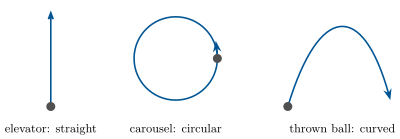

Three everyday trajectories: the straight climb, the endless circle, the thrown arch.
A camera left open at night draws trajectories: every headlamp traces the exact path its car followed.

Examples

Example 40.2 (Whose trajectory?)

Be careful to name which point you follow. The carousel horse’s nose draws a circle; the whole carousel’s center draws nothing at all — it stays put. A rolling wheel’s hub glides in a straight line while a point on its rim traces graceful hops. One machine, many trajectories: physics follows one point at a time.

Read in context →
Definition 5.2 High School Physics · Chapter 5 — Relative Motion

The trajectory of a body in a given reference frame is the curve formed by its successive positions in that frame: a straight line, a circle, an arc… The trajectory only makes sense once the frame is named.

Examples

Example 5.3 (The walker on the train)

A train travels at 300km/h300\,\mathrm{km}/\mathrm{h} relative to the ground while a passenger walks toward the front at 4km/h4\,\mathrm{km}/\mathrm{h} relative to the train.

  • In the train frame: the passenger moves at 4km/h4\,\mathrm{km}/\mathrm{h} down the aisle; the seats are at rest; the trees outside rush backward at 300km/h300\,\mathrm{km}/\mathrm{h}.
  • In the ground frame: the seats move at 300km/h300\,\mathrm{km}/\mathrm{h}, the passenger at 304km/h304\,\mathrm{km}/\mathrm{h}, and the trees are at rest.

The same scene, two frames, two entirely different descriptions — and no experiment performed inside the train can declare one of them “the real one”.

Read in context →