High School Physics · Grades 10–12
5Relative Motion
A passenger strolls toward the front of a high-speed train, coffee in hand, at a leisurely walking pace. A trackside observer clocks that same passenger at over . Both measurements are correct. Neither is “the” speed of the passenger, because there is no such thing: motion is not a property of a body alone, but of a body and the point of view chosen to describe it. This chapter makes that point of view precise — and teaches you to pick a good one.
5.1 Motion is relative
Definition 5.1 (Reference frame)
A reference frame is a rigid body — the ground, a train carriage, the Earth as a whole — relative to which positions are recorded, together with a clock to date them. A body is at rest in a frame when its position in that frame does not change over time; otherwise it is in motion in that frame.
Definition 5.2 (Trajectory)
The trajectory of a body in a given reference frame is the curve formed by its successive positions in that frame: a straight line, a circle, an arc… The trajectory only makes sense once the frame is named.
Example 5.3 (The walker on the train)
A train travels at relative to the ground while a passenger walks toward the front at relative to the train.
- In the train frame: the passenger moves at down the aisle; the seats are at rest; the trees outside rush backward at .
- In the ground frame: the seats move at , the passenger at , and the trees are at rest.
The same scene, two frames, two entirely different descriptions — and no experiment performed inside the train can declare one of them “the real one”.
Proposition 5.4 (Relativity of motion)
The state of rest or motion of a body, its trajectory, and its speed all depend on the reference frame chosen to describe them.
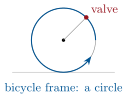
Proof. One example settles each claim. The seated passenger of Example 5.3 is at rest in the train frame and moves at in the ground frame (rest and speed depend on the frame). For the trajectory, watch the valve on a bicycle wheel: an observer riding the bicycle sees it trace a circle around the hub, while an observer standing on the road sees it trace a sequence of arches (a curve called a cycloid) — see the figure below. ∎

Remark 5.5
Note what does not change in the two pictures: the valve, the wheel, the physics. Only the description changes. Asking “is the valve really going in a circle?” is like asking whether a mountain is “really” to the left: it depends on where you stand.
5.2 Average speed
Definition 5.6 (Average speed)
The average speed of a body, in a given reference frame, is the distance it travels in that frame divided by the travel time :
With in metres and in seconds, is in metres per second (); everyday life prefers kilometres per hour ().
Method 5.7 (Converting between m/s and km/h)
One kilometre is and one hour is , so :
- from to : multiply by ;
- from to : divide by .
Sanity check: the number of is always the larger of the two.
Example 5.8 (Some speeds worth knowing)
A brisk walk: . A city car at : — about covered every second, worth remembering before stepping off a kerb. Sound in air: .
Example 5.9 (A hike with a break)
A hiker covers in of walking, then rests for , then covers in the final . Average speed over the whole outing:
The average counts all the elapsed time, breaks included — it is generally not the average of the speeds of the separate legs.
5.3 Choosing a frame: ground, geocentric, heliocentric
Since every frame is legitimate, we choose the one in which the motion we care about looks simplest. Three choices cover most of the physics in this book.
Definition 5.10 (The three standard frames)
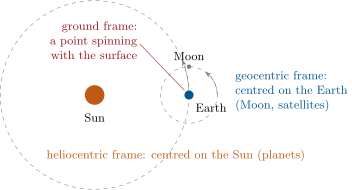
- The ground frame (or laboratory frame) is attached to the Earth’s surface where the experiment happens. It is the right frame for everyday motion: falling objects, vehicles, sports, laboratory benches.
- The geocentric frame is centred on the Earth but does not spin with it (its directions point to distant stars). It is the right frame for the Moon and for artificial satellites, which orbit the Earth as a whole and ignore its daily rotation.
- The heliocentric frame is centred on the Sun, with directions again fixed on distant stars. It is the right frame for the planets: each then follows a simple, nearly circular orbit.
Method 5.11 (Choosing the frame)
Name the bodies whose motion you want to describe, then pick the frame in which that motion is simplest:
- motion near the Earth’s surface, lasting minutes — ground frame;
- orbits around the Earth (Moon, satellites) — geocentric frame;
- orbits around the Sun (planets, comets) — heliocentric frame.
Always state your choice before describing a motion: a trajectory or a speed quoted without its frame is meaningless (Proposition 5.4).
Remark 5.12 (Who is right, Ptolemy or Copernicus?)
“The Sun rises in the east” and “the Earth spins toward the east” are the same observation reported in two frames — the first in the ground frame, where the Sun sweeps across the sky, the second in the geocentric frame, where the observer is carried around the Earth’s axis. For centuries the frames themselves were the battlefield: Ptolemy’s Earth-centred description tracked the sky accurately but needed loops upon loops to follow the planets, while the Sun-centred description revived by Copernicus in 1543 made each planet a simple near-circle and explained the strange backward loops of Mars as a mere frame effect — the Earth overtaking a slower planet. The modern verdict is not that one frame is true and the other false, but that they are not equally convenient; a deeper criterion for preferring some frames (the inertial ones) arrives with the principle of inertia in Chapter 6.
5.4 Composing motions along a line
What connects the of the walker (train frame) to the (ground frame)? Along a single line, the answer is plain addition.
Proposition 5.13 (Composition of speeds in one dimension)
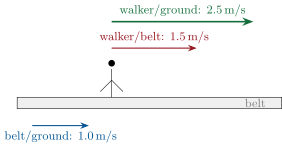
Suppose a body moves along a line on a moving support (a walkway, a train, flowing water), the support itself sliding along the same line relative to the ground. Choosing a positive direction on the line and counting speeds with a sign,
In words: speeds in the same direction add; speeds in opposite directions subtract.
Proof. During one second, the support carries the body metres along the line, and the body advances metres along the support. Both displacements happen along the same line, so the body’s total displacement over the ground in that second is their algebraic sum — which is its speed relative to the ground. ∎
Example 5.14 (The moving walkway)
An airport walkway rolls at . A traveller walks on it at relative to the belt, in the direction of travel: speed relative to the ground . Walking the wrong way at the same pace: , still (slowly) progressing against the belt. Standing still on the belt: relative to the ground, relative to the belt — at rest and in motion at the same time, in two different frames.
Remark 5.15 (Two directions at once)
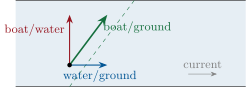
When the two motions are not along the same line — a boat aiming straight across a river while the current pushes it downstream — each motion runs its course independently, and the velocities compose as arrows placed tip to tail, exactly like the vectors of the mathematics volume. The boat still reaches the far bank in the time set by its crossing speed alone, but it lands downstream of its aiming point, and its ground-frame trajectory is a slanted straight line. The full vector treatment comes in a later chapter; here we only read the picture.
5.5 Exercises
Exercise 5.1 ★
A passenger is asleep in a train travelling at . State whether the passenger is at rest or in motion, and at what speed, relative to: the carriage; the ground; a tree beside the track; an oncoming train travelling at the other way. Then describe the motion of the tree in the frame of the passenger’s train.
Solution
Solution of Exercise 5.1.
Relative to the carriage: at rest. Relative to the ground and to the tree: in motion at . Relative to the oncoming train: speeds in opposite directions add, . In the frame of the passenger’s train, the tree moves backward at along a straight line.
Exercise 5.2 ★
Convert: and into ; and into . Check each answer with the sanity rule of Method 5.7.
Solution
Solution of Exercise 5.2.
; ; ; . In each pair the figure is the larger one, as the sanity rule demands.
Exercise 5.3 ★
A cyclist covers in ; a sprinter covers in . Compute both average speeds in and in . Who is faster, and does the answer surprise you?
Solution
Solution of Exercise 5.3.
Cyclist: . Sprinter: . The sprinter is half again as fast — but only for ten seconds, while the cyclist holds the pace for an hour and a half. Average speeds compare fairly only over comparable durations.
Exercise 5.4 ★
A moving walkway rolls at . A traveller walks at relative to the belt. Give the traveller’s speed relative to the ground when walking in the belt’s direction, against it, and when standing still on the belt.
Solution
Solution of Exercise 5.4.
Same direction: . Against the belt: . Standing still on the belt: the belt’s own .
Exercise 5.5 ★
For each motion, choose the most convenient frame among ground, geocentric and heliocentric, and justify in one sentence: a pen dropped inside a moving train (bonus: an even better frame is available); the orbit of the International Space Station; one Martian year; a sprint.
Solution
Solution of Exercise 5.5.
Dropped pen: ground frame works, but the train frame is better still — there the pen simply falls straight down. Space station: geocentric frame (it orbits the Earth as a whole, ignoring its spin). Martian year: heliocentric frame (Mars runs a near-circle around the Sun). Sprint: ground frame (start line, finish line and stopwatch are all fixed to the ground).
Exercise 5.6 ★★
A train rolls at . A passenger walks toward the front at relative to the train.
- Convert the train’s speed to , then give the passenger’s speed relative to the ground, walking toward the front and toward the rear.
- The carriage is long. How long does the walk to the front take, and how far does the passenger travel relative to the ground during it?
Solution
Solution of Exercise 5.6.
1. . Toward the front: ; toward the rear: .
2. Relative to the train the passenger covers at : . Relative to the ground the passenger covers — the carried by the train plus the walked, as the composition rule predicts.
Exercise 5.7 ★★
A boat’s speed in still water is ; a river flows at . The boat travels downstream, turns around, and comes back.
- Compute the boat’s speed relative to the bank on each leg, and the duration of each leg.
- Compute the average speed over the round trip. Why is it less than , even though the current helps on one leg exactly as much as it hinders on the other?
Solution
Solution of Exercise 5.7.
1. Downstream: , so . Upstream: , so .
2. Average speed: . The current’s help and hindrance are equal in speed but not in time: the boat spends being slowed and only being helped, so the slow leg dominates the average.
Exercise 5.8 ★★
Two trains pass each other on parallel tracks: train A ( long) at , train B ( long) at .
- They travel in opposite directions. What is the speed of B in the frame of A, and how long does the complete crossing last (from noses meeting to tails separating)?
- Same questions if they travel in the same direction.
Solution
Solution of Exercise 5.8.
1. Opposite directions: in the frame of A, B approaches at . The crossing is complete when B has slid past the combined length : .
2. Same direction: relative speed , and — nine times longer, which is why overtaking a truck feels endless.
Exercise 5.9 ★★
A bicycle rolls along a straight road. Describe the trajectory of the tyre valve in: the frame of the cyclist; the ground frame; and the frame of the valve itself. Describe also the trajectory of the wheel’s hub in the ground frame. No computation — name each curve.
Solution
Solution of Exercise 5.9.
Frame of the cyclist: a circle (the rim’s circle, centred on the hub). Ground frame: a cycloid — a chain of arches, one per turn of the wheel. Frame of the valve itself: the valve is at rest, a single point. The hub in the ground frame: a horizontal straight line at the height of one wheel radius.
Exercise 5.10 ★★
The Earth’s equator is about long, and the Earth spins once in .
- Compute the speed of a point on the equator in the geocentric frame, in and in .
- Explain in one sentence each: why we do not feel this speed, and why “the Sun rises” and “the Earth spins” report the same observation.
Solution
Solution of Exercise 5.10.
1. — faster than sound.
2. We do not feel it because everything around us — ground, air, buildings — shares exactly the same motion, so nothing moves relative to us (and the principle of inertia, Chapter 6, will explain why shared uniform motion is undetectable from inside). “The Sun rises” is the ground-frame report and “the Earth spins” the geocentric-frame report of one and the same observation.
Exercise 5.11 ★★
Standing still on a moving escalator, the ride up takes . Walking up the same escalator switched off takes . How long does walking up the moving escalator take? (Work with the speeds, not the times.)
Solution
Solution of Exercise 5.11.
Let be the escalator’s length. Escalator speed: ; walking speed: . Walking on the moving escalator, the speeds add:
so the ride takes . (Not the average of and : speeds add, times do not.)
Exercise 5.12 ★★★
A driver covers the same distance twice: outbound at , back at .
- Show that the average speed over the round trip is — not .
- Explain where the naive answer goes wrong, and state which leg dominates the average.
Solution
Solution of Exercise 5.12.
1. Over a distance each way: , so .
2. The naive averages the two speeds as if the driver spent equal times at each; in fact the distances are equal, so the slower leg lasts longer () and drags the average toward . The average speed is total distance over total time — nothing else.
Exercise 5.13 ★★★
Two cyclists start apart and ride toward each other, one at , the other at .
- Describe the motion of the second cyclist in the frame of the first, and deduce when they meet.
- How far has each ridden at the meeting?
- If instead they ride in the same direction (the faster one behind), how long does the chase last?
Solution
Solution of Exercise 5.13.
1. In the frame of the first cyclist, the second approaches in a straight line at from away: they meet after exactly .
2. The first has ridden , the second — total , as it must be.
3. Same direction: closing speed , so the chase lasts .
Exercise 5.14 ★★★
A swimmer crosses a river wide, heading straight across at relative to the water; the current flows at .
- Explain why the crossing time is set by the swimmer’s crossing speed alone, and compute it.
- How far downstream does the swimmer land?
- Using a right triangle, find the swimmer’s speed in the ground frame and the length of the path actually swum over the ground.
Solution
Solution of Exercise 5.14.
1. The current pushes the swimmer along the river, not across it: the two motions compose independently, and progress toward the far bank is made at regardless of the drift. Crossing time: .
2. Drift: downstream.
3. The ground-frame velocity is the hypotenuse of a right triangle with legs and : (a –– triangle scaled by ). Path length: — or directly .
Exercise 5.15 ★★★
The Earth orbits the Sun on a near-circle of radius , in one year ( seconds).
- Compute the Earth’s speed in the heliocentric frame, in .
- Compare it with the equator’s spin speed found in Exercise 5.10.
- Seen from the Earth, Mars occasionally seems to stop and drift backward among the stars for a few weeks. Explain in two sentences, using this chapter’s vocabulary, why the heliocentric frame dissolves the mystery.
Solution
Solution of Exercise 5.15.
1. .
2. : the Earth carries us around the Sun about sixty-five times faster than it spins us around its axis.
3. In the geocentric frame, Mars’s apparent path combines its own orbital motion with the Earth’s, and when the faster Earth overtakes Mars the combination runs backward for a few weeks. In the heliocentric frame both planets simply circle the Sun at steady rates — the “backward loop” is not a motion of Mars but an artefact of the frame.
5.6 Problem: The walkway, the river and the satellite
Problem 5.1
Weekend problem — the moving walkway, the river and the satellite: who moves, relative to what, and the armchair traveller’s final speed report
An airport, a ferry crossing, and a bright dot sliding across the dusk sky: three everyday scenes, one question asked three times — who moves, relative to what? Each part picks its frame, computes, and watches the answer change with the point of view; the finale totals up how fast you are moving right now, sitting perfectly still.
Part I — The walkway race. An airport walkway is long and rolls at . A traveller walks at (relative to whatever is underfoot).
- How long does the walkway take to carry a standing traveller from end to end?
- How long does the traveller take when walking on the moving belt, in its direction?
- How long when walking beside the walkway, on the fixed floor?
- A prankster walks the wrong way on the belt, at relative to it. Speed relative to the ground, and time to get from the far end back to the entrance?
- A child runs the wrong way at exactly relative to the belt. Describe the child’s motion in the ground frame, and name the gym machine this reinvents.
- Summarize questions 1–5 in a two-column table: each mover’s speed in the belt frame and in the ground frame. Which column do the travellers’ legs feel?
Part II — The river. A ferry crosses a river wide. Its speed relative to the water is ; the current flows at . The pilot first aims straight at the opposite bank.
- How long does the crossing take?
- How far downstream does the ferry land?
- Using a right triangle, compute the ferry’s speed in the ground frame and the length of its ground-frame trajectory. (A familiar triple of numbers appears.)
- Describe the ferry’s trajectory in the water frame and in the ground frame. What is the same about them, and what differs?
- A swimmer whose speed relative to the water is sets off from the same bank, aiming straight across like the ferry. How long does the crossing take, and how far downstream does the swimmer land? Compute the swimmer’s ground-frame speed (right triangle again). Why does the slower swimmer drift farther than the ferry?
- A log floats past the ferry. Give its speed in the ground frame and in the water frame. In which frame is the log “moving”? Comment.
Part III — The satellite pass. At dusk, the International Space Station crosses the sky in a few minutes. It orbits at an altitude of ; the Earth’s radius is , and one orbit takes (about ).
- In which standard frame is the station’s motion simplest? Compute its speed in that frame, in .
- Explain in two sentences why the ground frame describes the station awkwardly — what happens to its track over the ground between one orbit and the next?
- Compare the station’s orbital speed with the equator’s spin speed (): by what factor is the station faster?
- A geostationary satellite orbits at radius in exactly one day (). Compute its speed in the geocentric frame, then describe its motion in the ground frame. Reconcile the two answers in one sentence.
- In the geocentric frame the Moon traces a near-circle around the Earth in about days. Sketch in words its trajectory in the heliocentric frame over a few months.
Part IV — Who moves?
- “The Sun rises in the east.” “The Earth spins toward the east.” State the frame in which each sentence describes the observation, and explain why neither is wrong.
- In one sober paragraph: what did Ptolemy’s frame do well, what did Copernicus’s frame simplify (mention Mars’s backward loops), and why is the modern verdict about convenience rather than about one frame being true?
- The armchair traveller’s speed report. You sit still in an armchair near the equator. Give your speed in the ground frame, in the geocentric frame (), and in the heliocentric frame (). Then compute the distance you cover in the heliocentric frame during a film, and conclude the problem with the chapter’s one-sentence moral.
Solution
Solution of Problem 5.1.
1. .
2. Ground speed : .
3. .
4. relative to the ground, against the belt’s direction: — three whole minutes of brisk walking.
5. Ground speed : the child runs hard and goes nowhere, at rest in the ground frame while sprinting in the belt frame. That is a treadmill.
6. Belt frame / ground frame: standing traveller / ; walker with the belt / ; walker on the floor (the floor slides backward in the belt frame) / ; prankster / ; child / . Each mover’s legs feel the column of the frame of what is underfoot — the belt-frame column for those riding the belt, the ground-frame column for the walker on the floor: effort is walking speed relative to what is underfoot.
7. Progress across the river is made at whatever the current does: .
8. Drift: downstream.
9. Ground speed: hypotenuse of a right triangle with legs and : . Trajectory length: — the –– triple again, scaled to ––.
10. Water frame: a straight line, , perpendicular to the banks. Ground frame: also a straight line, but slanted, and long. Same shape (straight), different direction and length: the trajectory belongs to the frame, not to the ferry.
11. Progress across is made at , so . Drift: — double the ferry’s . Ground speed: hypotenuse with legs and : . The slower swimmer takes twice as long to cross, so the same current has twice the time to carry them downstream.
12. Ground frame: the log drifts at the current’s . Water frame: it is at rest, floating with the water around it. Whether the log “moves” has no frame-free answer — which is the whole point of the chapter.
13. The geocentric frame. Orbit radius , so
14. While the station completes one orbit, the Earth turns underneath it by about , so the track over the ground shifts westward at every pass. In the ground frame the station’s path is a complicated wavy curve that never repeats exactly; in the geocentric frame it is one fixed near-circle.
15. : the station outruns the spinning equator roughly seventeenfold, which is why it crosses the whole sky in minutes.
16. in the geocentric frame. In the ground frame it is at rest, hanging over one fixed point of the equator — it circles the Earth’s axis in exactly the time the ground itself does, so the two motions cancel in the ground frame. At rest and at : both true, one per frame.
17. In the heliocentric frame the Moon travels essentially along the Earth’s orbit — a huge near-circle around the Sun — overlaid with a gentle wobble of the cycle. The Sun’s influence dominates so strongly that the path always bends toward the Sun; it never loops backward.
18. “The Sun rises” is the report in the ground frame, where the observer is at rest and the Sun sweeps across the sky. “The Earth spins” is the report in the geocentric frame, where the Sun’s direction is steady and the observer is carried eastward around the axis. They describe the same observation; each is correct in its own frame, and Proposition 5.4 says no observation of the motion alone can arbitrate.
19. Ptolemy’s Earth-centred frame matched the sky’s daily motion naturally and predicted planetary positions serviceably, but only at the price of loops upon loops (epicycles) to reproduce each planet’s wanderings. Copernicus’s Sun-centred frame made every planet a steady near-circle and turned Mars’s backward loops into a frame effect — the Earth overtaking a slower runner on an inside lane. The modern verdict is not that the Sun “really” stands still (it too moves, around the centre of the galaxy) but that frames are tools: the heliocentric one makes planetary motion incomparably simpler, and simplicity, not truth, is what a frame is for.
20. Ground frame: — at rest in the armchair. Geocentric frame: about , carried around the Earth’s axis. Heliocentric frame: about , carried around the Sun. During a film: — nearly halfway to the Moon without leaving the armchair. Moral: motion is not a property of a body but of a body and a frame; choose the frame that makes the story simple, and always say which one you chose.