সব বই

পেশাদার

1 Markets I: The Ecosystem and Exchange-Traded Marketsবাজার অনলাইনইংরেজি 2 Markets II: Rates, FX and Creditবাজার অনলাইনইংরেজি 3 Markets III: Commodities, Energy and Cryptoবাজার অনলাইনইংরেজি 4 Quantitative Methodsপদ্ধতি অনলাইনইংরেজি 5 Derivatives and Volatilityডেরিভেটিভস অনলাইনইংরেজি 6 Rates, Credit, XVA and Riskসুদহার, ঋণ ও ঝুঁকি অনলাইনইংরেজি 7 Research Craft: Predictors, Backtests, Measurement, Portfoliosগবেষণা অনলাইনইংরেজি 8 Strategies I: Equities and Futuresকৌশল অনলাইনইংরেজি 9 Strategies II: Volatility, Relative Value, Macro and the Bank Desksকৌশল অনলাইনইংরেজি 10 Microstructure and Executionএক্সিকিউশন অনলাইনইংরেজি 11 Market Making and High-Frequency Tradingমার্কেট মেকিং অনলাইনইংরেজি 12 Machine Learning for Marketsমেশিন লার্নিং অনলাইনইংরেজি 13 Low-Latency Softwareপ্রযুক্তি অনলাইনইংরেজি 14 Networks, Hardware and Trading Infrastructureপ্রযুক্তি অনলাইনইংরেজি 15 Research, Data and Risk Platformsপ্রযুক্তি অনলাইনইংরেজি 16 The Desk and the Firmপ্রতিষ্ঠান অনলাইনইংরেজি 17 The Industry: Firms, Roles and Careersক্যারিয়ার অনলাইনইংরেজি 18 Interviews I: Maths, Probability and Speedক্যারিয়ার অনলাইনইংরেজি 19 Interviews II: Markets, Trading Games and the Final Roundক্যারিয়ার অনলাইনইংরেজি 20 Interviews III: Codeক্যারিয়ার অনলাইনইংরেজি
অ্যাপ পরিচিতি Coach সাইন ইন পড়া শুরু করো

বইগুলো এখনো বাংলা ভাষায় পাওয়া যায় না — Français সংস্করণ দেখানো হচ্ছে।

Physique · পরিভাষা

Champ électrostatique কী?

Définition 26.4 Physique universitaire — 1re année · অধ্যায় 26 — Électrostatique : champ et théorème de Gauss

Une distribution de charges au repos crée en tout point MM de l’espace un champ électrique E→(M)\vect E(M), défini par la force qu’il exerce sur une charge d’épreuve qq placée en MM : F→=qE→(M)\vect F = q\vect E(M) (V/m\mathrm{V}/\mathrm{m} == N/C\mathrm{N}/\mathrm{C}). Une charge ponctuelle q1q_1 en OO crée

E→(M)=q14πε0r2 e→r,r=OM,\vect E(M) = \frac{q_1}{4\pi\varepsilon_0 r^2}\,\vect e_r , \qquad r = OM ,

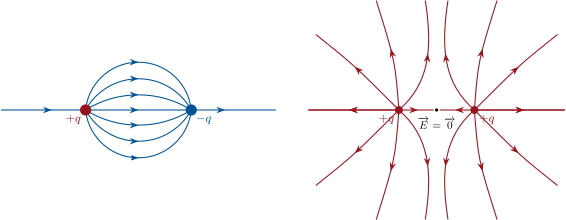
radial, dirigé vers l’extérieur si q1>0q_1 > 0 ; une distribution crée la somme vectorielle des champs de ses éléments. Une ligne de champ est une courbe tangente en chaque point à E→\vect E, orientée dans son sens.

Lignes de champ de deux charges opposées (à gauche) et de deux charges positives égales (à droite). Les lignes partent du + et aboutissent au - ou à l’infini ; à droite elles se repoussent et le champ s’annule au milieu, où ne passe aucune ligne.
Lignes de champ de deux charges opposées (à gauche) et de deux charges positives égales (à droite). Les lignes partent du ++ et aboutissent au −- ou à l’infini ; à droite elles se repoussent et le champ s’annule au milieu, où ne passe aucune ligne.
প্রসঙ্গসহ পড়ো →