এই বইটি এখনো বাংলা ভাষায় পাওয়া যায় না। সংস্করণ: English।
Middle School Economics · শ্রেণি 6–9
10Gains from Trade: Comparative Advantage
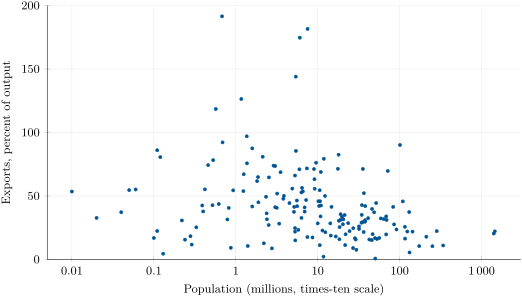
Small countries sell a large part of what they produce abroad. In 2024, the exports of the Netherlands, with 18 million people, were worth of its output; those of Luxembourg, with fewer than a million, (the reason a share can pass was given in Chapter 7). The United States, with 340 million people, exported of its output; India, . Among the 15 countries of more than 100 million people, the middle value was ; among the 40 countries of fewer than 2 million, about .
A small country cannot make everything well: it makes a few things and buys the rest. But why would a country, or a person, buy from others what it could make itself, even make faster? This chapter gives the answer: trade pays whenever two sides give up different amounts to make the same things.
You already know
The opportunity cost of a choice is the value of the best option given up (Chapter 8). Specialisation and exchange were defined in Chapter 9.

10.1 Two people, two tasks, a table of hours
Nadia and Omar are invented neighbours. Each can bake bread and sew shirts, and each has 24 hours a week for this work. The table gives the hours each needs for one unit.
| One loaf | One shirt | |
|---|---|---|
| Nadia | 1 hour | 3 hours |
| Omar | 2 hours | 4 hours |
How it is measured — Hours per unit
A table of hours per unit is the simplest way to describe what a person, a region or a country can produce. Each number is a count of the work needed for one unit, with the tools, land and skills the producer has. A lower number means a more productive producer. For whole countries, economists measure output per hour by industry, and the comparison is the same.
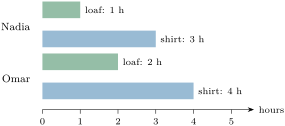
10.2 Absolute advantage
Definition 10.1 (Absolute advantage)
A producer has an absolute advantage in a good when it needs fewer hours (or less of any input) than another producer to make one unit of it.
Nadia has an absolute advantage in both goods: one hour against two for a loaf, three against four for a shirt. One might think that she gains nothing by trading with Omar. The next section shows that she does.
10.3 Comparative advantage
The three hours that Nadia spends on a shirt could make three loaves: her opportunity cost of a shirt is 3 loaves. Omar’s four hours for a shirt could make two loaves: his opportunity cost of a shirt is 2 loaves. The other way round, a loaf costs Nadia of a shirt and Omar of a shirt.
| Opportunity cost | of one loaf | of one shirt |
|---|---|---|
| Nadia | shirt | 3 loaves |
| Omar | shirt | 2 loaves |
Definition 10.2 (Comparative advantage)
A producer has a comparative advantage in a good when its opportunity cost of producing that good is lower than another producer’s.
Nadia has the comparative advantage in bread ( of a shirt against ), and Omar in shirts (2 loaves against 3). Omar is slower at everything, yet a shirt costs him fewer loaves than it costs Nadia. Every producer has a comparative advantage in something, unless the two opportunity costs are exactly equal. This result, which economists owe to David Ricardo, is the reason trade can benefit both sides.
10.4 Both gain: the exchange ratios that work
Example 10.3
Without trade, each spends half of the week on each good. Nadia makes loaves and shirts; Omar makes loaves and shirts. Together: 18 loaves and 7 shirts.
With specialisation, Omar sews all week: shirts. Nadia sews one shirt (3 hours) and bakes for the other 21 hours: 21 loaves. Together: 21 loaves and 7 shirts. The same shirts, and 3 more loaves, from the same hours.
With trade, Omar gives Nadia 3 shirts for loaves, that is loaves per shirt. Omar ends with 3 shirts and loaves (before: 3 and 6). Nadia ends with shirts and loaves (before: 4 and 12). Each has loaves more than without trade.
Definition 10.4 (Gains from trade)
The gains from trade are the extra goods that the two sides can consume when they specialise and exchange, compared with producing everything for themselves.
Definition 10.5 (Exchange ratio)
An exchange ratio is the quantity of one good given for one unit of another in an exchange: for example, loaves per shirt.
Not every exchange ratio works. Omar will not sell a shirt for fewer than 2 loaves: he could bake 2 loaves himself with the hours of a shirt. Nadia will not pay more than 3 loaves for a shirt: she could sew it herself for 3 loaves. Any ratio between 2 and 3 loaves per shirt gives both of them a gain. Where the ratio falls inside that range decides how the gain is shared.

Model — Comparative advantage, two people and two goods
Assumes. Two producers, two goods; each unit takes a fixed number of hours; each producer has a fixed number of hours; exchange is free and costs nothing.
Predicts. Each producer specialises in the good of its lower opportunity cost; at any exchange ratio between the two opportunity costs, both consume more than without trade.
Tested. Japan’s opening to trade after 1859 (the box below). The opening chart, where small countries trade a larger share of their output, is consistent with the model but does not test it: country size alone would give the same picture.
Breaks. Moving from one task to another costs time; carrying goods costs money, which narrows or closes the range of ratios; inside a country, the gains are not shared by everyone, which the grades 10–12 volume takes up.
On the record — Japan opens to trade
For more than two centuries, Japan traded almost nothing with the rest of the world. In July 1859, under pressure from Western powers, its ports opened to foreign trade, suddenly and with low taxes on imports and exports. Prices inside Japan, which had been set by Japanese costs alone, could now be compared with world prices. Japan began to export the goods that were cheap at home compared with abroad — silk, silkworm eggs and tea made about 80 % of its exports from 1868 to 1875 — and to import those that were dear at home: about half of its imports were cotton and woollen cloth. A study of these years valued each year’s trade, good by good, at the prices Japan had before the opening. Taken together, Japan’s exports were goods that had been cheap at home and its imports goods that had been dear, in every year from 1868 to 1875, as the comparative-advantage model predicts (Bernhofen and Brown, 2004).
10.5 Two regions
The same reasoning works for regions and countries. The series’ two invented countries, Brenland and Kestria, both grow grain and weave cloth. The chart gives the hours of work each needs for one unit.
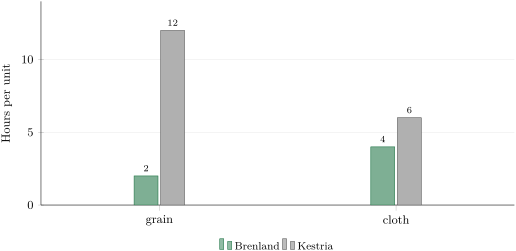
Brenland needs fewer hours for both goods: it has the absolute advantage in grain and in cloth. But a unit of cloth costs Brenland units of grain, and Kestria only unit of grain. Kestria has the comparative advantage in cloth, and Brenland in grain. Both countries gain if Brenland sends grain to Kestria and Kestria sends cloth to Brenland, at any exchange ratio between and 2 units of grain per unit of cloth.
10.6 Exercises
Exercise 10.1 ★
Pia needs 2 hours to bake a cake and 3 hours to knit a scarf. Leo needs 1 hour for a cake and 4 hours for a scarf. Who is faster at each task?
Solution
Solution of Exercise 10.1.
Leo is faster at cakes (1 hour against 2); Pia is faster at scarves (3 hours against 4).
Exercise 10.2 ★
Sara bakes a loaf in 1 hour and sews a shirt in 4 hours. What is her opportunity cost of one shirt, in loaves?
Solution
Solution of Exercise 10.2.
The 4 hours of a shirt could bake loaves: the opportunity cost of a shirt is 4 loaves.
Exercise 10.3 ★
Use the values in the text. What share of its output did the Netherlands export in 2024, and the United States? Which country has the larger population?
Solution
Solution of Exercise 10.3.
The Netherlands , the United States . The United States has the larger population (340 million against 18 million).
Exercise 10.4 ★
Two invented regions make cars and rice. The North needs 50 hours for a car and 20 hours for a tonne of rice; the South needs 80 hours for a car and 10 hours for a tonne of rice. Which region has the absolute advantage in each good?
Solution
Solution of Exercise 10.4.
The North in cars (50 hours against 80); the South in rice (10 hours against 20).
Exercise 10.5 ★★
Use the regions of exercise 4. (a) Compute each region’s opportunity cost of one car, in tonnes of rice. (b) Which region has the comparative advantage in cars, and which in rice?
Solution
Solution of Exercise 10.5.
(a) North: tonnes of rice per car; South: tonnes. (b) The North has the comparative advantage in cars (). A tonne of rice costs the North car and the South car, so the South has the comparative advantage in rice.
Exercise 10.6 ★★
Ana bakes a loaf in 1 hour and makes a chair in 5 hours; Bo bakes a loaf in 2 hours and makes a chair in 5 hours. Each works 20 hours. (a) If each spends half of the time on each good, how many loaves and chairs do they make together? (b) Who has the comparative advantage in chairs? (c) If each specialises fully in the good of his or her comparative advantage, what do they make together? What is gained?
Solution
Solution of Exercise 10.6.
(a) Ana: loaves and chairs; Bo: loaves and chairs. Together 15 loaves and 4 chairs. (b) A chair costs Ana loaves and Bo loaves: Bo has the comparative advantage in chairs. (c) Ana bakes loaves; Bo makes chairs. Together 20 loaves and 4 chairs: 5 more loaves, the same chairs.
Exercise 10.7 ★★
In the example of Nadia and Omar, Omar gives 3 shirts at a ratio of loaves per shirt instead of . (a) How many loaves does Omar get? (b) Compute the gain of each compared with no trade. (c) Who gains more than at ?
Solution
Solution of Exercise 10.7.
(a) loaves. (b) Omar: 3 shirts and loaves against 3 and 6 without trade, a gain of loaf. Nadia: 4 shirts and loaves against 4 and 12, a gain of loaves. (c) Nadia gains more than at (where each gained ); the total gain is still 3 loaves.
Exercise 10.8 ★★
Nadia offers Omar loaves per shirt. (a) Would Omar accept? Explain with his opportunity cost. (b) What happens to the gains from trade?
Solution
Solution of Exercise 10.8.
(a) No: with the 4 hours of a shirt, Omar can bake 2 loaves himself, more than the offered. (b) No trade takes place, and there are no gains from trade.
Exercise 10.9 ★★
What observation about a country’s trade would contradict the model “Comparative advantage, two people and two goods”? Describe it.
Solution
Solution of Exercise 10.9.
A country that trades freely, at low transport costs, and yet exports the goods whose opportunity cost is higher at home than abroad, and imports those whose opportunity cost is lower at home: for Japan after 1859, exporting goods that had been dear in Japan before the opening.
Exercise 10.10 ★★★
Use the chart of Brenland and Kestria. (a) Give each country’s opportunity cost of one unit of grain, in units of cloth. (b) They trade at 1 unit of grain for 1 unit of cloth. Brenland gives 1 unit of grain: how many hours of work did it cost Brenland, and how many hours would Brenland have needed to weave the unit of cloth it gets? (c) Do the same for Kestria, which gives 1 unit of cloth. (d) Who saves hours?
Solution
Solution of Exercise 10.10.
(a) Brenland: cloth per unit of grain; Kestria: cloth. (b) The grain cost Brenland 2 hours; weaving the cloth would have taken it 4 hours. (c) The cloth cost Kestria 6 hours; growing the grain would have taken it 12 hours. (d) Both: Brenland saves hours, Kestria hours.
Exercise 10.11 ★★★
Nadia becomes twice as fast at both tasks: half an hour per loaf, hours per shirt. (a) Compute her new opportunity cost of a shirt. (b) Does trade with Omar still pay for both? (c) If instead Nadia became faster only at shirts, needing 2 hours for one, what would happen to the gains from trade?
Solution
Solution of Exercise 10.11.
(a) loaves: unchanged. (b) Yes: the two opportunity costs are still 3 and 2 loaves, so every ratio between 2 and 3 gives both a gain. (c) A shirt would cost Nadia loaves, the same as Omar: the range of ratios shrinks to the single value 2, and there is no gain from trade.
Exercise 10.12 ★★★
When Brenland imports Kestria’s cloth, some of Brenland’s weavers lose customers. (a) Does the model of the chapter say that everyone in Brenland gains? (b) What does the model leave out? (c) What data would show who in Brenland gains and who loses?
Solution
Solution of Exercise 10.12.
(a) No: the model has two producers, each of whom gains; it says nothing about the groups inside a country. (b) It leaves out that weavers and farmers are different people, that changing jobs takes time and skills, and that some people lose their income while others gain. (c) For example, the jobs and pay of Brenland’s weavers and farmers, and the prices of cloth and grain, before and after trade with Kestria grew.
10.7 Problem: Grain and Cloth across the Border
Problem 10.1
Weekend problem — Brenland and Kestria’s hours per unit, opportunity costs and specialisation, and each country’s gain from trading
Brenland and Kestria are the series’ invented countries; the hours per unit are those of the chart above. Each country has 120 million hours of work a year for grain and cloth. Quantities are in millions of units.
Part I — Hours per unit.
- Write the table of hours per unit of grain and of cloth for the two countries.
- Which country has the absolute advantage in grain, and which in cloth?
- Without trade, each country spends half of its hours on each good. How much grain and cloth does each country produce?
- How much grain and cloth do the two countries produce together?
Part II — Opportunity costs and specialisation.
- Compute each country’s opportunity cost of one unit of cloth, in grain.
- Compute each country’s opportunity cost of one unit of grain, in cloth.
- Which country has the comparative advantage in each good?
- Kestria weaves cloth with all its hours. Brenland weaves 5 million units of cloth and grows grain with the rest of its hours. Compute the production of each country and the total. Compare with question 4.
Part III — Trade. Kestria sends 10 million units of cloth to Brenland and receives 10 million units of grain: 1 unit of grain per unit of cloth.
- What does Kestria have to consume after trade?
- What does Brenland have to consume after trade?
- Compare with Part I: what is each country’s gain, in units of grain?
- Check that the two gains add up to the extra production found in question 8.
- At a ratio of units of grain per unit of cloth (Kestria still sends 10 million units of cloth), compute each country’s gain in grain. Who gains more now?
Solution
Solution of Problem 10.1.
1. Brenland: grain 2 hours, cloth 4 hours; Kestria: grain 12 hours, cloth 6 hours. 2. Brenland in both goods (2 against 12, 4 against 6). 3. Brenland: grain and cloth; Kestria: grain and cloth (millions of units). 4. 35 grain and 25 cloth. 5. Brenland grain; Kestria grain. 6. Brenland cloth; Kestria cloth. 7. Kestria in cloth (), Brenland in grain (). 8. Kestria: cloth. Brenland: 5 cloth use hours; the other 100 hours grow grain. Total: 50 grain and 25 cloth, 15 grain more than in question 4, with the same cloth. 9. Kestria: cloth and 10 grain. 10. Brenland: grain and cloth. 11. Kestria: the same 10 cloth, and 10 grain instead of 5: a gain of 5 grain. Brenland: the same 15 cloth, and 40 grain instead of 30: a gain of 10 grain. 12. grain, the extra production of question 8. 13. Kestria receives grain: a gain of grain. Brenland keeps grain: a gain of grain. Kestria gains more now; the total gain is still 15.