এই বইটি এখনো বাংলা ভাষায় পাওয়া যায় না। সংস্করণ: English।
Middle School Economics · শ্রেণি 6–9
28Exchange Rates and Purchasing Power
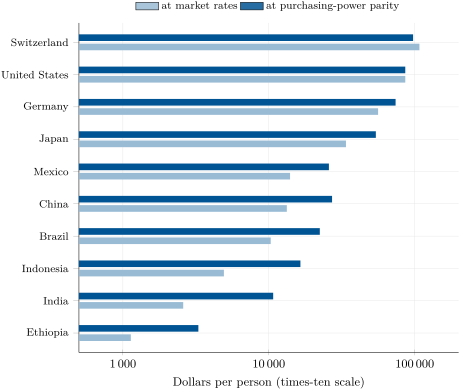
Converted into dollars at the exchange rate of the market, India’s GDP per person in 2024 was 2,592 dollars and that of the United States 86,170: a gap of 33 to 1. But a dollar’s worth of rupees buys much more in India than a dollar buys in the United States. Converted so that the same goods count the same everywhere, India’s GDP per person was 10,719 dollars, and the gap is 8 to 1. For Ethiopia, the second number is nearly three times the first; for Switzerland, it is smaller than the first.
You already know
A price index follows the cost of a fixed basket over time (Chapter 18). GDP per person measures what a country produces, per person, in a year (Chapter 17). Exports and imports are what a country sells to and buys from other countries (Chapter 27).
28.1 The price of a currency
Definition 28.1 (Currency)
A currency is the money used in a country or a group of countries: its notes, coins and bank deposits, counted in one unit.
Definition 28.2 (Exchange rate)
The exchange rate is the price of one unit of a foreign currency, in units of the home currency. For Brenland, is the number of dalens paid for one kest.
Currencies are bought and sold like other goods: travellers, firms that import or export, and savers who buy foreign assets all exchange one currency for another, mostly through banks. The exchange rate is the price at which they trade. In 2025 one kest cost dalens.

28.2 Converting amounts
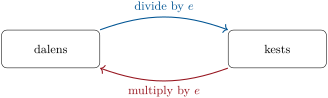
A meal that costs 20 kests in Kestria costs a Brenland traveller dalens. With 100 dalens she gets kests.
28.3 When a currency rises or falls
Definition 28.3 (Appreciation)
A currency appreciates when it buys more units of a foreign currency than before. For Brenland, the dalen appreciates when falls.
Definition 28.4 (Depreciation of a currency)
A currency depreciates when it buys fewer units of a foreign currency than before. For Brenland, the dalen depreciates when rises.
In 2024 one kest cost 1.207 dalens; in 2025, 1.242. The kest became dearer: the dalen depreciated. A Kestrian toy that costs 50 kests cost a Brenland shop dalens in 2024 and dalens in 2025, even though its price in kests did not change. In the other direction, a Brenland good of 100 dalens cost Kestrian buyers kests in 2024 and in 2025.
When a currency depreciates, the country’s imports become dearer at home and its exports cheaper abroad: it tends to buy fewer imports and sell more exports. When it appreciates, the reverse.
28.4 One basket, many prices
Definition 28.5 (Price level of a country)
The price level of a country, compared with another, is the cost of a basket of goods and services in the first country, converted at the market exchange rate, as a percentage of the cost of the same basket in the second.
Model — The law of one price
Assumes. A good can be shipped cheaply from one country to another, with no tariff or other barrier.
Predicts. Converted at the exchange rate, the good costs about the same everywhere: if it were much cheaper in one country, traders would buy it there and sell it in the other until the gap closed.
Tested. For a basket of everything households buy, the prediction fails in a regular way: in 2024 the price level of household consumption was below half of that of the United States in most countries with less than 5,000 dollars per person (chart below).
Breaks. Services that cannot be shipped (a haircut, a rent, a bus ride); tariffs and transport costs; taxes that differ from country to country.
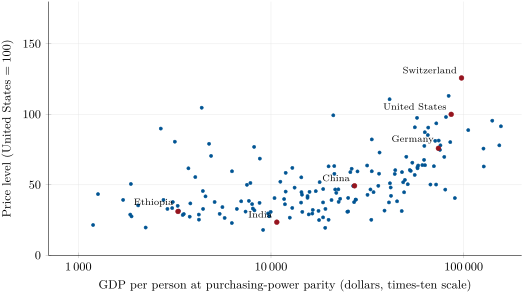
The dots rise from left to right. For the 31 countries with less than 5,000 dollars per person, the middle price level is 35; for the 41 countries with more than 50,000, it is 76. Goods that are easily shipped, such as phones, come closer to the law of one price. Services do not: a haircut in a poorer country is cut by a worker who earns less, and it cannot be shipped to a richer country where haircuts are dear.
28.5 Purchasing-power conversion
Definition 28.6 (Purchasing-power conversion)
A purchasing-power parity rate (PPP rate) between two currencies is the number of units of one currency that buys the same basket of goods and services as one unit of the other. Converting amounts with it is purchasing-power conversion.
If a basket costs 60 dalens in Brenland and 40 kests in Kestria, the PPP rate is dalens per kest. The market rate is 1.242: at the market rate, the basket bought in Kestria costs dalens, less than in Brenland. Kestria’s price level, compared with Brenland, is .
How it is measured — Purchasing-power conversion
The International Comparison Program, run by the World Bank, collects the prices of the same goods and services in most countries of the world. Its latest round has 2021 as its reference year, and its results were published in May 2024. From those prices it computes PPP rates and price levels; the values of other years are estimated from them. GDP per person “at purchasing-power parity” is converted at these rates, into dollars that buy in each country what a dollar buys in the United States.
Facts as of 2026
Several countries can share one currency. In 2026 the euro is the currency of 21 of the 27 member countries of the European Union; the most recent to adopt it is Bulgaria, in 2026. Between those countries there is no exchange rate any more: a price in Lisbon and a price in Vienna can be compared directly.
28.6 Exercises
Exercise 28.1 ★
In 2024 the United States’ GDP per person was 86,170 dollars; India’s was 2,592 dollars at market rates and 10,719 at purchasing-power parity. How many times larger was the United States’ figure with each conversion?
Exercise 28.2 ★
One kest costs dalens. How many kests does a traveller get for 500 dalens?
Solution
Solution of Exercise 28.2.
kests.
Exercise 28.3 ★
A Kestrian bicycle costs 80 kests. What does it cost in dalens when one kest costs dalens, and when it costs dalens?
Solution
Solution of Exercise 28.3.
dalens; dalens.
Exercise 28.4 ★
Read the price levels of Switzerland and India on the price-level chart. What does a basket that costs 100 dollars in the United States cost, converted into dollars, in each of them?
Solution
Solution of Exercise 28.4.
Switzerland about 126, India about 24 (the table values are and ): the basket costs about 126 dollars in Switzerland and about 24 dollars in India.
Exercise 28.5 ★★
One kest cost dalens in 2024 and in 2025. By what percentage did the price of the kest change? Did the dalen appreciate or depreciate?
Solution
Solution of Exercise 28.5.
: the kest became dearer. The dalen depreciated.
Exercise 28.6 ★★
A Brenland firm imports a machine that costs 200 kests. One kest costs dalens. Then the dalen depreciates so that the kest costs more. Compute the machine’s price in dalens before and after.
Solution
Solution of Exercise 28.6.
Before: dalens. After: the kest costs dalens, so the machine costs dalens.
Exercise 28.7 ★★
The dalen depreciates against the kest. What happens to the price in kests of Brenland’s exports, and to the price in dalens of its imports? In which direction do exports and imports move?
Exercise 28.8 ★★
A basket costs 300 dalens in Brenland and 250 kests in Kestria. Compute the PPP rate in dalens per kest.
Solution
Solution of Exercise 28.8.
dalens per kest.
Exercise 28.9 ★★
One kest costs dalens. The same television costs 800 dalens in Brenland and 500 kests in Kestria. Convert the Kestrian price into dalens. Does this observation contradict the law of one price? Give two reasons why traders might not close the gap.
Solution
Solution of Exercise 28.9.
dalens, against 800 in Brenland: a gap of 175 dalens, so the observation contradicts the law of one price. For example: shipping a television costs money; Brenland may have a tariff or a higher tax on televisions; buyers may not know the Kestrian price, or the guarantee may not hold abroad.
Exercise 28.10 ★★★
In an invented country, GDP per person is 2,000,000 zeds. The market rate is 100 zeds per dollar and the PPP rate 40 zeds per dollar. Compute GDP per person in dollars with each rate. Which says more about what people there can buy?
Exercise 28.11 ★★★
Explain why a haircut is usually cheaper, converted at the market rate, in a poorer country than in a richer one, while a phone costs about the same.
Solution
Solution of Exercise 28.11.
A haircut cannot be shipped: it is made where it is bought, and its price depends on the wages of local hairdressers, which are lower in a poorer country. A phone can be shipped: if it were much cheaper in one country, traders would buy it there and sell it elsewhere, so its converted price is about the same.
Exercise 28.12 ★★★
Comparing GDP per person converted at market rates, does one overstate or understate how much poorer the people of a poor country are than those of a rich one? Use the opening chart and the price-level chart.
Solution
Solution of Exercise 28.12.
It overstates the gap. Prices, services above all, are lower in poor countries (the price-level chart), so their incomes buy more than the market rate suggests. India’s GDP per person is a thirty-third of the United States’ at market rates but an eighth at purchasing-power parity.
28.7 Problem: A Summer in Kestria
Problem 28.1
Weekend problem — converting a holiday budget, a moving exchange rate, and Brenland and Kestria compared at market and at purchasing-power rates
Brenland and Kestria are invented. Mira, who lives in Brenland, spends her summer in Kestria. In 2025 one kest costs dalens; in 2024 it cost .
Part I — The budget.
- Mira has saved dalens. How many kests does she get in 2025?
- A night in a youth hostel costs 30 kests. What is that in dalens?
- A meal costs 15 kests. What is that in dalens?
Part II — The rate moves.
- Between 2024 and 2025, did the dalen appreciate or depreciate?
- By what percentage did the price of the kest change?
- What would kests have cost Mira in 2024, and what do they cost in 2025?
Part III — Comparing the two countries. A basket of bread, a bus ride, a haircut and a cinema ticket costs 60 dalens in Brenland and 40 kests in Kestria.
- Compute the PPP rate in dalens per kest.
- Convert the Kestrian basket into dalens at the market rate. Where is the basket cheaper?
- Compute Kestria’s price level, compared with Brenland, in percent.
- Kestria’s GDP per person is kests. Convert it into dalens at the market rate.
- Convert it into dalens at the PPP rate.
- Brenland’s GDP per person in 2025 is dalens. Compare it with your answers to questions 10 and 11. Which country is richer per person, and which conversion should be used to compare what people can buy?
Solution
Solution of Problem 28.1.
1. kests. 2. dalens. 3. dalens. 4. The kest became dearer, so the dalen depreciated. 5. . 6. 2024: dalens; 2025: dalens. 7. dalens per kest. 8. dalens: the basket is cheaper in Kestria. 9. : . 10. dalens. 11. dalens. 12. At the market rate, Brenland is richer per person ( against dalens); at the PPP rate, Kestria is ( against ). To compare what people can buy, one uses the PPP rate, because prices are lower in Kestria.