本书暂未推出简体中文版。现有版本:English。
Middle School Economics · 6–9 年级
21Banks, Saving and Interest
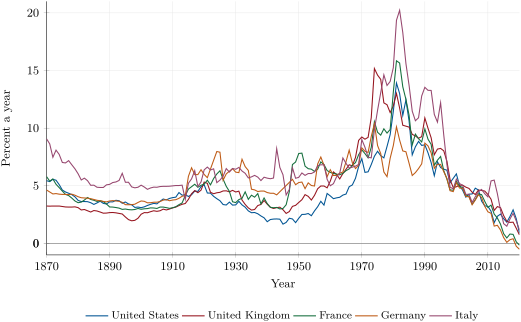
A government that borrows for ten years pays a yearly interest rate on the money. From 1870 to 1960, this rate was between and in nine years out of ten in these five countries. Then it climbed: in the United States in 1981, in Italy in 1982. Then it fell for forty years. In 2020, Germany and France borrowed for ten years at rates below zero: lenders accepted to get back slightly less than they lent.
Why do people lend at all, why do rates differ, and what does a bank do with the money it receives?
You already know
Saving is the part of income that is not spent (Chapter 14); money is what people accept in payment (Chapter 11); the inflation rate is the rate of change of a price index (Chapter 18); compound growth multiplies a value by each year (Chapter 19).
21.1 What a bank does
Definition 21.1 (Bank)
Definition 21.2 (Deposit)
A deposit is money placed with a bank, which the bank must pay back to the depositor, at any time or at a date agreed in advance.
Definition 21.3 (Loan)
A loan is a sum of money lent by a lender to a borrower, who agrees to pay it back later, usually with interest.
A bank stands between people who save and people who borrow. The savers do not need to know whom to lend to, nor check that the borrowers will repay: the bank does it for many of them at once. A family that deposits its savings, a firm that borrows to buy a machine and a couple who borrow to buy a flat may never meet.

21.2 Interest, the price of borrowing
Definition 21.4 (Principal)
The principal of a loan or a deposit is the sum lent or deposited at the start.
Definition 21.5 (Interest)
Interest is the amount a borrower pays to a lender, on top of the principal, for the use of the money.
Definition 21.6 (Interest rate)
The interest rate is the interest for one year divided by the principal, in percent.
The interest rate is a price: the price of having money now rather than later. A borrower pays it because a sum now is worth more to them than the same sum later: it buys a machine that earns money, or a flat to live in from today. A lender asks for it because lending means waiting, and because the money might not come back.
How it is measured — A government bond’s rate
A government borrows by selling bonds: a ten-year bond of dalens promises a payment every year and the dalens back after ten years. Bonds are then bought and sold between investors every day. When their price falls, a buyer gets the same payments for less money, so the rate that the buyer earns rises. The “long-term rate” of the opening chart is that rate, worked out from the market price of the government’s ten-year bonds, one value for each year.
Facts as of 2026
Central banks set the rate at which banks can place money with them or borrow from them for a short time. Since 16 September 2026, the European Central Bank pays a year on the deposits that banks place with it overnight, up from in June 2026.
21.3 Simple and compound interest
Definition 21.7 (Simple interest)
With simple interest, the interest of each year is computed on the principal only. After years at , a principal has earned .
Definition 21.8 (Compound interest)
With compound interest, the interest of each year is added to the principal and earns interest in the following years. After years at , a principal has become .
Compound interest is compound growth (Chapter 19) applied to money. A deposit of dalens at :
| After (years) | 0 | 1 | 2 | 3 | 10 | 20 |
|---|---|---|---|---|---|---|
| Simple interest | ||||||
| Compound interest |
The gap is small in the first years and grows: after 20 years the compound deposit has earned dalens of interest, against with simple interest. Most deposits and loans pay compound interest.
21.4 Why rates differ
Definition 21.9 (Default)
A borrower defaults on a loan when they do not pay back the interest or the principal on the agreed dates.
Model — Risk and the interest rate
Assumes. Lenders want to be paid for waiting and for the risk that the borrower defaults.
Predicts. Borrowers more likely to default pay higher rates; longer loans pay higher rates than short ones.
Tested. In the United States from 1870 to 2020, the ten-year government rate was above the short-term rate in 103 of the 151 years (chart below).
Breaks. When a central bank pushes short rates up or down on purpose (the United States, 1979–1981); in panics, when short-term lenders suddenly want their money back (1873); when short-term borrowing is in very high demand, as in the stock-market boom of 1928–1929; and when lenders rush to the safest borrowers in a crisis, whose rates then fall.
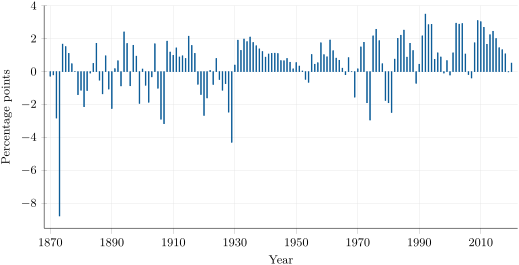
In 1873, short-term rates jumped points above long-term rates: in a panic, people who had lent for a few months wanted their money back at once. In 1929 the gap was points, but it was already points in 1928, before the stock-market crash of October 1929: in the boom years, much short-term money was lent to buyers of shares, and its price stayed high. From 1979 to 1981, the central bank of the United States raised short-term rates very high to bring inflation down.
21.5 Interest after inflation, a first look
A deposit at a year gives dalens after a year for dalens deposited. If prices rose by during the year, the dalens buy exactly what dalens bought a year earlier: the saver has gained nothing. What a lender gains in goods is roughly the interest rate minus the inflation rate. In the United States in 1975, short-term rates were and inflation : lenders were paid less than the rise in prices.
21.6 What a bank keeps at hand
A bank does not keep all its deposits as cash. On a normal day, only a few depositors take their money out, so the bank keeps part of the deposits at hand, as cash and as deposits at the central bank, and lends the rest.
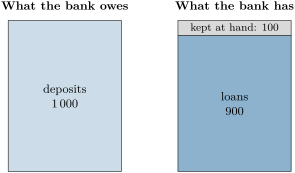
If too many depositors ask for their money on the same day, the bank cannot pay them all at once: its loans come back only over years. What then happens, and how the loans of banks create new deposits, is told in the volume for grades 10 to 12.
21.7 Exercises
Exercise 21.1 ★
Use the opening chart. About how high was the United States’ long-term rate at its peak, and in which year?
Solution
Solution of Exercise 21.1.
About (), in 1981.
Exercise 21.2 ★
A deposit of dalens earns simple interest a year. How much interest does it earn in 3 years?
Solution
Solution of Exercise 21.2.
dalens.
Exercise 21.3 ★
The same dalens earn compound interest. Compute the deposit after 1, 2 and 3 years.
Solution
Solution of Exercise 21.3.
; ; dalens.
Exercise 21.4 ★
Use the opening chart. In which years were the rates lowest, and which countries’ rates went below zero?
Solution
Solution of Exercise 21.4.
Around 2019–2020, at the end of the chart. Germany’s rate went below zero (in 2019 and 2020), and France’s (in 2020).
Exercise 21.5 ★★
Compute what dalens become after 10 years at compound interest, using a power.
Solution
Solution of Exercise 21.5.
dalens.
Exercise 21.6 ★★
A firm borrows dalens for one year. Bank A charges for the year. Bank B charges a month, compounded each month for 12 months. Which loan costs less, and by how much?
Exercise 21.7 ★★
A bank lends to a safe firm at . A new firm, which is more likely to default, asks for the same loan of dalens. If the model “Risk and the interest rate” holds, will its rate be higher or lower? If the bank adds 2 percentage points for the risk, how much more interest does the new firm pay in a year?
Exercise 21.8 ★★
In the United States, the short-term rate was in 1975 and in 1981; inflation was and . Compute the rate minus inflation in each year. In which year did lenders gain in goods?
Exercise 21.9 ★★
Give an observation from this chapter that does not fit the model “Risk and the interest rate”.
Solution
Solution of Exercise 21.9.
For example: from 1979 to 1981, and in 1873 and 1929, the short-term rate in the United States was above the ten-year rate, although the model predicts that longer loans pay more.
Exercise 21.10 ★★★
Using the rule of 70, how long does a deposit at compound interest take to double? Check with a power.
Solution
Solution of Exercise 21.10.
years. Check: , close to 2.
Exercise 21.11 ★★★
A bank keeps of its deposits at hand. A family deposits dalens. How much of this deposit can the bank lend?
Solution
Solution of Exercise 21.11.
It keeps dalens and can lend dalens.
Exercise 21.12 ★★★
The opening chart shows long-term rates falling from the early 1980s to 2020. Explain what the chart alone cannot tell about why they fell.
21.8 Problem: Saving for a Boat
Problem 21.1
Weekend problem — a deposit at simple and compound interest, a loan at two rates, and Brenland’s interest rate after inflation
Everything in this problem is invented. Mira wants a sailing boat.
Part I — The deposit. Mira deposits dalens for 10 years at a year.
- How much interest does the deposit earn in the first year?
- With simple interest, how much does she have after 10 years?
- With compound interest, how much does she have after 2 years? After 10 years?
- How much more does compound interest give after 10 years?
Part II — The loan. Another sailor, who has dalens, wants a boat costing dalens now. He borrows the rest for 2 years, with compound interest, paying everything back at the end.
- How much does he borrow? How much does he pay back at a year?
- How much does he pay back at a year?
- How much more interest does he pay at ?
- Give a reason why one bank might offer him and another .
Part III — Brenland. Brenland’s consumer price index (2015 = 100) and the central bank’s rate:
| Year | 2021 | 2022 | 2024 | 2025 |
|---|---|---|---|---|
| Consumer price index | 115.9 | 127.7 | 140.0 | 143.5 |
| Central bank rate (%) | 3.11 | 5.42 | 5.36 | 4.62 |
- Compute the inflation rate in 2022, to one decimal.
- Compute the central bank’s rate minus inflation in 2022. What does the sign mean for a lender?
- Compute the inflation rate and the rate minus inflation in 2025.
- Mira’s deposit of Part I, at compound interest, is worth its 10-year value. If prices rise by a year during the 10 years, what is it worth in the prices of the start? Did her saving gain in goods?
Solution
Solution of Problem 21.1.
1. dalens. 2. dalens. 3. ; dalens. 4. dalens. 5. dalens; dalens. 6. dalens. 7. dalens. 8. The second bank may judge him more likely to default (for example, it knows less about his income), or it may have higher costs. 9. . 10. points. Negative: a lender at the central bank’s rate got back less, in goods, than he lent. 11. : . Rate minus inflation: points. 12. Prices are multiplied by . The deposit is worth dalens in the prices of the start: more than the deposited, so her saving gained about dalens’ worth of goods.