এই বইটি এখনো বাংলা ভাষায় পাওয়া যায় না। সংস্করণ: English।
Middle School Economics · শ্রেণি 6–9
8Scarcity and Opportunity Cost
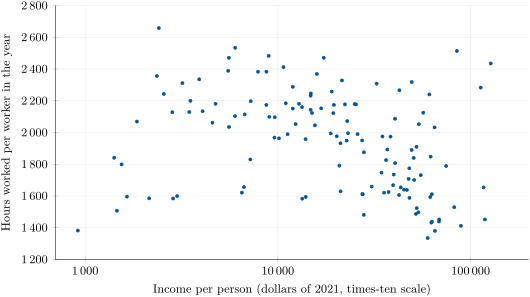
Every dot is a country. On the right are the richer countries, and most of them are low on the chart: their workers work fewer hours in a year. A worker in Germany worked hours in 2023, one in Norway , where income per person was dollars; a worker in India or Bangladesh worked hours, about a thousand hours more, and income per person in India was dollars. Among the 43 poorest of the 130 countries, the middle value is hours; among the 43 richest, hours. The dots are scattered: the United States ( hours) and Korea ( hours) are rich and work long hours.
Why would richer people choose to work less? Each person has 24 hours a day, rich or poor. An hour spent at work is an hour not spent resting, with one’s family or at a game. This chapter is about that kind of choice: when you cannot have everything, getting one thing means giving up another. It will find two forces at work when a wage rises, and they pull in opposite directions.
You already know
Hours worked per worker were measured in Chapter 5, income per person in Chapter 2, and the times-ten scale in Chapter 1.

8.1 Wants and means
People want more things than they can have: more food of a better kind, a bigger home, more trips, more time with friends, more sleep. The means to get them — money, time, land, workers, machines — are limited.
Definition 8.1 (Scarcity)
Scarcity is the situation in which people’s wants are larger than the means to satisfy them, so that they must choose which wants to satisfy and which to leave.
Scarcity does not mean that a thing is rare. Bread is not rare, but a family with a budget of 2 000 dalens a month cannot buy unlimited bread and everything else. Even a very rich person faces scarcity: he or she has only 24 hours a day.

8.2 To choose is to give up
Definition 8.2 (Choice set)
A person’s choice set is the list of all the options that he or she can afford, with the money and the time available.
An option outside the choice set is not a choice at all: a trip that costs 500 dalens is not in the choice set of someone who has 60 dalens. Inside the choice set, choosing one option means giving up all the others.
8.3 Opportunity cost
Definition 8.3 (Opportunity cost)
The opportunity cost of a choice is the value of the best option given up to make it.
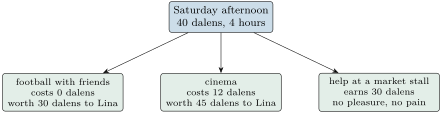
Only the best option given up counts, not all of them: Lina cannot go to the football game and work at the stall in the same afternoon, so she gives up only one of them by going to the cinema.
Example 8.4
For Lina, the cinema is worth 45 dalens of pleasure, minus the 12 dalens of the ticket: a net value of 33 dalens. Football is worth 30 dalens and costs nothing: 30 dalens. Working at the stall brings 30 dalens of pay. The best alternative to the cinema is worth 30 dalens (football or the stall, which tie), so the opportunity cost of the cinema is 30 dalens. The cinema’s net value, 33 dalens, is larger: it is the best choice. If the stall paid 40 dalens, the opportunity cost of the cinema would be 40 dalens, and working would be the best choice.
How it is measured — Valuing time
Money is easy to count; time is harder. A first estimate of what an hour is worth to a person is what that person could earn in an hour of extra work: the hourly wage. It is only a first estimate. Many people cannot choose to work one more hour, and an hour of rest after ten hours of work is worth more than the first hour of a free day.
The opportunity cost of an hour rises when the hourly wage rises. This simple idea is a model of how people choose. Applied to free time, it gives a surprise: when the wage rises, an hour of rest costs more, so by this force alone people would rest less and work more. A second force pulls the other way. A higher wage also makes a person richer, and richer people want more of most things, rest included. This pull of a larger income is called the income effect. The model alone does not say which of the two forces wins.
Model — Choosing by opportunity cost
Assumes. A person compares the options in the choice set and picks the one whose value is larger than the value of the best option given up.
Predicts. When the hourly wage rises, the opportunity cost of time rises: people buy more goods and services that save time, such as meals prepared by others. For free time the model gives no sign by itself: a dearer hour of rest pushes towards more work, a larger income towards more rest.
Tested. Richer households spend a larger share of their food budget on meals prepared by others (the chart below). The hours of the opening chart, and the long fall of hours as wages rose since 1950 (Chapter 5), are consistent with the income effect having won so far; they do not test the opportunity cost alone, because both forces act at once.
Breaks. Habits and rules: many workers cannot choose their hours. People also let costs they have already paid steer their choices (the section “A cost already paid”).
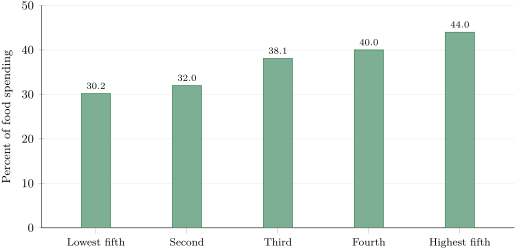
The households of the lowest fifth spent of their food dollars on meals away from home: . The highest fifth spent of dollars: . This fits the model: a meal cooked by someone else saves an hour of cooking, and an hour is worth more to a person who earns more. It is not a proof. Eating out is also a pleasure, and richer households may simply buy more of every pleasure.
8.4 A cost already paid
Definition 8.5 (Sunk cost)
A sunk cost is a cost that has already been paid and cannot be recovered, whatever one chooses now.
A sunk cost is not an opportunity cost of any choice that remains, because no choice can bring it back. The model says to leave it out: compare only what each option still brings and still costs.
Example 8.6
Tom paid 20 dalens for a concert ticket that cannot be sold or refunded. On the evening of the concert, he feels ill, and staying home is worth 15 dalens to him, while the concert, ill as he is, is worth 10. The 20 dalens are gone either way: they are a sunk cost. Staying home (15) beats the concert (10). “I paid for it, so I must go” adds the 20 dalens to one side only, and leads to the worse choice.
Do people leave sunk costs out? An experiment in a university theatre tested it. Among the first 60 people who bought a season ticket, some paid the full price of 15 dollars and the others, chosen at random, were given a discount of 2 or of 7 dollars. Over the first five plays of the season, those who had paid the full price used more tickets, each on average, than those given a discount, and . Over the last five plays the gap disappeared (Arkes and Blumer, 1985). By the model, the price already paid should not matter for the decision to go out on a given evening. Here it did, for a while: this is a place where the model breaks.
8.5 Persons, firms and countries
The same reasoning works for a firm. A baker who owns her shop pays no rent. Using the shop is not free all the same: she could rent it to someone else. The rent she gives up is the opportunity cost of using it herself.
It works for a country too. A hectare of land near a growing town can grow wheat or hold houses. The opportunity cost of the houses is the wheat no longer grown there, and the opportunity cost of the wheat is the houses not built. Workers, machines and money spent on one thing are not available for another.
8.6 Exercises
Exercise 8.1 ★
Use the values in the text. How many hours did a worker work in 2023 in Germany, and in India? What is the difference?
Solution
Solution of Exercise 8.1.
Germany hours, India hours; the difference is hours.
Exercise 8.2 ★
Sami has a free evening. Here is what each option is worth to him, after its costs: a film at home 8 dalens, a game with friends 14 dalens, reading 11 dalens. He chooses the game. What is the opportunity cost of his choice?
Solution
Solution of Exercise 8.2.
The options given up are the film (8) and reading (11). The best of them is reading, so the opportunity cost of the game is 11 dalens.
Exercise 8.3 ★
To visit her aunt, Rosa can take the train (18 dalens, 2 hours) or the bus (10 dalens, 4 hours). (a) What does the train cost more in money? (b) How much time does it save? (c) If an hour of Rosa’s time is worth 3 dalens to her, which trip costs her less in all?
Solution
Solution of Exercise 8.3.
(a) dalens more. (b) hours. (c) Train: dalens; bus: dalens. The bus costs her less in all.
Exercise 8.4 ★
A firm can use a free hall for a fair worth 500 dalens, a concert worth 800 dalens, or a market worth 650 dalens. It chooses the concert. What is the best alternative given up, and the opportunity cost?
Solution
Solution of Exercise 8.4.
The best alternative given up is the market (650 dalens, more than the fair’s 500), so the opportunity cost of the concert is 650 dalens.
Exercise 8.5 ★★
Ana paid 25 dalens, which cannot be refunded, for a concert on Friday. On Friday, a friend invites her to a party worth 30 dalens to her; the concert is now worth 20 dalens to her. (a) Which costs are sunk? (b) Which option does the model predict she chooses? (c) What would she choose if she counted the 25 dalens as part of the concert’s value?
Solution
Solution of Exercise 8.5.
(a) The 25 dalens of the ticket. (b) The party, worth 30 dalens, against 20 for the concert. (c) She would compare with 30 and choose the concert: the worse choice.
Exercise 8.6 ★★
A firm owns a warehouse it uses for its own goods. Another firm offers to rent it for 1 200 dalens a month. (a) What is the opportunity cost, per month, of using the warehouse itself? (b) The firm could store its goods elsewhere for 900 dalens a month. What does the model predict it does?
Solution
Solution of Exercise 8.6.
(a) 1 200 dalens a month, the rent it gives up. (b) Renting the warehouse out and storing its goods elsewhere brings dalens a month more than using it itself: the model predicts that it rents it out.
Exercise 8.7 ★★
Cooking dinner takes Ben one hour and costs 6 dalens of food; a ready meal costs 14 dalens and takes no time. (a) If an hour of Ben’s time is worth 5 dalens, which is cheaper for him in all? (b) Ben’s wage rises, and an hour is now worth 12 dalens. Which is cheaper now? (c) What does the model predict about people’s purchases of ready meals when wages rise?
Solution
Solution of Exercise 8.7.
(a) Cooking: dalens; ready meal: 14 dalens. Cooking is cheaper. (b) Cooking: dalens; ready meal: 14 dalens. The ready meal is cheaper. (c) When wages rise, people buy more ready meals and other goods that save time.
Exercise 8.8 ★★
Use the values in the text. (a) How many more hours did a worker in India work in 2023 than one in Norway? (b) How many times larger was income per person in Norway? Round to one decimal.
Solution
Solution of Exercise 8.8.
(a) hours more. (b) times.
Exercise 8.9 ★★
Describe an observation that would contradict the model “Choosing by opportunity cost”: what would people do that the model says they do not?
Solution
Solution of Exercise 8.9.
For example: people who keep buying a good in one shop when the shop next door sells exactly the same good for less, with no extra time or effort; or people who go to a concert they no longer want to see only because they paid for the ticket.
Exercise 8.10 ★★★
An invented country has 100 hectares near its capital. A hectare can grow 5 tonnes of wheat a year or hold 40 homes. (a) If it builds homes on 30 hectares, how much wheat does it give up each year? (b) What is the opportunity cost of one home, in tonnes of wheat? (c) And of one tonne of wheat, in homes?
Solution
Solution of Exercise 8.10.
(a) tonnes of wheat a year. (b) One hectare gives 5 tonnes or 40 homes, so one home costs tonne of wheat a year. (c) One tonne of wheat costs homes.
Exercise 8.11 ★★★
A museum is free to enter. A visit takes three hours, and the bus costs 4 dalens. (a) Is the visit free? Explain using opportunity cost. (b) For a person whose hour is worth 6 dalens and who would otherwise rest, give a first estimate of the visit’s cost.
Solution
Solution of Exercise 8.11.
(a) No: entry is free, but the visit takes three hours that could be used otherwise, and the bus costs 4 dalens. (b) dalens.
Exercise 8.12 ★★★
In the theatre experiment described in the chapter, suppose the result had been the opposite: those who paid the most went to fewer plays. (a) Would this contradict the model? (b) What result would have agreed with the model exactly?
Solution
Solution of Exercise 8.12.
(a) Yes: the model says that the price already paid does not matter, so a link in either direction contradicts it. (b) The same number of plays, on average, in every discount group, apart from differences due to chance.
8.7 Problem: A Saturday in Brenmoor
Problem 8.1
Weekend problem — listing the options of a free day in Brenland’s capital, finding the best one and its opportunity cost, and choosing again when prices change
Everything in this problem is invented. Mira lives in Brenmoor, the capital of Brenland. On Saturday she has 50 dalens and 8 free hours. She values an hour of her time at 4 dalens. Her options for the day are:
| Option | Money paid (dalens) | Hours | Worth to Mira (dalens) |
|---|---|---|---|
| A: bus to the beach | 12 (bus) | 8 | 70 |
| B: a museum and a café | 15 | 5 | 45 |
| C: work at her uncle’s shop | earns 48 | 8 | 0 |
| D: a concert in town | 55 | 4 | 90 |
Part I — The options.
- Which option is not in Mira’s choice set? Why?
- For option B, Mira has 3 hours left. If she spends them resting, what are they worth to her?
- For each option in the choice set, compute its net value: what it is worth to Mira, plus what it earns, minus what it costs, plus the value of the hours it leaves free.
Part II — The best choice.
- Which option is the best? What is its opportunity cost?
- By how many dalens does the best option beat the next best?
- Mira’s friend says: “Working at the shop costs you nothing, you are paid!” What does the friend leave out?
Part III — A change. The bus fare to the beach rises from 12 to 30 dalens.
- Compute the new net value of option A.
- What is the best option now, and its opportunity cost?
- Mira had already bought, on Friday, a non-refundable bus ticket at the old fare of 12 dalens. Does that change the comparison? Explain with the word “sunk”.
- Her uncle now offers 75 dalens for the day at the shop. With the bus ticket already paid, compute the net values of A and C again.
- What does Mira choose, and what is the opportunity cost of her choice, in dalens?
Solution
Solution of Problem 8.1.
1. D: it costs 55 dalens and Mira has only 50. 2. dalens. 3. A: ; B: ; C: dalens. 4. A, the beach. Its opportunity cost is the best option given up, C: 48 dalens. 5. dalens. 6. The friend leaves out the beach day that Mira gives up, worth 58 dalens to her: working costs her that. 7. dalens. 8. C, the shop (48), ahead of B (42) and A (40). Its opportunity cost is 42 dalens. 9. Yes: with the ticket already bought, going to the beach costs her nothing more today, so A is worth 70 dalens. The 12 dalens are sunk: they are paid whatever she does, and they do not count. A (70) is again the best choice; its opportunity cost is 48 dalens. 10. A: 70 dalens (the ticket is sunk); C: 75 dalens. 11. She works at the shop, and leaves the ticket unused. The opportunity cost of her choice is the beach day, 70 dalens.