এই বইটি এখনো বাংলা ভাষায় পাওয়া যায় না। সংস্করণ: English।
Middle School Economics · শ্রেণি 6–9
11Money
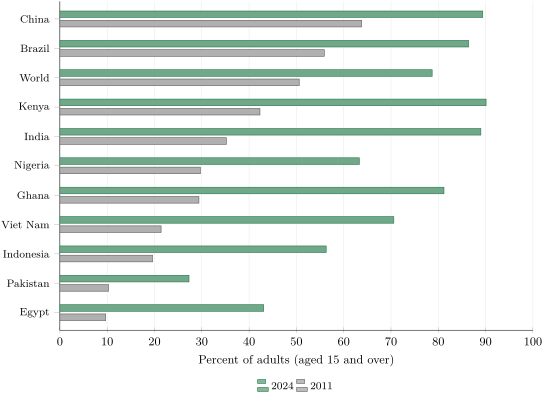
In 2011, half of the world’s adults () had an account in which to keep money and from which to pay. In 2024, did. In Kenya the share went from to , in India from to , often through a phone: a mobile-money account lets its owner pay a shop or send money to a relative with a text message. In Pakistan, the share was still in 2024.
Facts as of 2026
The latest survey of accounts was made in 2024: of the world’s adults had an account. The next survey will change these numbers.
Coins, notes, a number in an account, a payment by phone: all are money. This chapter asks what money does, why people use it rather than swapping goods, and what makes some things good money and others bad.
You already know
In an exchange, each side gives something to the other (Chapter 9). Specialisation and exchange bring gains from trade (Chapter 10).
11.1 Barter
Definition 11.1 (Barter)
Barter is the exchange of goods or services directly for other goods or services, without money.
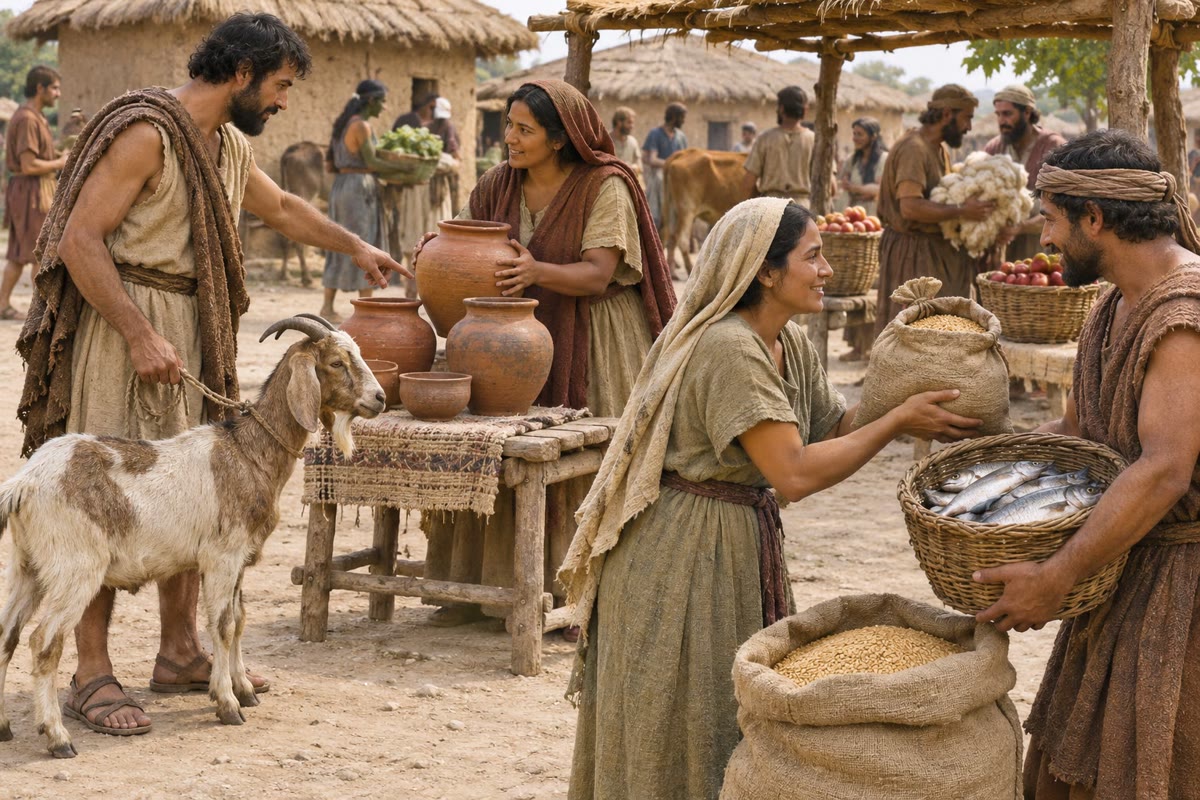
Barter works between neighbours who know each other’s needs. It works badly in a large market, for a simple reason.
Definition 11.2 (Double coincidence of wants)
A double coincidence of wants is the situation in which each of two people has what the other wants and wants what the other has. Barter needs one for every exchange.
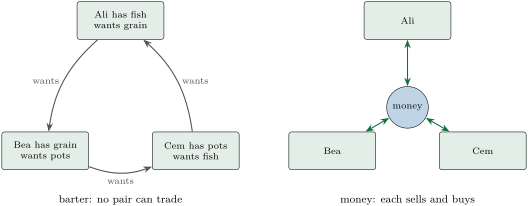
A second difficulty is the number of prices. With 4 goods, barter needs a rate for each pair of goods: fish for grain, fish for pots, fish for cloth, grain for pots, grain for cloth, pots for cloth — 6 rates. With money, 4 prices are enough, one per good. With 10 goods, barter needs 45 rates; money, 10 prices.
11.2 What money does
Definition 11.3 (Money)
Money is anything that is widely accepted in a society as payment for goods and services and for the settling of debts.
Money does three jobs.
Definition 11.4 (Means of payment)
Money is a means of payment: it is given in exchange for goods and services, and accepted because others will accept it in turn.
Definition 11.5 (Unit of account)
Money is a unit of account: prices, wages, debts and budgets are all written in it, so that they can be compared and added.
Definition 11.6 (Store of value)
Money is a store of value: it can be kept today and spent later, and still buy roughly as much.
How it is measured — An account
The chart that opens the chapter counts the adults who answered “yes” in a survey made in each country: do you, alone or with someone else, have an account at a bank or another financial institution, or use a mobile-money service? An account is a record of money that its owner can pay from; the survey does not ask how much is in it or how often it is used.
11.3 What has served as money
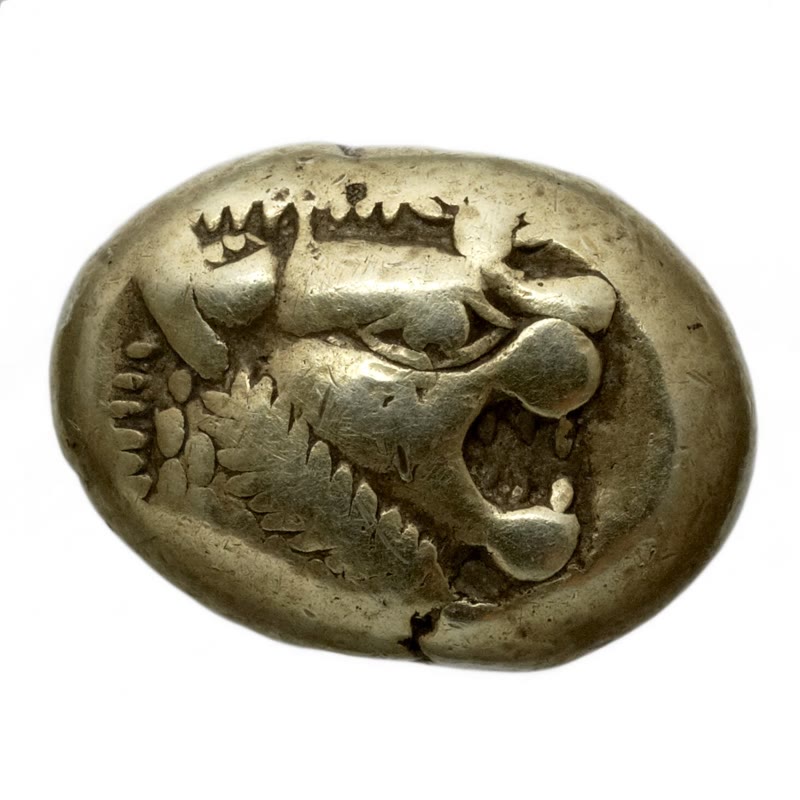
Many things have served as money: cattle, grain, salt, shells, beads, pieces of metal by weight, then coins, notes printed on paper, and today numbers in accounts. Coins were a great step, because a ruler’s mark promised the weight and the metal: nobody had to weigh and test each piece.
On the record — Cigarettes as money
During the Second World War, prisoners in a camp received food and cigarettes in parcels from the Red Cross, among them 25 or 50 cigarettes per man per week. They began to swap food and cigarettes, and cigarettes soon became the camp’s money: prices were written in cigarettes, goods were sold for them, and they were saved. A bread ration cost about 7 cigarettes, rising to 8 before the next issue came. Cigarettes were all alike, kept well and could pay for small or, in packets, large purchases. But cigarettes were also smoked: when parcels stopped coming, the stock of cigarettes shrank, prices in cigarettes fell and trading turned back to barter; when a large delivery arrived, prices shot up. No one had designed this money; the prisoners chose it because it worked (Radford, 1945).
11.4 What makes good money
The cigarettes of the camp show what a good money needs:
- Accepted: everyone takes it, because everyone else does.
- Durable: it does not rot, break or wear out quickly.
- Divisible: it can pay for small and large things.
- Hard to forge: false pieces are rare, so it need not be checked each time.
- Scarce, but not too scarce: its quantity does not jump up or down, so its value stays steady.
Fish fail on durability, cattle on divisibility, cigarettes on steadiness (they were smoked). The notes and accounts of today are not valuable in themselves; they work because they are accepted and their quantity is controlled, as later chapters explain.
Model — Money as a means of exchange
Assumes. Trading is costly without a common good that everyone accepts; people want to save the time spent searching for a double coincidence of wants.
Predicts. One widely accepted, durable and divisible good comes to serve as money; a society that loses its money turns back to barter or adopts another good as money.
Tested. Cigarettes became the money of a prisoner-of-war camp, and trading turned back to barter when they ran short (the record above).
Breaks. Money whose value falls fast stops being a store of value: people then spend it at once or switch to another money (Chapter 18).
11.5 A price is an amount of money
Definition 11.7 (Price)
The price of a good is the amount of money that must be given for one unit of it.
A price compares a good with money, and so, through money, with every other good. If a loaf costs 2 dalens and a shirt 30 dalens, a shirt is worth 15 loaves. If every price and every wage were doubled at once, nothing real would change: a shirt would still be worth 15 loaves and an hour of work would buy as much as before. What matters for a buyer is a price compared with other prices and with income.
11.6 Exercises
Exercise 11.1 ★
Use the opening chart. About what share of adults had an account in Nigeria in 2011, and in 2024?
Solution
Solution of Exercise 11.1.
About in 2011 and about in 2024 (the table gives and ).
Exercise 11.2 ★
A barter market has 4 goods: fish, grain, pots and cloth. (a) List all the pairs of goods that need an exchange rate. How many are there? (b) How many prices are needed with money?
Solution
Solution of Exercise 11.2.
(a) Fish–grain, fish–pots, fish–cloth, grain–pots, grain–cloth, pots–cloth: 6 rates. (b) 4 prices, one per good.
Exercise 11.3 ★
Which job of money is used in each scene? (a) A café writes its prices on a board. (b) A girl puts 5 dalens of her pocket money in a box for the summer. (c) A man pays for his bread.
Exercise 11.4 ★
A shop’s list gives: bread 2 dalens, milk 1.5 dalens, cheese 6 dalens. Write each price in loaves of bread.
Solution
Solution of Exercise 11.4.
Bread loaf; milk loaf; cheese loaves.
Exercise 11.5 ★★
How many barter exchange rates are needed for 10 goods? Explain how you count them.
Solution
Solution of Exercise 11.5.
Each of the 10 goods pairs with the 9 others: ; but this counts every pair twice (fish–grain and grain–fish), so there are rates.
Exercise 11.6 ★★
In an invented camp, a bread ration costs 8 cigarettes and a tin of jam 12 cigarettes. A newcomer measures prices in dalens and knows that one cigarette is worth 0.25 dalen. (a) Write both prices in dalens. (b) How many bread rations is a tin of jam worth? (c) Does the answer to (b) depend on the unit used?
Solution
Solution of Exercise 11.6.
(a) Bread dalens; jam dalens. (b) rations (or ). (c) No: the unit changes both prices in the same proportion.
Exercise 11.7 ★★
An invented money loses half of its value every month: what it buys in one month, it buys only half of the month after. (a) What does a sum that buys 80 loaves today buy after 3 months? (b) Which job of money does it fail? (c) What would people do with their money?
Solution
Solution of Exercise 11.7.
(a) loaves. (b) Store of value. (c) Spend it as soon as they get it, or keep their savings in goods or in another money.
Exercise 11.8 ★★
Use the values in the text. By how many percentage points did the share of adults with an account rise from 2011 to 2024 in Kenya, and in the world?
Solution
Solution of Exercise 11.8.
Kenya: percentage points; the world: percentage points.
Exercise 11.9 ★★
Describe an observation that would contradict the model “Money as a means of exchange”.
Exercise 11.10 ★★★
(a) Complete the table of barter exchange rates for 2, 3, 4, 5 and 6 goods. (b) Find the pattern: how many rates does each extra good add? (c) Use it to find the number of rates for 12 goods.
Solution
Solution of Exercise 11.10.
(a) 2 goods: 1 rate; 3: 3; 4: 6; 5: 10; 6: 15. (b) The new good needs a rate with each of the goods already there: the third good adds 2, the fourth 3, the fifth 4, and so on. (c) From 10 goods (45 rates), the 11th adds 10 and the 12th adds 11: rates.
Exercise 11.11 ★★★
In an invented country, forged coins spread and one coin in four is false. Checking a coin takes a minute. (a) What happens to the time a shopkeeper spends on each sale? (b) What might people start to use instead of coins? (c) Which property of good money has been lost?
Solution
Solution of Exercise 11.11.
(a) It grows: each coin must be checked, a minute per coin, and false coins are refused. (b) Coins of another country, notes or payments from an account, or even goods (barter). (c) Being hard to forge.
Exercise 11.12 ★★★
The opening chart counts adults with an account. Name two questions about how people pay that the chart cannot answer, and say what data would answer one of them.
Solution
Solution of Exercise 11.12.
For example: how often people pay in cash, by card or by phone; how much money the accounts hold; whether the accounts are used at all. A survey in which people write down every payment they make for some days (a payment diary) would answer the first.
11.7 Problem: The Island Market
Problem 11.1
Weekend problem — barter between five traders, shells as money, and the prices after a find of shells
Everything in this problem is invented. On a small island, five traders meet each week. Each has one good and wants another:
| Trader | Has | Wants |
|---|---|---|
| Ana | fish | bread |
| Bo | bread | rope |
| Cy | rope | pots |
| Di | pots | salt |
| Eli | salt | fish |
Part I — Barter.
- Can any two traders barter directly? Check each pair.
- How many barter exchange rates would the 5 goods need?
- Ana could swap her fish for something she does not want, hoping to swap it again. Describe a chain of swaps that brings her bread. How many swaps does it take?
Part II — Shells as money. The islanders agree to use a rare kind of shell as money. The 5 traders hold 100 shells in all. Prices are: fish 4 shells, bread 2, rope 5, pots 8, salt 1.
- How many prices are needed now?
- Ana sells her fish and buys bread. How many shells does she have left over?
- Write the price of a pot in loaves of bread, and the price of rope in units of salt.
- Which jobs of money do the shells do when (a) Ana writes her prices on a slate, (b) Bo keeps 10 shells for the winter?
- Why is it important that the shells are rare and hard to copy?
Part III — A find of shells. A storm throws a bank of the same shells onto the beach. The traders collect 100 more: there are now 200 shells, and the goods are the same.
- If every price changes in proportion to the number of shells, what are the new prices?
- What is the price of a pot in loaves of bread now? Compare with question 6.
- Bo had saved 10 shells for the winter. What could they buy in bread before the storm, and after?
- Who gains and who loses from the find of shells?
Solution
Solution of Problem 11.1.
1. No: in each pair, at most one trader wants what the other has (for example, Bo wants rope, not Ana’s fish). 2. rates. 3. Ana gives fish to Eli for salt, salt to Di for pots, pots to Cy for rope, and rope to Bo for bread: 4 swaps. 4. 5 prices, one per good. 5. She receives 4 shells and pays 2: she has 2 shells left over. 6. A pot is worth loaves; rope is worth units of salt. 7. (a) Unit of account. (b) Store of value. 8. If anyone could find or copy shells, their number would jump, each shell would buy less, and nobody could trust what a shell is worth. 9. Every price doubles: fish 8, bread 4, rope 10, pots 16, salt 2 shells. 10. loaves: the same as in question 6. 11. Before: loaves; after: loaves. 12. Those who collected the new shells gain: they can buy goods with them. Those who had saved shells, like Bo, lose: their shells buy half as much. The goods on the island have not changed.