本书暂未推出简体中文版。现有版本:English。
Middle School Economics · 6–9 年级
23Competition and Monopoly: A First Look
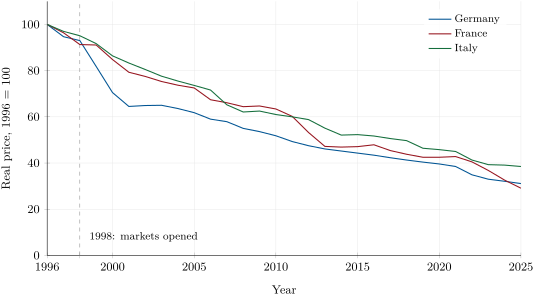
Until 1998, the countries of the European Union were allowed to reserve telephone calls for a single company, often owned by the state. In 1998, other companies had to be let in. In Germany, the real price of telephone services fell by points in 1999 and by in 2000; by 2025 it was (1996 = 100). In France and Italy it fell more slowly at first, then kept falling, to and .
What changes when a market has many sellers instead of one?
You already know
A firm’s profit is its revenue minus its costs; firms enter a market when they expect a profit and leave it after losses (Chapter 15). The market price is the price at which buyers and sellers trade (Chapter 12).
23.1 Many sellers, one seller
Definition 23.1 (Competition)
There is competition in a market when several sellers try to win the same buyers, who can choose between them.
Definition 23.2 (Monopoly)
A monopoly is a market with a single seller of a good that has no close substitute.

23.2 What competition does to the price
When a seller charges much more than its cost, a rival can take its buyers by charging a little less, and still make a profit. The first seller must then lower its price too, or lose its buyers. This goes on as long as a price cut still pays. Competition therefore pushes the price toward the cost of producing the good, including a normal reward for the people who run the firm and lend it money. It also rewards a better product: a seller who offers better coffee, a faster train or a more reliable phone can win buyers without cutting its price.
How it is measured — A real price
A real price is a price divided by a price index of all consumer goods: it says whether a good became cheaper or dearer compared with everything else. In the opening chart, the price index of telephone services is divided by the index of all consumer prices, and the ratio is set to 100 in 1996. A real price of 31 means that a call costs, compared with all other goods, less than a third of what it cost in 1996.
23.3 What a single seller does
A single seller has no rival to fear. It still cannot charge any price it likes: at a higher price, buyers buy less. It chooses the price that brings it the largest profit.
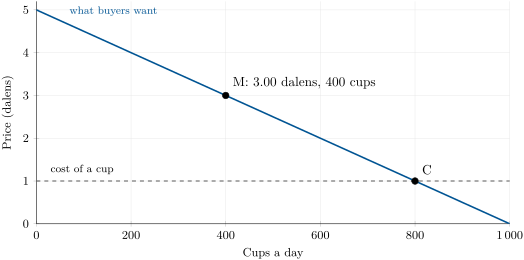
In an invented park, buyers want cups of juice a day at a price of dalens. A cup costs dalen to make. The only stall in the park compares its profit at each price:
| Price (dalens) | 4.00 | 3.50 | 3.00 | 2.50 | 2.00 | 1.50 | 1.00 |
| Cups a day | 200 | 300 | 400 | 500 | 600 | 700 | 800 |
| Profit (dalens) | 600 | 750 | 800 | 750 | 600 | 350 | 0 |
The single stall charges dalens and sells 400 cups. If many stalls compete, the price is pushed down toward the cost of dalen, and 800 cups are sold. The single seller sells half as many cups at three times the price.
23.4 Where a monopoly comes from
Definition 23.3 (Barrier to entry)
A barrier to entry is anything that stops new sellers from entering a market where the existing sellers make a profit.
Definition 23.4 (Patent)
A patent is a right given by law to the inventor of a new product or method: for a fixed number of years, nobody else may make or sell it without the inventor’s permission.
Definition 23.5 (Network effect)
A good has a network effect when each user gains from more people using the same good, as with a telephone network or a messaging service.
Definition 23.6 (Natural monopoly)
A natural monopoly is a market in which one firm can supply all buyers at a lower cost per unit than two or more firms could, usually because the fixed cost is very large (water pipes, railway tracks, electricity lines).
Monopolies come from barriers to entry. A law can reserve a market for one firm, as for telephone calls before 1998. A patent gives a monopoly for some years, which is the reward that pays for the cost of inventing. A network effect can make buyers flock to the seller that already has the most users. A natural monopoly comes from cost: building two sets of water pipes to every house would cost almost twice as much as one.
23.5 The threat of entry
A single seller that charges a high price invites rivals in. When entry is easy, the threat alone can keep its price down: the seller prefers a lower profit for many years to a high profit that attracts a rival. Where entry is blocked, the threat disappears.
Model — Competition and entry
Assumes. Sellers can enter the market freely; buyers compare prices.
Predicts. When a market is opened to entry, the price falls toward the cost; a single seller sells less, at a higher price, than many sellers would.
Tested. Telephone services in Europe after the markets opened in 1998 (opening chart). Medicines in the United States first copied from 2015 to 2017, once their patents ended: with one maker of the copy (a generic), its price was 39 % below the brand’s price before; with two makers, 54 %; with four, 79 %; with six or more, more than 95 % (Conrad and Lutter, 2019).
Breaks. Natural monopolies, where entry would raise costs; network effects, where buyers stay with the largest seller; sellers who agree not to compete (grade 11).
On the record — Opening the telephone market
Before 1998, the countries of the European Union could reserve telephone calls for one company. A 1996 decision of the European Commission (Directive 96/19/EC) required the member states to open voice telephony and their telephone networks to competition by 1 January 1998, with up to five more years for countries with less developed networks. The model predicted that prices would fall toward cost. The real price of telephone services fell in all three countries of the opening chart. Over the same years, the cost of carrying a call also fell, thanks to new technology, so the chart alone does not say how much of the fall came from competition.
23.6 Exercises
Exercise 23.1 ★
Use the opening chart. What was the real price of telephone services in Germany in 2025 (1996 = 100)?
Solution
Solution of Exercise 23.1.
About 31 ().
Exercise 23.2 ★
A seller charges dalens for a good that costs it dalens to make. What is its margin per unit?
Solution
Solution of Exercise 23.2.
dalens per unit.
Exercise 23.3 ★
Use the opening chart. In which years did Germany’s real price fall fastest?
Solution
Solution of Exercise 23.3.
In 1999 and 2000, just after the market opened (from to , then to ).
Exercise 23.4 ★
Use the juice table. Compute the single stall’s revenue at a price of dalens and at dalens.
Solution
Solution of Exercise 23.4.
dalens; dalens.
Exercise 23.5 ★★
A single seller faces this demand; each unit costs it dalens. Find its best price.
| Price (dalens) | 16 | 14 | 12 | 10 | 8 |
| Units sold | 20 | 30 | 40 | 50 | 60 |
Exercise 23.6 ★★
In the market of exercise 5, many sellers can enter, each with the same cost of dalens a unit. If the demand line continues (10 more units for each 2 dalens less), about what price and quantity does competition lead to?
Solution
Solution of Exercise 23.6.
The price is pushed toward the cost, 4 dalens. Continuing the table: at 6 dalens, 70 units; at 4 dalens, 80 units. About 4 dalens and 80 units, twice the single seller’s quantity.
Exercise 23.7 ★★
A medicine sells for 100 dollars a box. Its patent ends and copies appear. Using the figures of the model box, about what price does the copy sell for with one maker? With six or more?
Solution
Solution of Exercise 23.7.
With one maker: about dollars. With six or more: less than 5 dollars (more than below 100).
Exercise 23.8 ★★
In France, the real price of telephone services fell from 100 in 1996 to in 2025. Compute the change in percent.
Solution
Solution of Exercise 23.8.
: a fall of .
Exercise 23.9 ★★
A second bus company starts running on a route, but the fares do not change. Give two possible explanations, one of which does not fit the model “Competition and entry”.
Solution
Solution of Exercise 23.9.
The fare may already have been close to the cost, so there was nothing to cut (this fits the model). Or the two companies may have agreed not to compete on fares (this does not fit: the model assumes sellers compete). A third possibility: they compete on service instead, with more buses or newer ones.
Exercise 23.10 ★★★
A town uses million cubic metres of water a year. A network of pipes costs million dalens a year; each cubic metre then costs dalen to deliver. (a) Compute the cost per cubic metre if one firm supplies the whole town. (b) If two firms each build their own network and each supplies half the town, compute the cost per cubic metre.
Solution
Solution of Exercise 23.10.
(a) dalen per cubic metre. (b) Each firm: dalens per cubic metre. One firm supplies the water more cheaply: a natural monopoly.
Exercise 23.11 ★★★
A messaging service is free and has 90 % of the users in a country. A new service is just as good. Explain why it may still fail to win users.
Solution
Solution of Exercise 23.11.
A messaging service is useful because of the people one can reach with it (a network effect). A user who moves alone to the new service can reach almost nobody, so each user waits for the others; the large service keeps its users even if the new one is as good.
Exercise 23.12 ★★★
A telephone call in 2025 often comes with video, messages and data, which a call of 1996 did not. What does this mean for reading the opening chart?
Solution
Solution of Exercise 23.12.
What is bought for the price has changed: a “call” of 2025 includes more. If the price index does not fully count this, the real price of the same service has fallen even more than the chart shows; if it counts it, part of the fall comes from better products, not only from lower prices for the same thing. Either way, the chart compares services that are not exactly the same.
23.7 Problem: The Ferry to Kestria
Problem 23.1
Weekend problem — one ferry company, the threat of a rival, and two companies
Everything in this problem is invented. A ferry crosses from Brenland to Kestria. At a fare of dalens, passengers a day cross. Each passenger costs a company dalens, and each company running a ferry pays dalens a day whatever the number of passengers.
Part I — One company.
- Compute the number of passengers and the revenue at fares of and dalens.
- Compute the company’s profit at fares of , , , , and dalens.
- Which fare gives the largest profit? How many passengers cross then?
- Why does the company not lower its fare to dalens, which would carry more passengers?
Part II — The threat of a rival. A second company could start a ferry. If it did, both would charge the same fare and share the passengers equally.
- If the fare stayed at dalens, what would each company’s profit be? Would the rival enter?
- At a fare of dalens, what would each company’s profit be? Would a rival enter?
- The first company charges dalens to keep the rival away. Compute its passengers and its profit, alone.
- Compare the fare, the passengers and the profit with Part I.
Part III — Two companies. Instead, the second company enters while the fare is dalens.
- What is each company’s profit at a fare of dalens?
- One company cuts its fare to dalens and the other stays at : all passengers take the cheaper ferry. Compute the profit of the company that cut its fare.
- The two companies keep cutting by dalens, each time matching each other. Compute each company’s profit when both charge , and dalens.
- They stop at the lowest of these fares at which neither loses money. What is the fare, and how many passengers cross in all?
Solution
Solution of Problem 23.1.
1. At 40: passengers, revenue dalens. At 30: 200 passengers, revenue dalens. 2. Profit : at 40, ; at 35, ; at 30, ; at 25, ; at 20, ; at 15, dalens. 3. 30 dalens, with 200 passengers. 4. At 20 dalens it would carry 300 passengers but earn dalens instead of . 5. Each carries 100 passengers: dalens. The rival would enter. 6. Each carries 175: dalens, a loss. No rival would enter. 7. 350 passengers; profit dalens. 8. The fare is 15 instead of 30 dalens, 350 passengers cross instead of 200, and the profit is 750 instead of dalens: the threat alone lowers the fare. 9. dalens each. 10. 250 passengers: dalens. 11. At 25: 125 passengers each, dalens. At 20: 150 each, dalens. At 15: 175 each, dalens. 12. 20 dalens; 300 passengers in all.