यह किताब अभी हिन्दी में उपलब्ध नहीं है। संस्करण: English।
Middle School Economics · कक्षा 6–9
26Price Controls, Taxes and Subsidies
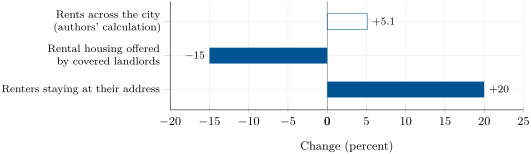
A rent control caps the rent that landlords may charge sitting tenants. In San Francisco, when the 1994 rule extended it to more buildings, the tenants of those buildings became nearly more likely to stay at their address: the rule protected them from rent rises. The landlords of the same buildings reduced the housing they offered for rent by . The authors then calculate that, with fewer flats for rent, rents across the city were about higher. That number is not measured like the other two: it comes from the cut and an assumed response of renters to rents.
Governments often set prices, or tax and subsidise goods, to help some buyers or sellers. The supply and demand lines of Chapter 24 predict what follows, and who gains.
You already know
At a price where the quantity demanded is larger than the quantity supplied there is a shortage; where it is smaller, a market surplus (Chapter 12). With and , the equilibrium price is (Chapter 24). The elasticity measures how much buyers respond to the price (Chapter 25).
All the numbers of this chapter use the worked example of Chapter 24: demand , supply , equilibrium price 10 dalens and quantity 80 units.
26.1 A maximum price
Definition 26.1 (Price ceiling)
A price ceiling is a maximum price set by law: sellers may not charge more.
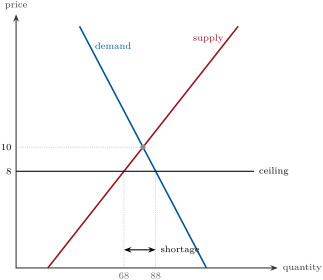
A ceiling of 8 dalens, below the equilibrium price of 10, gives a quantity demanded of units and a quantity supplied of . Only 68 units are sold, and 20 units that buyers want at that price are not available: a shortage of 20.
Model — A price ceiling
Assumes. Many buyers and sellers; a legal maximum price below the equilibrium price.
Predicts. A shortage equal to at the ceiling; fewer units sold than without the ceiling; the goods go to whoever comes first, knows the seller or accepts a lower quality; sellers spend less on upkeep.
Tested. Rent control in San Francisco (opening chart): the covered landlords offered less housing for rent.
Breaks. A ceiling above the equilibrium price has no effect; trading at higher prices outside the law (a black market) reduces the shortage but not the number of units produced.
26.2 A minimum price
Definition 26.2 (Price floor)
A price floor is a minimum price set by law: buyers may not pay less.
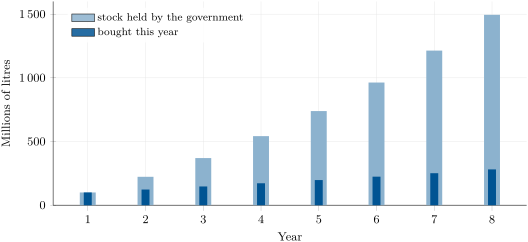
A floor of 12 dalens, above the equilibrium, gives a quantity demanded of and a quantity supplied of : 20 units are offered and not bought. Governments that set a floor for a farm product often buy the unsold quantity themselves, and the stock grows year after year.
26.3 A tax per unit
Definition 26.3 (Tax per unit)
A tax per unit is a fixed amount of money paid to the government on each unit of a good sold.
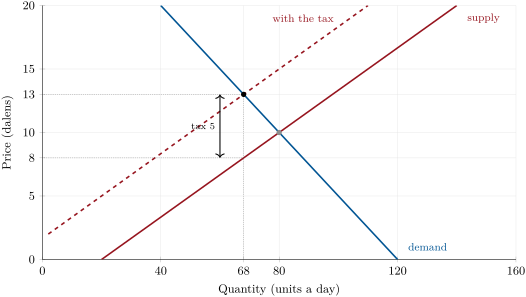
Suppose sellers must pay 5 dalens on each unit. When buyers pay a price , sellers keep , and they offer what they used to offer at that price: . The new equilibrium is
with units sold. Buyers pay 13 dalens, 3 more than before; sellers keep dalens, 2 less than before. The government collects dalens.
26.4 Who bears the tax
The tax is 5 dalens, but buyers pay only 3 more and sellers keep 2 less: the burden is shared. With and , a tax of per unit raises the buyers’ price by , and lowers the price kept by sellers by . Here : buyers bear three fifths of the tax. Whoever responds less to the price bears more of the tax: buyers who cannot do without the good, or sellers who cannot produce less. It makes no difference whether the law says that buyers or sellers hand the tax to the government.
Model — A tax per unit
Assumes. Many buyers and sellers; a fixed tax on each unit sold.
Predicts. The price paid by buyers rises by a part of the tax and the price kept by sellers falls by the rest; the shares are set by the slopes, for buyers; fewer units are sold.
Tested. When Germany cut its fuel taxes for three months from 1 June 2022, the whole cut reached the price paid at the pump for gasoline, and at least part of it for diesel (Dovern et al., 2023). In the model, buyers get the whole change when sellers can offer more at almost the same cost (a very large ).
Breaks. With few sellers, who may keep part of a tax cut or pass on more than a tax rise; when the tax is evaded.
26.5 A subsidy
Definition 26.4 (Subsidy)
A subsidy is an amount of money that a government pays for each unit of a good produced or sold: a tax with a minus sign.
With a subsidy of 5 dalens a unit paid to sellers, sellers receive when buyers pay : . Then gives and units. Buyers pay 3 dalens less, sellers receive , 2 more; the subsidy costs the government dalens. Unlike a ceiling, a subsidy lowers the price without a shortage, and someone pays for it through taxes.
On the record — A fuel tax cut
In 2022, Germany lowered its tax on fuel for three months, June, July and August. A study comparing German fuel prices with those of similar countries without the cut found that for gasoline the whole tax cut was passed on to buyers; for diesel, at least part of it was, and less in August than in June (Dovern et al., 2023). For gasoline, the tax cut worked like a subsidy of the same size paid to buyers.
26.6 Exercises
Exercise 26.1 ★
Use the opening chart. By what percentage did the covered landlords reduce the housing they offered for rent? What rise in rents across the city do the authors calculate, and how was it obtained?
Solution
Solution of Exercise 26.1.
They reduced it by . The authors calculate that rents across the city were about higher; this is a calculation from their estimates (the supply cut and an assumed response of renters), not a measured effect.
Exercise 26.2 ★
In the worked example, a ceiling is set at 9 dalens. Compute the shortage.
Exercise 26.3 ★
In the worked example, a floor is set at 11 dalens. Compute the unsold quantity.
Solution
Solution of Exercise 26.3.
Demanded , supplied : 10 units unsold.
Exercise 26.4 ★
With a tax of 5 dalens a unit, buyers pay 13 dalens. How much does the seller keep on each unit?
Solution
Solution of Exercise 26.4.
dalens.
Exercise 26.5 ★★
In the worked example, the tax is 10 dalens a unit. Compute the price paid by buyers, the price kept by sellers, and the quantity sold.
Solution
Solution of Exercise 26.5.
. Then , so : buyers pay 16 dalens, sellers keep dalens, and units are sold.
Exercise 26.6 ★★
Compute the government’s revenue from the tax of exercise 5.
Solution
Solution of Exercise 26.6.
dalens.
Exercise 26.7 ★★
In the worked example, a ceiling is set at 12 dalens. What happens to the price and the quantity sold?
Solution
Solution of Exercise 26.7.
Nothing: the ceiling is above the equilibrium price of 10 dalens, so the price stays at 10 and 80 units are sold.
Exercise 26.8 ★★
In the worked example, a subsidy of 2 dalens a unit is paid to sellers. Compute the price paid by buyers, the amount received by sellers, the quantity and the cost of the subsidy.
Solution
Solution of Exercise 26.8.
. Then , so : buyers pay dalens, sellers receive , and units are sold. Cost: dalens.
Exercise 26.9 ★★
A town sets a maximum rent, but a year later no flats are missing: anyone who looks for a flat finds one at the legal rent. Give two possible explanations.
Solution
Solution of Exercise 26.9.
For example: the maximum rent is above the rent the market would set anyway, so it changes nothing; or tenants pay extra in other ways that the law does not see (a fee, a payment for furniture), so the real rent is higher than the legal one.
Exercise 26.10 ★★★
Demand is and supply . Compute the equilibrium, then the prices paid by buyers and kept by sellers with a tax of 5 dalens a unit. Who bears more of the tax?
Exercise 26.11 ★★★
Demand is . With a tax of 5 dalens a unit, by how much does the buyers’ price rise when supply is , and when supply is (sellers respond little to the price)?
Exercise 26.12 ★★★
The study of the opening chart compares the buildings that rent control covered from 1994 with similar buildings that it did not cover. Why is this better than comparing the covered buildings before and after 1994?
Solution
Solution of Exercise 26.12.
Many other things changed in the city after 1994: incomes, the number of people who wanted to live there, rents everywhere. A before-and-after comparison would mix all of them with the effect of rent control. Similar buildings that were not covered went through the same changes, so the difference between the two groups is due to rent control.
26.7 Problem: Bread in a Hard Winter
Problem 26.1
Weekend problem — Brenmoor’s bread market in winter, a maximum price and its shortage, and a subsidy per loaf instead
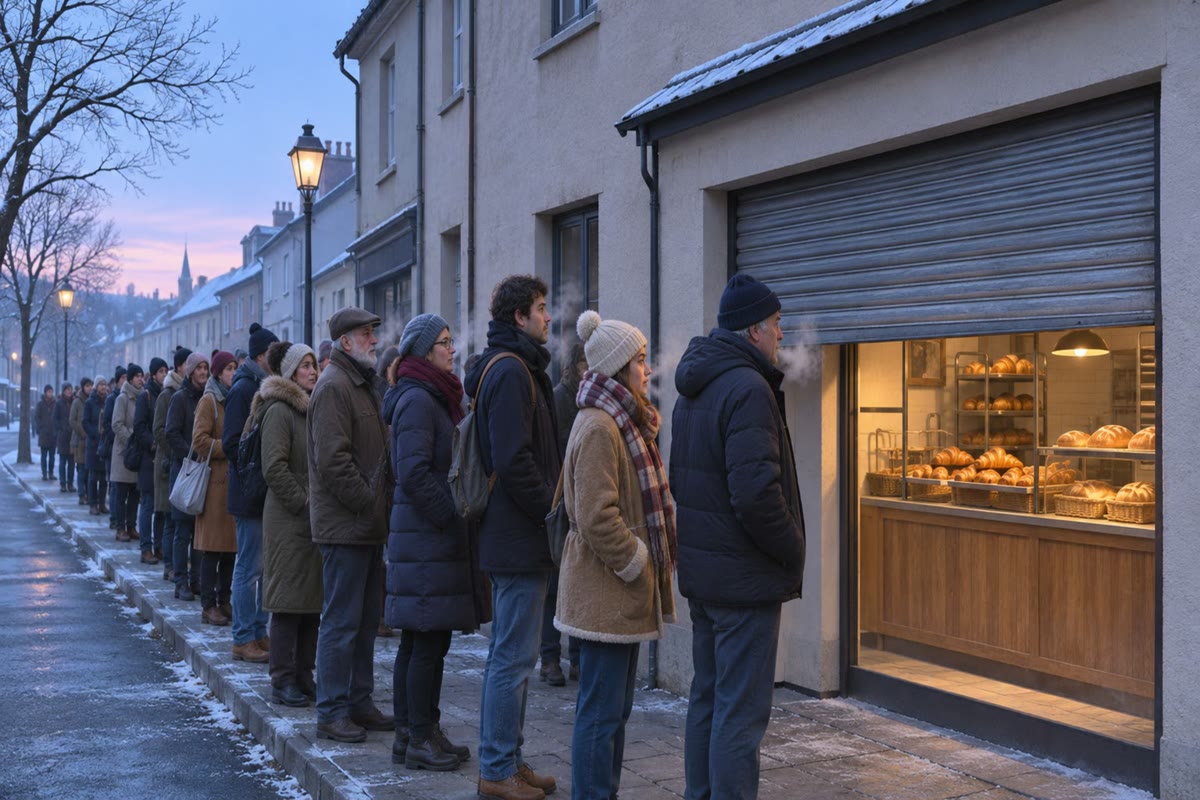
Everything in this problem is invented. In a hard winter, flour becomes dear. Brenmoor’s bakers offer loaves a day at a price of dalens, and the town’s families want loaves.
Part I — The market.
- Compute the quantity demanded at 2 and at 3 dalens.
- Compute the quantity supplied at 2 and at 3 dalens.
- Find the equilibrium price and quantity.
- Compute the bakers’ daily revenue at the equilibrium.
Part II — A maximum price. The town sets a maximum price of dalens a loaf.
- Compute the quantities demanded and supplied, and the shortage.
- How many loaves are sold each day?
- At what price would families want only the loaves that are sold? (This is about the price a black market could reach.)
- Name two other things that may happen while the maximum price lasts.
Part III — A subsidy instead. The town removes the maximum price and pays bakers a subsidy per loaf, so that families pay dalens and no loaf is missing.
- How many loaves do families want at dalens?
- What price must bakers receive to offer that many loaves?
- What subsidy per loaf is needed?
- What does the subsidy cost the town each day?
- Compare with Part I: the price paid by families, the amount received by bakers, the number of loaves. Who pays for the difference?
Solution
Solution of Problem 26.1.
1. At 2 dalens: loaves; at 3: . 2. At 2 dalens: loaves; at 3: . 3. , so : 3 dalens and loaves. 4. dalens. 5. Demanded ; supplied ; shortage loaves. 6. loaves, the quantity bakers offer. 7. gives dalens. 8. For example: queues before dawn; smaller or poorer loaves; bread kept for regular customers; some bakers closing for the winter. 9. loaves. 10. gives dalens. 11. dalen per loaf. 12. dalens a day. 13. Families pay instead of 3 dalens; bakers receive instead of 3; loaves are baked instead of . The town’s taxpayers pay the difference, dalens a day.