यह किताब अभी हिन्दी में उपलब्ध नहीं है। संस्करण: English।
Middle School Economics · कक्षा 6–9
9Specialisation and the Division of Labour
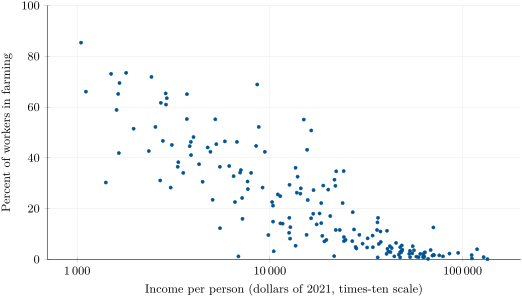
In the poorest countries, most workers are farmers: of the workers of Burundi in 2024, in Ethiopia. In the richest, almost none are: in the United States, in the United Kingdom. Among the countries with an income per person below dollars, the middle value is about ; above dollars, . The dots fall from the upper left to the lower right almost as one curve.
In a poor village, most families grow their own food and make most of what they use. In a rich country, a farmer grows one or two crops and buys everything else, and almost everyone else does one job and buys food from a few farmers. This chapter explains why doing one thing and exchanging makes people more productive.
You already know
The three sectors of employment and the move from farms to services were seen in Chapter 5; trade between countries in Chapter 7.
9.1 Doing everything yourself
Imagine a family on a farm far from any town. It grows its grain and vegetables, keeps a cow and some hens, cuts its wood, builds and mends its house, sews its clothes and makes its tools. Each member does a little of everything, and does each task only now and then. Such a family can survive, but it produces little: every task is done by someone who rarely does it, with simple tools, and much time goes in moving from one task to the next.
Definition 9.1 (Specialisation)
A person, a firm, a region or a country specialises when it concentrates on producing a few goods or services, or on a few tasks, and obtains the rest from others.
9.2 Splitting the task
Definition 9.2 (Division of labour)
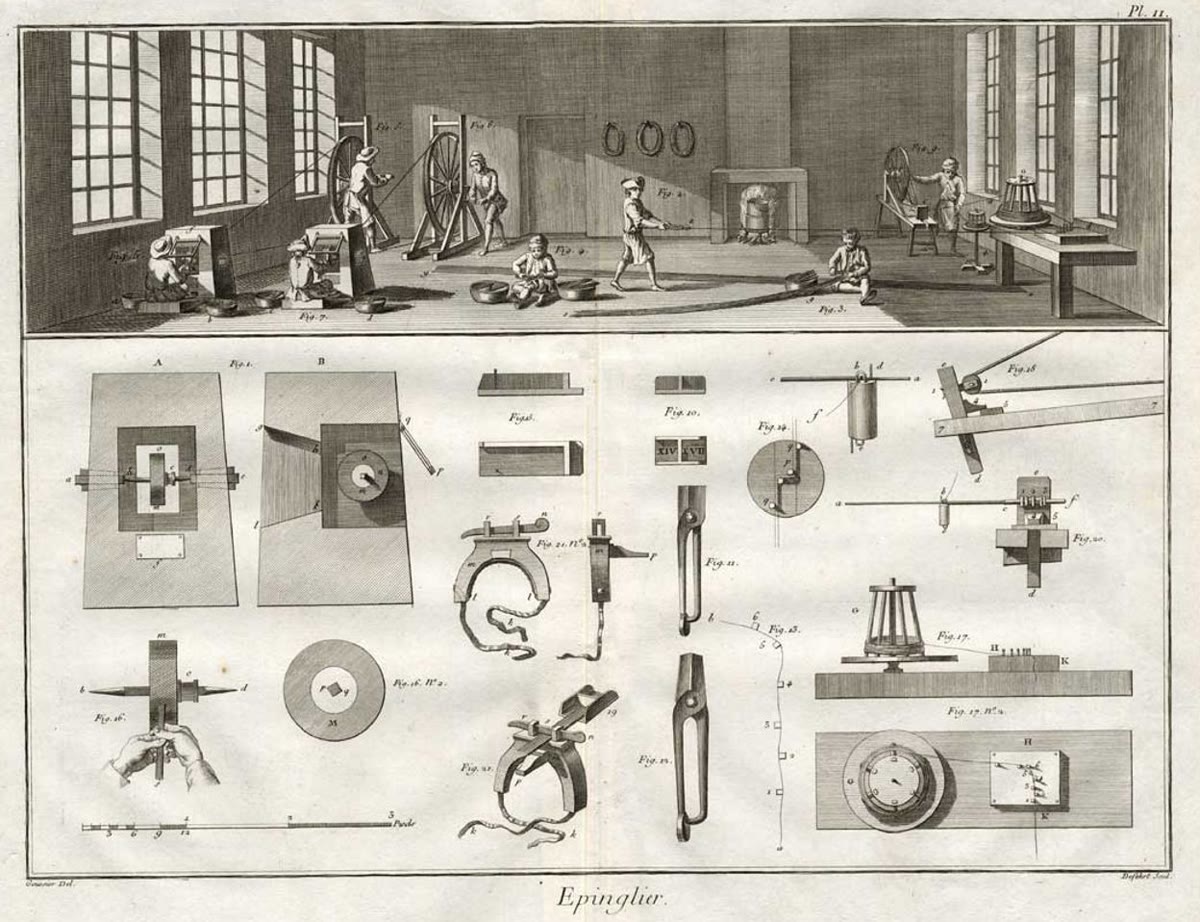
The division of labour is the splitting of the making of one good into separate tasks, each done by a different worker.
Definition 9.3 (Output per worker)
Output per worker is the quantity produced in a given time divided by the number of workers who produced it:
How it is measured — Output per worker
For one workshop, output per worker is easy to count: toys made in a day, divided by the workers. For a whole country, the goods are of thousands of kinds, so they are added up by their value, as in Chapter 17. Output per hour worked is often better than output per worker, because workers in different countries work different numbers of hours (Chapter 8).
Example 9.4
An invented workshop makes wooden toy trains. Making one train takes four steps: cutting the pieces (6 minutes), drilling them (4 minutes), assembling (8 minutes) and painting (6 minutes). A worker who does everything also loses 2 minutes each time she changes task — putting away one tool, taking another — three changes per train.
Each worker makes whole trains. One train takes minutes. In a working day of 8 hours, or 480 minutes, a worker makes trains. Four workers make 64 trains: 16 trains per worker.
Each worker does one step. Each now repeats one task all day; with practice, cutting takes 5 minutes, drilling 4, assembling 6 and painting 5, and no time is lost changing task. Each worker passes the piece to the next. The line can go no faster than its slowest station, assembling: one train every 6 minutes, so trains a day, or trains per worker. Output per worker rose from 16 to 20 trains, by a quarter, with the same workers, the same tools and the same hours.

9.3 Why it works: practice, tools, saved time
The example shows three reasons why the division of labour raises output per worker.
- Practice. A worker who does one task a hundred times a day becomes faster and makes fewer mistakes.
- Saved time. No time is lost moving from one task, one tool or one place to the next.
- Tools. When a task is done all day, it pays to build a special tool or machine for it, which would be wasted on a task done once a week.
9.4 Specialists need to exchange
Definition 9.5 (Exchange)
An exchange is a voluntary transfer in which two sides each give something to the other: goods for goods, goods for money, or work for money.
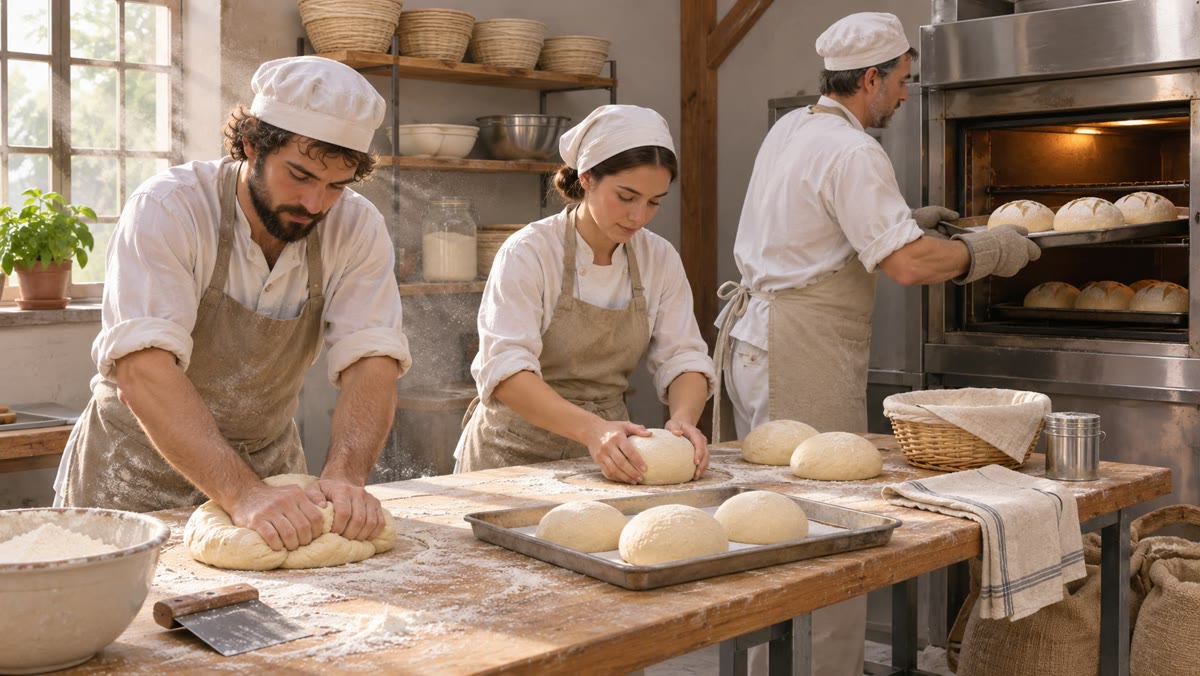
A worker who paints toy trains all day cannot eat trains. Specialisation works only if the specialists can exchange what they make for what they need: the painter is paid a wage and buys bread, the baker sells bread and buys shoes. Money makes this easy, because a baker who wants shoes does not have to find a shoemaker who wants bread.
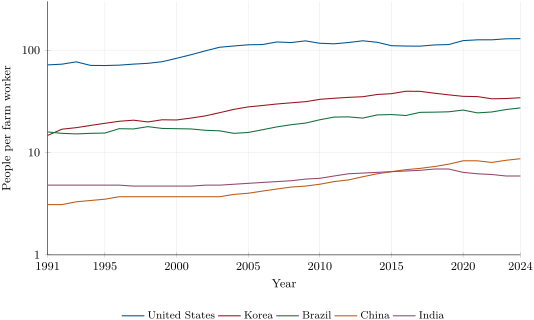
The chart below follows the farmers of five countries: for each farm worker, how many people live in the country. In the United States, there were people per farm worker in 1991 and in 2024; in China, and then ; in India, and then . The number does not say how many people a farmer feeds, because countries also import and export food. It says how few people are left on the farms when the others specialise in other work.
9.5 Bigger markets, finer jobs
A village of 200 people cannot keep a full-time shoemaker busy: it needs a few pairs of shoes a month. The village cobbler is also a farmer. A town of 20 000 people supports several shoemakers, a shop selling only shoes, and perhaps a workshop that makes only soles. A country of millions supports factories that make only shoe laces. The larger the market, the finer the division of labour can be.
Model — Specialisation and the size of the market
Assumes. The making of a good can be split into tasks; workers get faster by repeating a task; goods can be exchanged at a low cost.
Predicts. Output per worker rises as the division of labour gets finer; a larger market (more buyers within reach) supports more distinct jobs; as output per worker in farming rises, the share of workers on farms falls.
Tested. Across countries, the share of workers in farming falls steadily as income rises (the opening chart); within countries, the people per farm worker rose in all five countries of the chart above.
Breaks. Tasks that cannot be split (a doctor’s diagnosis, a teacher’s lesson) or that depend on the whole being seen by one person; work so repetitive that attention, and with it quality, falls; markets that are cut off, because transport is dear, a border is closed or a war breaks out.
9.6 Exercises
Exercise 9.1 ★
Use the values in the text. What share of workers were in farming in 2024 in Ethiopia, and in the United States?
Solution
Solution of Exercise 9.1.
Ethiopia , the United States .
Exercise 9.2 ★
One worker makes 12 chairs a week. A team of four workers who split the work makes 60 chairs a week. Compute output per worker in each case.
Solution
Solution of Exercise 9.2.
Alone: 12 chairs per worker a week. Team: chairs per worker a week.
Exercise 9.3 ★
A tailor makes a shirt in five steps. Each time she changes step she loses 3 minutes. (a) How many minutes does she lose per shirt? (b) In a week she makes 40 shirts. How many hours does she lose in all?
Solution
Solution of Exercise 9.3.
(a) Five steps mean four changes: minutes per shirt. (b) minutes, which is hours.
Exercise 9.4 ★
Use the values in the text. How many people were there per farm worker in 2024 in the United States, and in China?
Solution
Solution of Exercise 9.4.
The United States , China people per farm worker.
Exercise 9.5 ★★
A one-person workshop makes stools. Cutting takes 10 minutes, assembling 15 and varnishing 5, plus 5 minutes lost at each of two changes of task. (a) How many stools does one worker make in 8 hours? (b) Three workers split the work; with practice the steps take 8, 12 and 4 minutes, and nobody changes task. How many stools does the line make in 8 hours? (c) Compute output per worker before and after.
Solution
Solution of Exercise 9.5.
(a) minutes per stool; stools. (b) The slowest step takes 12 minutes: stools. (c) Before: 12 stools per worker; after: stools per worker.
Exercise 9.6 ★★
In an invented village of 200 people, each person buys one pair of shoes a year. A full-time shoemaker makes 250 pairs a year. (a) Can the village keep a full-time shoemaker busy? (b) How many people must a town have to keep four full-time shoemakers busy?
Solution
Solution of Exercise 9.6.
(a) No: the village needs 200 pairs a year, less than the 250 a full-time shoemaker makes. (b) pairs a year, so a town of people.
Exercise 9.7 ★★
A road opens between a town and a city, and the shoemakers of the town can now sell to twice as many buyers. According to the model, what happens to the number of different jobs in the town’s shoe trade: more, fewer or the same? Can the model say by how much?
Solution
Solution of Exercise 9.7.
The model predicts more distinct jobs: some tasks that were too small to fill a full-time job (making only soles, only repairing) now are. It gives only the direction: it does not say how many new kinds of job appear, and nothing says that a doubled market doubles them.
Exercise 9.8 ★★
The share of workers in farming was in China in 1991 and in 2024. In Korea, it was and . (a) By how many percentage points did it fall in each country? (b) In which country did it fall by the larger number of times?
Solution
Solution of Exercise 9.8.
(a) China: percentage points; Korea: percentage points. (b) China: times; Korea: times. Korea’s share fell by the larger number of times, although China’s fell by more points.
Exercise 9.9 ★★
What observation in a workshop would contradict the model “Specialisation and the size of the market”? Describe it with numbers.
Solution
Solution of Exercise 9.9.
For example: four workers who each make whole toys make 16 a day each, 64 in all; after the work is split into four steps, with the same tools and hours, the line makes only 48 a day, 12 per worker.
Exercise 9.10 ★★★
A line has four stations taking 3, 5, 4 and 3 minutes per piece. (a) How many pieces does the line make in a 7-hour day? (b) Which station is the bottleneck? (c) A fifth worker is hired to help at the bottleneck, which now takes minutes. How many pieces does the line make now, and what is the output per worker before and after?
Solution
Solution of Exercise 9.10.
(a) The slowest station takes 5 minutes: pieces in 7 hours, or 420 minutes. (b) The second station. (c) The slowest station is now the third, at 4 minutes: pieces. Output per worker: before , after : unchanged, because the new bottleneck limits the gain.
Exercise 9.11 ★★★
A storm cuts the only road between a valley and the rest of the country for a year. Using the model, predict what happens to the jobs in the valley and to output per worker. Explain each step.
Solution
Solution of Exercise 9.11.
The valley’s producers can sell only inside the valley: the market becomes smaller. Specialists whose work needed outside buyers lose them, so some jobs disappear and people take up several tasks again (a little farming, a little building). With less practice, fewer special tools and more time lost between tasks, output per worker falls.
Exercise 9.12 ★★★
Suppose that a country has a low share of workers in farming but also a low income per person. (a) Where would it be on the opening chart? (b) Would that contradict the model? What else could explain it?
Solution
Solution of Exercise 9.12.
(a) In the lower left, far below the curve. (b) One such country does not overturn the model, but it must be explained. Perhaps its farm workers were counted badly; or its people left the farms for poorly paid work in towns, or for no work at all, rather than because farms became more productive; or it imports its food with the income from one export, such as oil.
9.7 Problem: The Bicycle Workshop of Brenmoor
Problem 9.1
Weekend problem — one worker building whole bicycles, four workers splitting the job, and a doubled market
Everything in this problem is invented. A workshop in Brenmoor, the capital of Brenland, builds bicycles. The work has four steps: the frame (70 minutes), the wheels (50 minutes), the gears and brakes (60 minutes) and the final check (45 minutes). The working day lasts 8 hours.
Part I — One worker builds whole bicycles. A worker who builds whole bicycles also loses 5 minutes at each of the three changes of step.
- How long does one bicycle take this worker?
- How many bicycles does one worker build in a 5-day week?
- The workshop has four such workers. How many bicycles does it build in a week?
Part II — Four workers split the job. Each worker now does one step all day. With practice, the frame takes 48 minutes, the wheels 30, the gears and brakes 40 and the check 24, and no time is lost changing step.
- Which step is the bottleneck? How many bicycles does the line build in a day, and in a week?
- Compute output per worker per week before and after the split, and the rate of change in percent.
- The worker at the check is busy only part of the day. How many minutes a day is she busy?
- Give two reasons why each step became faster.
Part III — Selling to Kestria. A new trade agreement lets the workshop sell to Kestria too, and it can sell twice as many bicycles as before. It splits the work further: eight workers, two on each step, with the frame now taking 40 minutes per worker per bicycle, the wheels 24, the gears and brakes 32 and the check 20.
- With two workers on each step, how many minutes does each step need per bicycle on the line? (Two workers each taking 40 minutes per frame finish a frame every 20 minutes.)
- How many bicycles does the line build in a week now?
- Compute output per worker per week.
- How many workers did the workshop hire, and by what percent did output per worker rise compared with Part II?
- Can the workshop sell all it builds, if it could sell twice as many as in Part II? Explain.
Solution
Solution of Problem 9.1.
1. minutes, or 4 hours. 2. bicycles a day, so a week. 3. bicycles a week. 4. The frame, at 48 minutes. bicycles a day, 50 a week. 5. Before: 10 bicycles per worker per week; after: . The rate of change is , a rise of . 6. minutes a day, half of the day. 7. For example: practice (each worker repeats one step all day) and no time lost changing step; special tools for each step could also help. 8. Frame minutes; wheels ; gears and brakes ; check minutes. 9. The slowest step is the frame, one bicycle every 20 minutes: a day, a week. 10. bicycles per worker per week. 11. It hired workers. Output per worker rose from to 15: , a rise of . 12. No: it can sell bicycles a week but builds 120. To sell them all it needs still more buyers; otherwise it builds only 100, and output per worker falls back to . The size of the market limits how far the division of labour pays.