本书暂未推出简体中文版。现有版本:English。
Middle School Economics · 6–9 年级
27International Trade
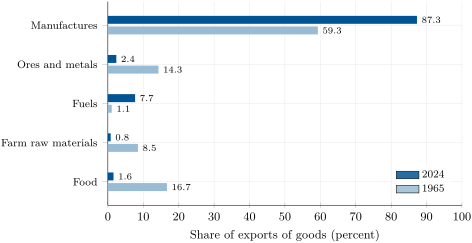
In 1965, food, farm raw materials and ores made up two fifths of what South Korea sold to other countries. By 2024, manufactured goods were of its exports, and food was . A country’s exports are not fixed by its soil: they change as its workers, machines and skills change.
You already know
A country has a comparative advantage in a good when its opportunity cost of that good is lower than the other country’s; both gain when each makes more of the good in which it has its comparative advantage and they trade (Chapter 10). Exports are goods and services sold to other countries, imports those bought from them (Chapter 7). With supply and demand lines one finds a price and the quantities bought and sold (Chapter 24).
27.1 Comparative advantage between countries
In Chapter 10, a worker in Brenland needs 4 hours for a roll of cloth and 2 hours for a sack of grain; in Kestria, 6 hours and 12 hours. Kestria takes longer for both goods, yet it gains from trade: a roll of cloth costs it half a sack of grain, against two sacks in Brenland. Kestria has the comparative advantage in cloth, Brenland in grain.
Comparative advantage is not given once and for all. A country whose workers have little schooling and few machines has its lowest opportunity costs in goods made with land and hands; as its workers learn more and its firms invest, its lowest opportunity costs can move to manufactured goods. That is one way to read the opening chart, but the chart shows the change, not its causes.
27.2 Exports, imports and the balance
Definition 27.1 (Trade balance)
The trade balance of a country over a year is the value of its exports minus the value of its imports.
Definition 27.2 (Trade surplus)
A country has a trade surplus when its trade balance is positive: it sells more to other countries than it buys from them.
Definition 27.3 (Trade deficit)
A country has a trade deficit when its trade balance is negative: it buys more from other countries than it sells to them.
A deficit is not a loss, as a household’s shopping is not a loss: the country gets goods for its money. A country with a deficit pays for the difference by borrowing from abroad or by selling assets to foreigners; a country with a surplus lends or buys assets abroad.
How it is measured — The trade balance
Customs offices record the goods that cross the border and their value; surveys of firms add services, such as transport, tourism and banking. In 2024 Brenland exported 125,104 million dalens of goods and services and imported 126,420 million: a deficit of 1,316 million. In 2025 it had a surplus of 1,113 million. A country can have a surplus with one partner and a deficit with another: the balance that matters for borrowing is the total.
27.3 What countries sell
Countries often sell each other the same kinds of goods: cars go both ways between countries that both make cars, because each firm makes its own models. Countries also sell each other parts: a good may cross several borders before it is finished.
People cross borders too. Workers who move abroad often send money home to their families. In 2024 such money was of the value of all that Tajikistan produced, in the Philippines and in Mexico, against for the world as a whole.
27.4 A tariff
Definition 27.4 (Tariff)
A tariff is a tax on imported goods.
Definition 27.5 (Import quota)
An import quota is a legal limit on the quantity of a good that may be imported.
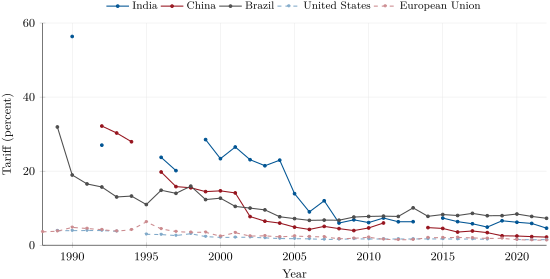
India’s average tariff was in 1990 and in 2022; China’s in 1992 and in 2022. In the United States and the European Union, tariffs were already low in 1990.
Take Brenland’s market for cloth, a small part of the world market: whatever Brenland buys, the world price stays at 6 dalens a metre. Brenland’s buyers want thousand metres a year and its weavers offer . Without trade the price would be 11 dalens, where . With trade, the price at home is the world price: buyers want 70, weavers make 20, and 50 are imported.
With a tariff of 2 dalens a metre, an imported metre costs dalens at home, and Brenland’s weavers can sell at 8 too. Buyers want , weavers make , and imports fall to 30. The state collects thousand dalens.
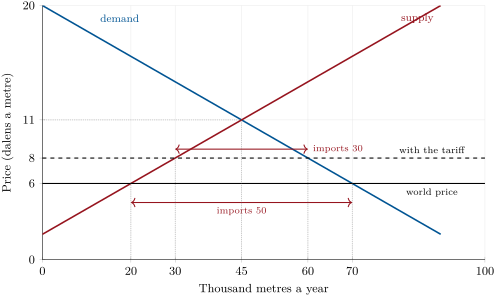
Who gains and who loses? Buyers pay 2 dalens more on each of the 60 thousand metres they still buy: 120 thousand dalens a year. Of that, 60 go to the state and to Brenland’s weavers. Every dalen that buyers pay extra on those metres goes to someone at home. But the tariff also costs something that nobody receives: buyers give up 10 thousand metres they would have bought at 6 dalens, and weavers make 10 thousand more metres at a cost above 6 dalens, when the same cloth could be bought abroad for 6.
Model — A tariff in a small country
Assumes. The country’s buyers are too few to move the world price; many sellers at home and abroad.
Predicts. The home price rises by the tariff; imports fall; home producers sell more and at a higher price; the state collects revenue; home buyers lose more than producers and the state gain.
Tested. Consistent with it: after the 2018 United States tariffs on imported washing machines, the home price of washers rose by nearly (Flaaen, Hortaçsu and Tintelnot, 2020). It is not a test of the small-country model: the United States is a large buyer, the case the next field sets aside. A test would need a small country’s tariff, with its rate set beside the rise in the home price.
Breaks. A large country’s buyers can push down the world price, so part of the tariff falls on foreign sellers; other countries may answer with tariffs of their own; sellers of related goods may raise their prices too.
On the record — Washing machines, 2018
In 2018 the United States put tariffs on imported washing machines. A study found that the price of washers rose by nearly , and that the price of dryers, which were not taxed and are often bought together with a washer, rose by about as much (Flaaen, Hortaçsu and Tintelnot, 2020). The buyers of dryers paid more too, although the tariff did not name dryers.
27.5 Distance
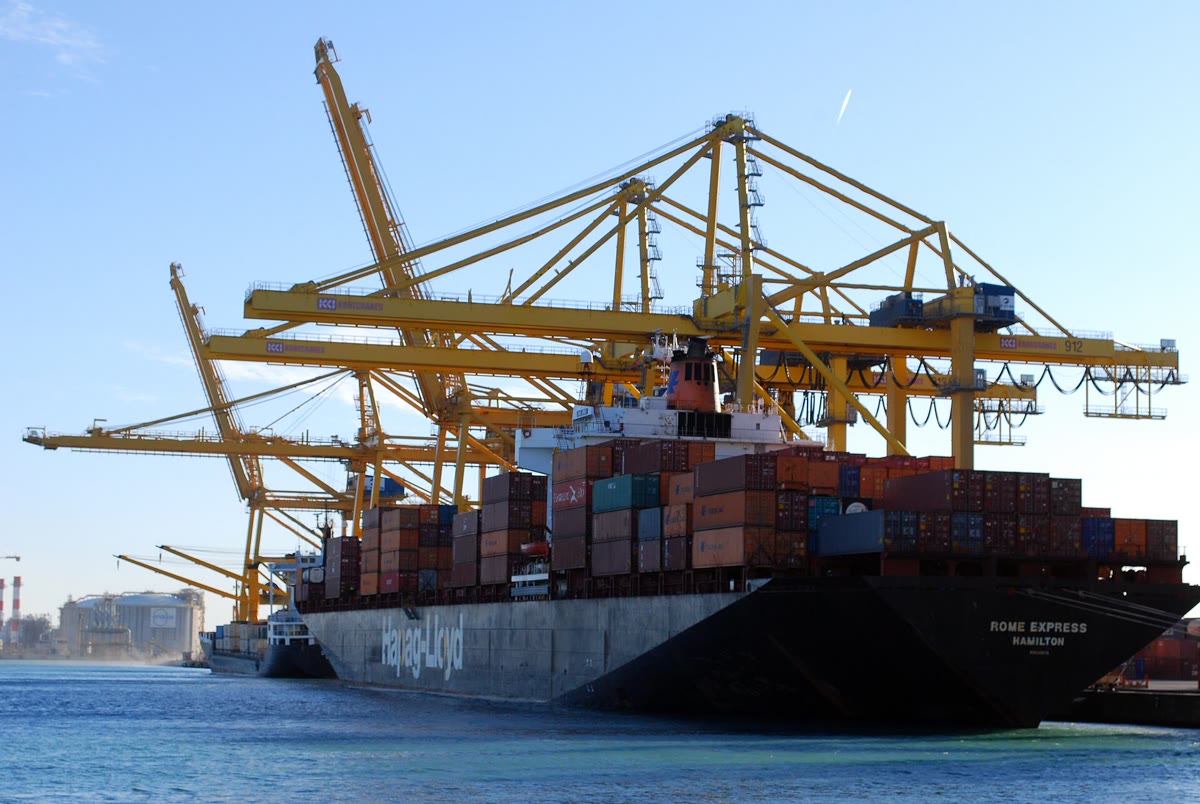
Moving goods costs money. A transport cost works like a tariff: it raises the home price of an imported good above its price where it is made. Unlike a tariff, it brings no revenue to the state: the money pays for ships, fuel and work. When transport costs fall, imported goods become cheaper at home, and exporters can sell more abroad. Containers, which go from ship to train to lorry without being opened, cut the cost of loading and unloading.
For the same reason, countries tend to trade more with near countries than with far ones. In Brenland’s accounts, about three tenths of its exports go to Kestria, its neighbour.
27.6 Exercises
Exercise 27.1 ★
Use the opening chart. What share of South Korea’s exports of goods were manufactures in 1965 and in 2024?
Solution
Solution of Exercise 27.1.
in 1965 and in 2024.
Exercise 27.2 ★
A country exports 450 million dalens of goods and services in a year and imports 520 million. Compute its trade balance. Is it a surplus or a deficit?
Exercise 27.3 ★
Use the tariff chart. Read India’s average tariff in 1990 and in 2022.
Solution
Solution of Exercise 27.3.
About in 1990 and about in 2022.
Exercise 27.4 ★
The world price of a bicycle is 150 dalens. Brenland, a small country, puts a tariff of 30 dalens on each imported bicycle. What is the price of a bicycle in Brenland?
Solution
Solution of Exercise 27.4.
dalens.
Exercise 27.5 ★★
In Brenland’s cloth market (, , world price 6), compute imports without a tariff and with a tariff of 3 dalens a metre.
Exercise 27.6 ★★
Compute the state’s revenue from the tariff of 3 dalens in exercise 5.
Solution
Solution of Exercise 27.6.
thousand dalens a year.
Exercise 27.7 ★★
In Brenland’s cloth market, the tariff doubles from 2 to 4 dalens a metre. What happens to the home price and to imports? Do imports halve?
Solution
Solution of Exercise 27.7.
The home price rises from 8 to 10 dalens. Buyers want , weavers make : imports fall from 30 to 10 thousand metres. They do not halve: they fall to a third, because each extra dalen of tariff both lowers the quantity demanded and raises the quantity made at home.
Exercise 27.8 ★★
In 2025 Brenland sold 40,231 million dalens of goods and services to Kestria and bought 34,739 million from it. Its total exports were 129,777 million and its total imports 128,664 million. Compute its balance with Kestria and its total balance.
Solution
Solution of Exercise 27.8.
With Kestria: million dalens, a surplus. In total: million, a surplus. (So Brenland has a deficit of million with its other partners taken together.)
Exercise 27.9 ★★
A country puts a tariff on a good, and the world price of the good falls by half the tariff. Which assumption of the tariff model does this observation contradict? What kind of country is it likely to be?
Exercise 27.10 ★★★
In Brenland’s cloth market with a tariff of 3 dalens a metre (exercise 5), compute how much more buyers pay on the metres they still buy, how much more weavers receive on the metres they sell, and the state’s revenue. Check that the first is the sum of the other two.
Solution
Solution of Exercise 27.10.
Buyers: thousand dalens. Weavers: thousand dalens. State: thousand dalens. And .
Exercise 27.11 ★★★
The cost of shipping goods between two countries halves. What happens to the prices of imported goods in each country, to the quantity traded, and to the producers of the imported goods in each country?
Exercise 27.12 ★★★
What can the opening chart not tell you about why South Korea’s exports changed? Name two possible causes that the chart cannot tell apart.
Solution
Solution of Exercise 27.12.
The chart shows shares of the value of exports in two years, not the reasons. For example: more schooling and more machines in Korea; changes in what the rest of the world wanted to buy; changes in the prices of the goods (a share of value changes when prices change, even if quantities do not); government decisions. The chart cannot tell these apart.
27.7 Problem: A Tariff on Kestrian Cloth
Problem 27.1
Weekend problem — Brenland’s cloth market and the world price, a tariff on imported cloth, and who gains and who loses
Everything in this problem is invented. In a fine-cloth market, Brenland’s buyers want thousand metres a year at a price of dalens a metre, and its weavers offer . Kestria and other countries sell any quantity to Brenland at the world price of 10 dalens a metre.
Part I — Without a tariff.
- Compute the quantities demanded and supplied at 10 and at 20 dalens.
- Without any trade, what would the price and the quantity be?
- With trade at the world price, how much does Brenland import?
- What is the weavers’ revenue at the world price?
Part II — A tariff of 4 dalens a metre.
- What is the price of cloth in Brenland?
- Compute the quantities demanded and supplied at that price.
- Compute the imports.
- Compute the state’s revenue from the tariff.
Part III — Who gains and who loses.
- How much more do buyers pay on the metres they still buy?
- How much more do weavers receive on the metres they sell, compared with selling the same metres at 10 dalens?
- Compare the answer to question 9 with the sum of the answers to questions 8 and 10.
- How many metres do buyers no longer buy? How many more metres do Brenland’s weavers make?
- Explain why buyers lose more than the weavers and the state gain.
Solution
Solution of Problem 27.1.
1. At 10 dalens: demanded , supplied thousand metres. At 20: demanded , supplied . 2. gives : 20 dalens and 300 thousand metres. 3. thousand metres. 4. thousand dalens, that is 1 million dalens a year. 5. dalens. 6. Demanded ; supplied thousand metres. 7. thousand metres. 8. thousand dalens. 9. thousand dalens. 10. thousand dalens. 11. : the same. Every extra dalen buyers pay on the metres they still buy goes to the state or to the weavers. 12. Buyers buy thousand metres fewer; weavers make thousand metres more. 13. Besides the 1,920 thousand dalens, buyers lose the 120 thousand metres they would have bought at 10 dalens and no longer buy. And the weavers’ 720 is not all gain: making the 80 thousand extra metres costs them between 10 and 14 dalens a metre, when the same cloth could be bought abroad for 10. These two losses go to nobody, so buyers lose more than the weavers and the state gain.