
সব বই

পেশাদার

1 Markets I: The Ecosystem and Exchange-Traded Marketsবাজার অনলাইন 2 Markets II: Rates, FX and Creditবাজার অনলাইন 3 Markets III: Commodities, Energy and Cryptoবাজার অনলাইন 4 Quantitative Methodsপদ্ধতি অনলাইন 5 Derivatives and Volatilityডেরিভেটিভস অনলাইন 6 Rates, Credit, XVA and Riskসুদহার, ঋণ ও ঝুঁকি অনলাইন 7 Research Craft: Predictors, Backtests, Measurement, Portfoliosগবেষণা অনলাইন 8 Strategies I: Equities and Futuresকৌশল অনলাইন 9 Strategies II: Volatility, Relative Value, Macro and the Bank Desksকৌশল অনলাইন 10 Microstructure and Executionএক্সিকিউশন অনলাইন 11 Market Making and High-Frequency Tradingমার্কেট মেকিং অনলাইন 12 Machine Learning for Marketsমেশিন লার্নিং অনলাইন 13 Low-Latency Softwareপ্রযুক্তি অনলাইন 14 Networks, Hardware and Trading Infrastructureপ্রযুক্তি অনলাইন 15 Research, Data and Risk Platformsপ্রযুক্তি অনলাইন 16 The Desk and the Firmপ্রতিষ্ঠান অনলাইন 17 The Industry: Firms, Roles and Careersক্যারিয়ার অনলাইন 18 Interviews I: Maths, Probability and Speedক্যারিয়ার অনলাইন 19 Interviews II: Markets, Trading Games and the Final Roundক্যারিয়ার অনলাইন 20 Interviews III: Codeক্যারিয়ার অনলাইন
অ্যাপ পরিচিতি Coach সাইন ইন পড়া শুরু করো

বইগুলো এখনো বাংলা ভাষায় পাওয়া যায় না — ইংরেজি সংস্করণ দেখানো হচ্ছে।

Biology · পরিভাষা

Allostery and cooperativity কী?

Definition 7.9 University Biology — Year 3 · অধ্যায় 7 — Structural Biology of Proteins

A protein is allosteric when the binding of a ligand at one site changes the affinity of another site, through a change of conformation transmitted across the molecule. When the two sites bind the same ligand and the effect is positive, binding is cooperative: the fractional saturation YY rises with ligand concentration as a sigmoid rather than a hyperbola, described empirically by the Hill equation Y=[S]nH/(KnH+[S]nH)Y = [S]^{n_{H}}/(K^{n_{H}} + [S]^{n_{H}}) with a Hill coefficient nH>1n_{H} > 1 (haemoglobin: nH≈2.8n_{H} \approx 2.8 for its four sites; myoglobin, one site: nH=1n_{H} = 1). Haemoglobin exists in two quaternary conformations, the T state (tense, low affinity, favoured when no oxygen is bound) and the R state (relaxed, high affinity), and switches between them as a whole; protons, carbon dioxide and 2,3-bisphosphoglycerate stabilise T and so lower the affinity — the Bohr effect, by which working tissue, acid and warm, takes more oxygen from the blood.
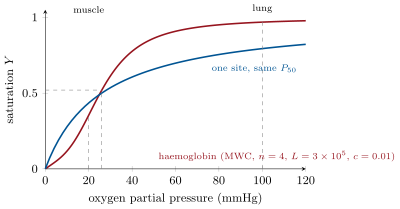
Oxygen saturation of haemoglobin computed from the Monod–Wyman–Changeux equation with the parameters of the example (red), against a single-site carrier of the same half-saturation pressure (blue). Between lung and working muscle the cooperative carrier unloads nearly twice as much.

উদাহরণ

Example 7.11 (Haemoglobin in numbers)

Take n=4n = 4, KR=1 mmHgK_{R} = 1\,\mathrm{mmHg}, c=0.01c = 0.01 (so KT=100 mmHgK_{T} = 100\,\mathrm{mmHg}) and L=3×10⁵L = 3\times 10^{5}. At the partial pressure of oxygen in arterial blood, 100 mmHg100\,\mathrm{mmHg}, α=100\alpha = 100 and Y=0.97Y = 0.97; at 40 mmHg40\,\mathrm{mmHg}, the venous value at rest, Y=0.78Y = 0.78; at 26 mmHg26\,\mathrm{mmHg}, Y=0.52Y = 0.52 — the model reproduces the half-saturation pressure of 26 mmHg26\,\mathrm{mmHg}; at 20 mmHg20\,\mathrm{mmHg}, in an exercising muscle, Y=0.35Y = 0.35. A non-cooperative carrier of the same half-saturation pressure would give 100/126=0.79100/126 = 0.79 in the lungs and 20/46=0.4320/46 = 0.43 in the muscle, unloading 0.360.36 of its capacity where haemoglobin unloads 0.620.62. Cooperativity is what makes a carrier that loads fully at one pressure and unloads mostly at a pressure only five times lower.

প্রসঙ্গসহ পড়ো →