Coach
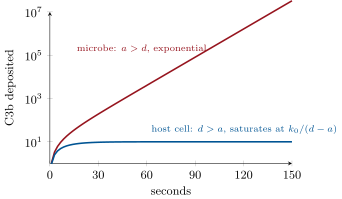
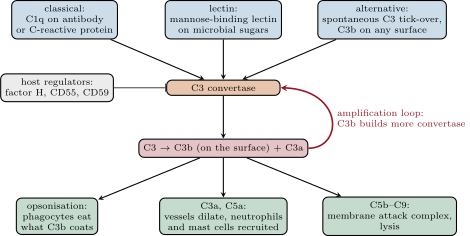
CoachComplement is a system of some thirty plasma proteins, of the serum globulins, that marks and destroys microbes by a cascade of proteolytic activations. Three pathways converge on the cleavage of the central protein C3: the classical pathway, started by C1q binding antibodies on a surface (or C-reactive protein, or apoptotic cells); the lectin pathway, started by mannose-binding lectin recognising microbial sugars; and the alternative pathway, in which C3 hydrolyses spontaneously at a low rate and the resulting C3b attaches to any surface it meets. Each pathway builds a C3 convertase, an enzyme that cleaves more C3; the C3b it deposits covalently on the surface builds more convertase in turn — an amplification loop — so that a bacterium is coated with millions of C3b within minutes. C3b is an opsonin: phagocytes carry receptors for it and eat what it coats. The small fragments C3a and C5a are anaphylatoxins that dilate vessels, attract neutrophils and activate mast cells. And C5b assembles C6–C9 into the membrane attack complex, a pore of that lyses Gram-negative bacteria and enveloped viruses. Host cells are spared because they carry regulators — factor H, CD55, CD59 — that dismantle the convertase and block the pore on their own surfaces; microbes, lacking them, are consumed by the loop.