
Biology · Glossary

What is Interspecific competition?

Definition 27.3 University Biology — Year 1 · Chapter 27 — Interactions Between Species

Two species compete when they both use a resource — food, light, water, space, nesting sites — whose supply limits their growth. Competition may be by exploitation (each takes what the other would have used) or by interference (direct aggression, toxins, territories). Its outcome follows the competitive exclusion principle: two species that need the same limiting resource in the same way cannot coexist indefinitely in a stable environment; the better competitor eliminates the other. Coexisting competitors therefore differ in niche (niche partitioning) — and where two species overlap they often diverge in form more than where each lives alone (character displacement).
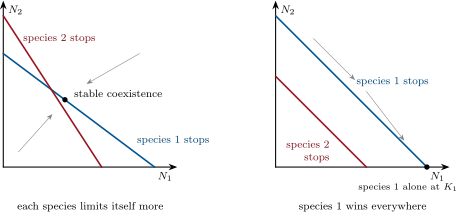
Two outcomes of two-species competition, read from the isoclines (the lines where each species stops growing). Left: the isoclines cross so that each species is held back more by itself than by the other, and they coexist. Right: species 1’s isocline lies outside species 2’s, and species 1 always wins.
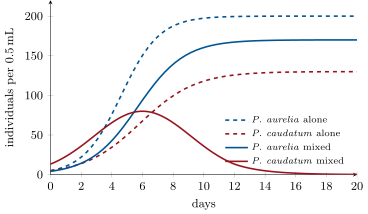
Gause’s competition experiment (redrawn from his data). Each species alone grows to its plateau; together, P. aurelia rises almost to its own while P. caudatum peaks and is driven to extinction.
Read in context →