
সব বই

পেশাদার

1 Markets I: The Ecosystem and Exchange-Traded Marketsবাজার অনলাইন 2 Markets II: Rates, FX and Creditবাজার অনলাইন 3 Markets III: Commodities, Energy and Cryptoবাজার অনলাইন 4 Quantitative Methodsপদ্ধতি অনলাইন 5 Derivatives and Volatilityডেরিভেটিভস অনলাইন 6 Rates, Credit, XVA and Riskসুদহার, ঋণ ও ঝুঁকি অনলাইন 7 Research Craft: Predictors, Backtests, Measurement, Portfoliosগবেষণা অনলাইন 8 Strategies I: Equities and Futuresকৌশল অনলাইন 9 Strategies II: Volatility, Relative Value, Macro and the Bank Desksকৌশল অনলাইন 10 Microstructure and Executionএক্সিকিউশন অনলাইন 11 Market Making and High-Frequency Tradingমার্কেট মেকিং অনলাইন 12 Machine Learning for Marketsমেশিন লার্নিং অনলাইন 13 Low-Latency Softwareপ্রযুক্তি অনলাইন 14 Networks, Hardware and Trading Infrastructureপ্রযুক্তি অনলাইন 15 Research, Data and Risk Platformsপ্রযুক্তি অনলাইন 16 The Desk and the Firmপ্রতিষ্ঠান অনলাইন 17 The Industry: Firms, Roles and Careersক্যারিয়ার অনলাইন 18 Interviews I: Maths, Probability and Speedক্যারিয়ার অনলাইন 19 Interviews II: Markets, Trading Games and the Final Roundক্যারিয়ার অনলাইন 20 Interviews III: Codeক্যারিয়ার অনলাইন
অ্যাপ পরিচিতি Coach সাইন ইন পড়া শুরু করো

বইগুলো এখনো বাংলা ভাষায় পাওয়া যায় না — ইংরেজি সংস্করণ দেখানো হচ্ছে।

Biology · পরিভাষা

Interspecific competition কী?

Definition 27.3 University Biology — Year 1 · অধ্যায় 27 — Interactions Between Species

Two species compete when they both use a resource — food, light, water, space, nesting sites — whose supply limits their growth. Competition may be by exploitation (each takes what the other would have used) or by interference (direct aggression, toxins, territories). Its outcome follows the competitive exclusion principle: two species that need the same limiting resource in the same way cannot coexist indefinitely in a stable environment; the better competitor eliminates the other. Coexisting competitors therefore differ in niche (niche partitioning) — and where two species overlap they often diverge in form more than where each lives alone (character displacement).
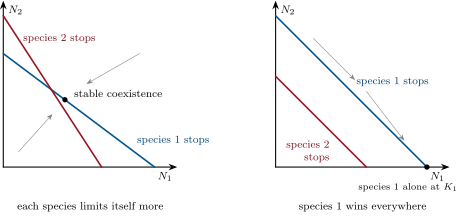
Two outcomes of two-species competition, read from the isoclines (the lines where each species stops growing). Left: the isoclines cross so that each species is held back more by itself than by the other, and they coexist. Right: species 1’s isocline lies outside species 2’s, and species 1 always wins.
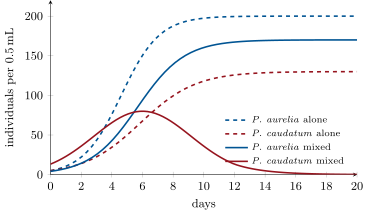
Gause’s competition experiment (redrawn from his data). Each species alone grows to its plateau; together, P. aurelia rises almost to its own while P. caudatum peaks and is driven to extinction.
প্রসঙ্গসহ পড়ো →