
Biology · Glossary

What is Membrane potential?

Definition 7.12 University Biology — Year 1 · Chapter 7 — Membranes and Membrane Transport

Every living cell holds an electrical potential difference across its plasma membrane, the membrane potential Vm=VinVoutV_m = V_{\text{in}} - V_{\text{out}}, negative inside: 70mV-70\,\mathrm{mV} in a neuron, 90mV-90\,\mathrm{mV} in a muscle fibre, 120mV-120\,\mathrm{mV} or more in a plant cell. It arises because the membrane is selectively permeable to ions whose concentrations differ across it.
Resting potential against external potassium. At high potassium the membrane behaves as a potassium electrode and follows the Nernst line; at low potassium the small sodium leak pulls it above E_K.
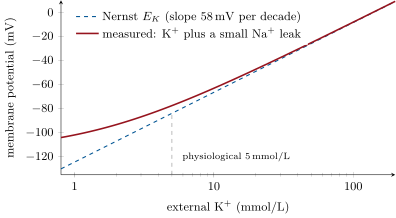
Resting potential against external potassium. At high potassium the membrane behaves as a potassium electrode and follows the Nernst line; at low potassium the small sodium leak pulls it above EKE_K.
Read in context →