 Coach
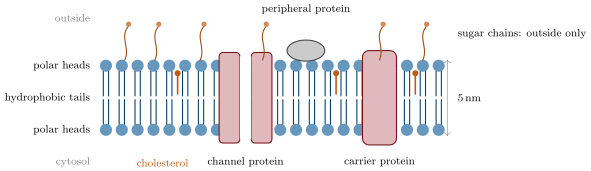
CoachThe plasma membrane — and every membrane of the cell — is a lipid bilayer about thick: two sheets of phospholipids (Chapter 9) with their hydrophobic tails facing each other and their polar heads facing the two aqueous sides, with cholesterol between the tails, and membrane proteins embedded in it or attached to it. In the fluid mosaic model (Singer and Nicolson, 1972) the bilayer is a two-dimensional fluid in which lipids and proteins diffuse laterally, and the proteins are a mosaic of independent units, not a continuous coat. The two faces differ: sugars attached to lipids and proteins face outward only (the glycocalyx), and some phospholipids are confined to one leaflet.
Examples
Example 7.17 (Cholesterol delivery)
Cholesterol travels in the blood inside protein-coated particles too large for any carrier. A cell needing cholesterol displays receptors for the particle; particle and receptor gather in a coated pit, which pinches off, and the vesicle delivers the particle to a lysosome where the cholesterol is freed. A person whose receptors are defective cannot clear the particles: blood cholesterol doubles and arteries clog in early adulthood. One membrane protein, one disease.