
Biology · Glossary

What is Nomenclature and ranks?

Definition 29.2 University Biology — Year 1 · Chapter 29 — Classifying the Living World

Every species has a binomial name: the name of its genus (capitalised) followed by a specific epithet, both in italics — Homo sapiens, Quercus robur, Escherichia coli — often followed by the author and year of its description. The system, fixed by Linnaeus in 1753 (plants) and 1758 (animals), nests species in a hierarchy of ranks: genus, family, order, class, phylum (or division), kingdom, domain. A group at any rank is a taxon. Each name is tied to a type specimen, deposited in a museum or herbarium, which fixes what the name refers to; the oldest valid name has priority; and the rules are codified so that one organism has one name worldwide. The ranks are conventions — there is no property that all families share and no genus does; only the species is a natural unit.
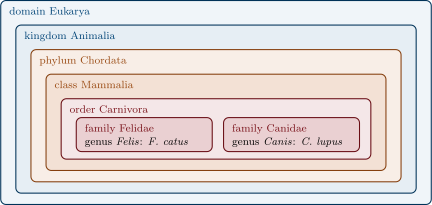
The nested ranks of the Linnaean hierarchy, for the cat and the wolf. Each box is a taxon; the binomial names the genus and the species.
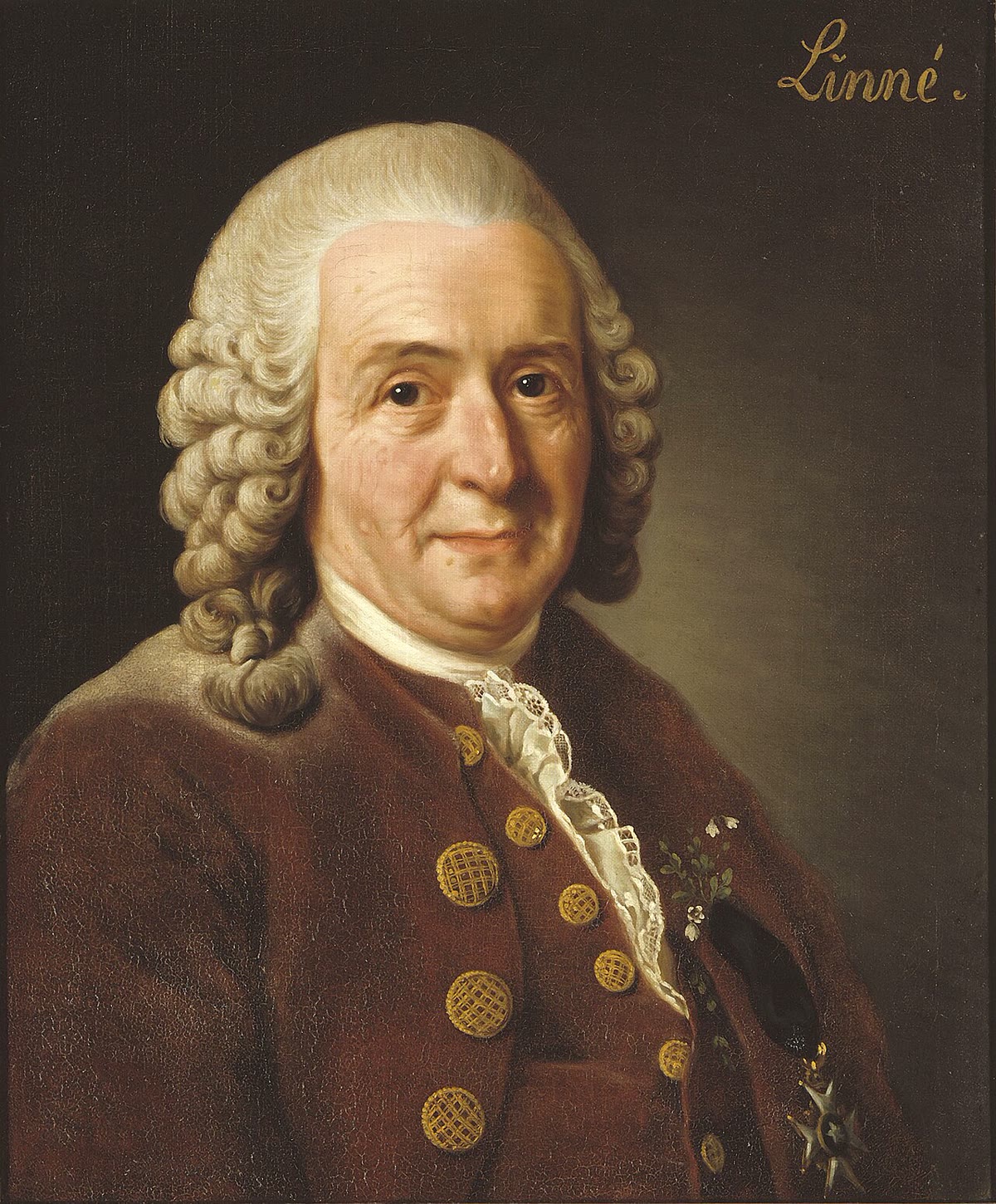
Carl Linnaeus (1707–1778), whose Species Plantarum of 1753 and tenth edition of the Systema Naturae of 1758 are the starting points of botanical and zoological nomenclature. Portrait by Alexander Roslin, 1775.
Read in context →