 Coach
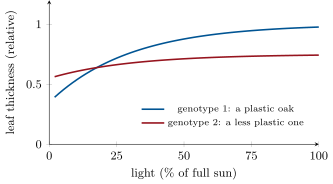
CoachPhenotypic plasticity is the capacity of one genotype to produce different phenotypes in different environments. The norm of reaction of a genotype is the curve of its phenotype against an environmental variable — leaf thickness against light, stem length against temperature; genotypes differ in their norms, and the differences are heritable even when the plasticity itself is not. Acclimation is the reversible, physiological form: a leaf that thickens its cuticle in a dry week, a cell that makes antifreeze in autumn. Adaptation, in the evolutionary sense, is the heritable fit of a lineage to its habitat, selected over generations; a cactus is adapted to drought, a bean acclimates to a dry spell. Plants are more plastic than animals because they are modular and indeterminate (Chapter 13): the next leaf can be built differently from the last, and the sessile life makes plasticity the only way to move.
Examples
Example 15.11 (Cues that lie)
Plasticity is only as good as the cue. A seedling under a neighbour’s far-red shade elongates — correctly, if the neighbour is a seedling it can overtop; fatally, if it is a tree, since the reserves spent on stem are lost to root and leaf. Crops planted densely shade each other, elongate, and lodge; breeders have selected wheats and rices that ignore the far-red signal. A warm week in February brings out leaves that a March frost kills; the plants that survive are those that also count the cold (Chapter 14). Every plastic response is a bet on the cue’s honesty, and the norm of reaction is shaped by how often, in the lineage’s past, the cue told the truth.