University Biology — Year 2 · Bachelor Year 2
14Reproductive Development and Flowering Control
A chrysanthemum grower can make a greenhouse flower for Christmas or for Easter by switching the lights; a winter wheat sown in spring never flowers at all, because it has not been cold; a cocklebur that has seen a single night longer than its critical length is committed to flowering, whatever happens afterward. A plant has no calendar, but it has clocks, thermometers and light meters, and it decides once a year, on their evidence, to convert a meristem that has been making leaves into one that will make a flower. This chapter follows that decision from the leaf that measures the night to the meristem that changes its programme, then the building of the flower by a code of genes, and the reverse transition at the other end of the cycle: the seed that will not germinate until it is told the season is right.
14.1 The transition to flowering
Definition 14.1 (Floral transition and induction)
A vegetative shoot apical meristem makes leaves with a bud in each axil, indefinitely. At the floral transition it becomes an inflorescence meristem, which makes bracts and, in their axils, floral meristems, each of which is determinate: it makes sepals, petals, stamens and carpels and then stops. The change is triggered by floral induction — a signal, arriving from the leaves or arising in the plant’s own physiology, that switches the meristem’s identity genes. Annuals flower once and die; perennials flower each year from some meristems and keep others vegetative. The timing decides whether pollen meets pollen, whether seeds ripen before frost, and whether the flower opens when its pollinator flies: it is under strong selection, and plants have evolved several ways of reading the season.
Proposition 14.2 (Photoperiodism: the plant measures the night)
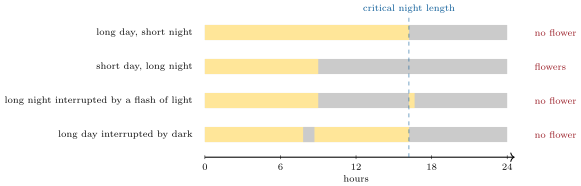
Many plants flower in response to day length. Short-day plants (chrysanthemum, soybean, rice, cocklebur) flower when the day is shorter than a critical length — in autumn or spring; long-day plants (spinach, wheat, clover, Arabidopsis) when it is longer — in early summer; day-neutral plants (tomato, maize) flower when they are big enough. What the plant measures is in fact the length of the uninterrupted night: a short-day plant is a long-night plant, and a flash of light in the middle of a long night cancels its effect, whereas a period of darkness in a long day does not. The measurement is made in the leaves, by the pigment phytochrome — a protein that switches between a red-absorbing form and a far-red-absorbing form with each photon it catches, so that its state records the light — read against an internal circadian clock of about twenty-four hours: flowering is triggered when light coincides with a particular phase of the clock, which happens only at the right day length.
Evidence. Garner and Allard (1920) found that a mutant tobacco flowered only in the short days of a winter greenhouse, and that soybeans sown at intervals through the summer all flowered together in September: day length, not age or temperature, set the date. Hamner and Bonner (1938) showed with cocklebur that one long night was enough, that a minute of light in the middle of the night abolished the effect, and that shortening the day with no change to the night did not induce. Borthwick and Hendricks (1952) found that the most effective light was red and that far-red light given immediately after red cancelled it — the signature of phytochrome, isolated in 1959. Grafting a single induced leaf onto an uninduced plant made the whole plant flower: the leaf exports a signal. ∎
Definition 14.3 (Florigen)
The signal the leaf exports was named florigen in 1937 and identified seventy years later as a small protein, the product of the gene FLOWERING LOCUS T (FT). In the leaf, the clock and phytochrome together switch on FT only when the day length is right (in Arabidopsis, a long-day plant, when light coincides with the afternoon peak of the clock-controlled activator CONSTANS); the FT protein enters the phloem, travels with the sugar stream to the shoot apex, and there, with a partner protein, switches on the genes that convert the meristem. The same protein is the florigen of rice, a short-day plant, in which the clock wires it the other way round. Grafting experiments, the transport of the protein in the phloem, and the flowering of plants in which FT is expressed from a leaf-specific promoter all agree: the flower is decided in the leaf and executed in the bud.
Proposition 14.4 (Vernalisation: the plant counts the cold)
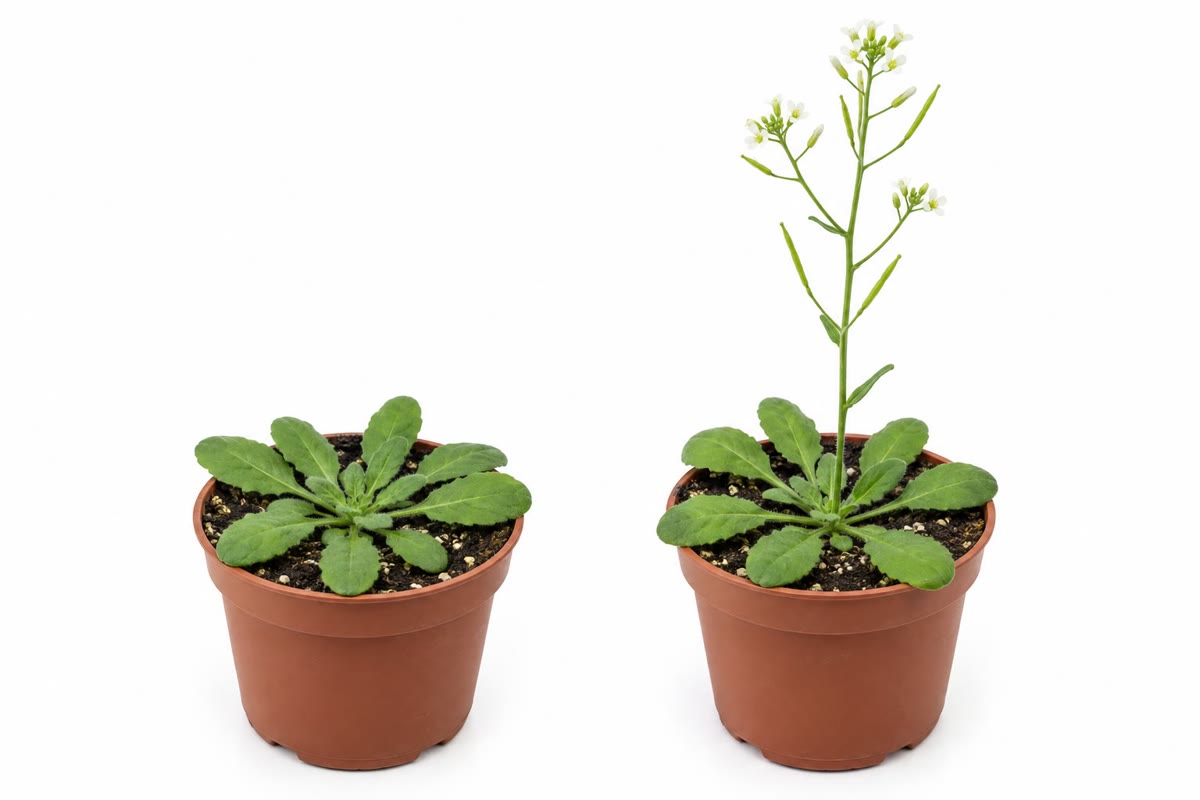
Winter cereals, biennials (carrot, cabbage, foxglove) and many perennials of cold climates will not flower until they have experienced weeks of cold — vernalisation — which ensures that a plant germinating in autumn waits for spring rather than flowering into the frost. The cold is sensed by the meristem itself, not the leaves; it cannot be replaced by any other treatment; and its effect is remembered through the rest of the plant’s growth, through hundreds of cell divisions, but not through meiosis — every seed starts unvernalised. In Arabidopsis the memory is a gene, FLOWERING LOCUS C (FLC), whose product represses flowering: weeks of cold progressively silence it by covering its chromatin with repressive marks, the silencing is copied at each division, and it is erased in the embryo. The plant thus integrates the cold over time — a few cold days do not count — and a mutant that lacks FLC needs no winter.
Theorem 14.5 (Why integration protects against a false spring)
Suppose a repressor is silenced at a constant rate per day of cold, so that after cold days the fraction still active is , and flowering is permitted when . The number of cold days required is , and — because the silencing is stable — the cold days need not be consecutive: what counts is their total. A plant with days is not fooled by a fortnight’s thaw in January nor by a cold snap in October; a plant that sensed only the current temperature would flower at the first warm week. The same integration, with a threshold, is how the plant reads the accumulated day length before committing; both are examples of a system responding to the integral of a signal rather than to its instantaneous value.
Proof. If each cold day silences a fraction of the remaining active copies (or of the chromatin still unmarked), the active fraction obeys , hence with the count of cold days; the inequality gives . Days that are not cold neither add nor subtract, since the marks are stable, so only the total matters. ∎
14.2 Building the flower: the ABC model
Proposition 14.6 (The ABC model)
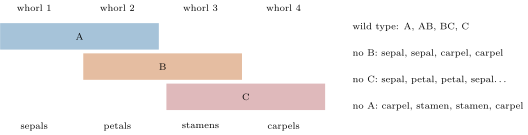
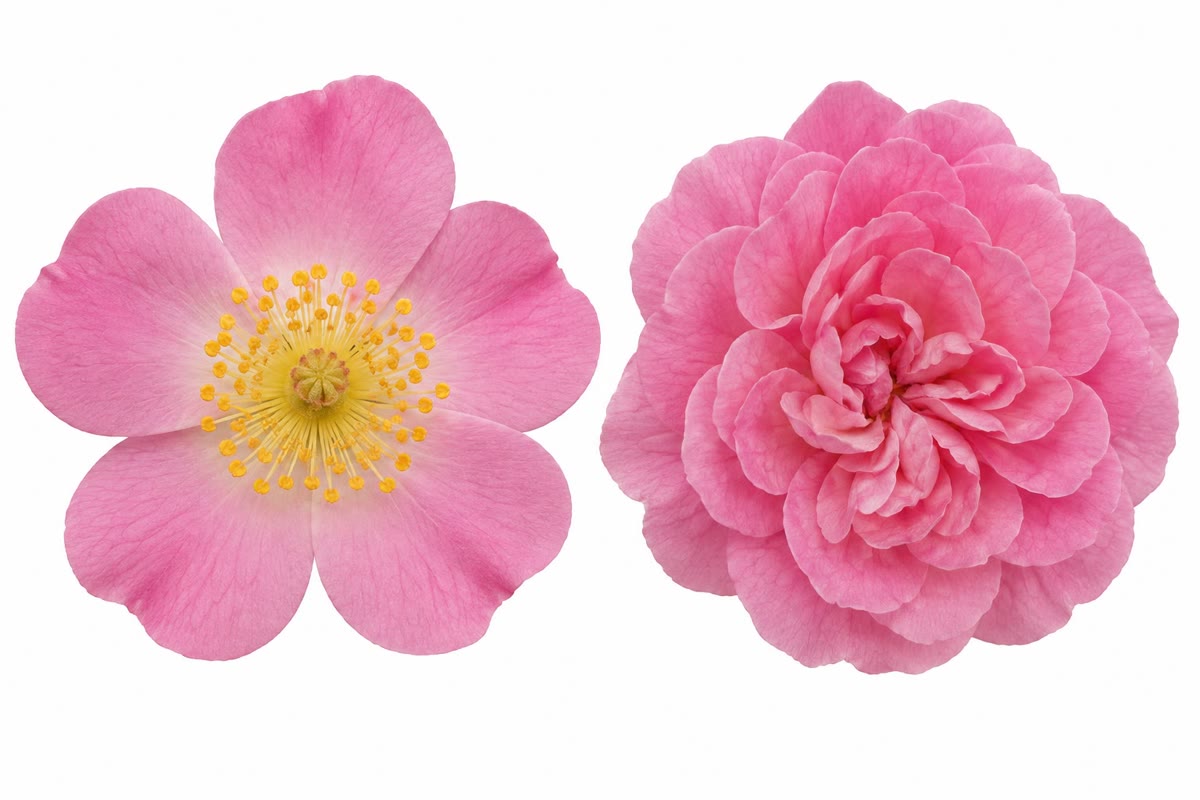
A floral meristem lays down four concentric whorls: sepals, petals, stamens, carpels. Their identities are set by three classes of homeotic genes, acting in overlapping rings: class A alone in whorl 1 gives sepals; A and B together in whorl 2 give petals; B and C together in whorl 3 give stamens; C alone in whorl 4 gives carpels. A and C repress each other, so that where one is lost the other spreads over the whole flower. The rules predict every single mutant: lose B and the flower is sepal–sepal–carpel–carpel; lose C and it is sepal–petal–petal–sepal, then another flower inside, since C also stops the meristem; lose A and it is carpel–stamen–stamen–carpel. Most of these genes encode transcription factors of one family (MADS-box), and a fourth class, E, is needed for all three functions; expressing B and C together in a leaf turns it into a stamen-like organ. The garden’s double flowers — roses, peonies, camellias — are class-C mutants, their stamens turned into extra petals.
Evidence. Coen and Meyerowitz (1991) compared the homeotic mutants of Arabidopsis and of the snapdragon: in both, three classes of mutation each transformed two adjacent whorls, in the same pairs, and the combinations of mutants behaved as the model predicts (the triple mutant makes only leaves). Cloning showed the genes to be transcription factors expressed in the predicted rings; putting a B gene under a promoter active in all four whorls gave petal–petal–stamen–stamen. ∎
14.3 Dormancy and germination
Definition 14.7 (Seed dormancy)
A viable seed that does not germinate in conditions that would support growth is dormant. Dormancy is imposed during seed maturation by abscisic acid (ABA), which also drives the accumulation of reserves and the drying of the embryo, and it is maintained by the seed coat (impermeable to water or oxygen, mechanically restraining) or by the embryo’s own state. It is broken by the signals that mark the end of the unfavourable season: weeks of cold and damp (stratification, the seed’s vernalisation), light — for small seeds that must be near the surface, sensed by phytochrome — or darkness, alternating temperatures, the leaching of inhibitors by rain, the scarification of the coat by soil or a gut, smoke and heat after fire. The decision is a balance between ABA and gibberellin: the breaking signals lower ABA and raise gibberellin, which mobilises the reserves (Chapter 6) and lets the radicle grow. A population of seeds is not uniform: a fraction germinates at the first opportunity, the rest wait a year or more, so that no single bad season kills the whole cohort — the seed bank, a hedge against an unpredictable world.
Evidence. Lettuce seeds (Borthwick, 1952) germinate in the dark after a flash of red light and not after a flash of far-red; given red then far-red then red, they germinate — the last flash decides. The same reversible pigment that times flowering starts germination. Seeds of many trees sown fresh in warm soil do nothing; the same seeds after two months in a moist refrigerator germinate at once, and ABA-deficient mutants germinate on the plant before the seed is even dry. ∎
Theorem 14.8 (Germination as a bet)
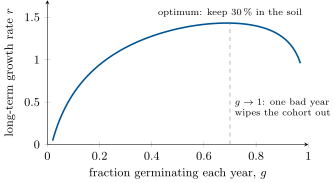
Let a fraction of a seed cohort germinate each year and the rest survive in the soil with probability to the next year. In a good year a germinating seed leaves seeds; in a bad year, none; years are good with probability . A strategy that germinates everything at once () has, over a run of years, a long-term growth rate -averaged as : one bad year extinguishes it. A strategy with grows in good years by a factor and in bad years by , so its long-term rate,
is finite and, for not too close to 1, is maximised at an intermediate . With , and , the optimum is near : germinate most, keep a reserve. Dormancy is not a failure to germinate but an evolved partial refusal.
Proof. Population size after years is the product of the yearly factors, so its growth rate is the average of their logarithms (the geometric mean rate), which is what selection maximises over long runs. With the bad-year factor is zero and the log is . For both factors are positive; differentiating with respect to and setting the derivative to zero gives the optimum, which for the figures quoted lies near (evaluating at gives , , , ). ∎
14.4 Exercises
Exercise 14.1 ★
Distinguish vegetative, inflorescence and floral meristems, and say which are determinate.
Solution
Solution of Exercise 14.1.
Vegetative meristem: makes leaves with axillary buds, indefinitely (indeterminate). Inflorescence meristem: makes bracts and floral meristems in their axils, indeterminate in many species. Floral meristem: makes the four whorls and stops — determinate.
Exercise 14.2 ★
Define short-day, long-day and day-neutral plants with an example of each, and say what a short-day plant actually measures.
Solution
Solution of Exercise 14.2.
Short-day plants flower when the day is shorter than a critical length (chrysanthemum, soybean, rice); long-day plants when it is longer (spinach, wheat, Arabidopsis); day-neutral plants flower on reaching a size (tomato, maize). A short-day plant measures the length of the uninterrupted night.
Exercise 14.3 ★
Give the organ identity of each whorl in the wild type and in the three single mutants of the ABC model.
Exercise 14.4 ★
Name four signals that break seed dormancy and, for each, the season or place it reports.
Solution
Solution of Exercise 14.4.
Weeks of cold and damp (winter has passed); light (the seed lies near the surface); alternating temperatures (bare soil, no canopy); leaching by rain (the rains have come); scarification (passage through a gut or abrasion in soil); smoke and heat (a fire has cleared the ground).
Exercise 14.5 ★★
A short-day plant has a critical night of . Say whether it flowers under: light/ dark; /; light, dark, one minute of light, dark; light, dark, light, dark.
Solution
Solution of Exercise 14.5.
16/8: night of 8 hours, below the critical 10: no. 12/12: yes. 12 light, 6 dark, flash, 6 dark: two nights of 6 hours: no. 8 light, 4 dark, 4 light, 8 dark: longest night 8 hours: no.
Exercise 14.6 ★★
A leaf of an induced short-day plant is grafted onto a long-day plant kept in long days, and the long-day plant flowers. What does this show about florigen? What if the graft is made with a leaf that has been induced but has its phloem interrupted at the petiole?
Solution
Solution of Exercise 14.6.
Florigen is a graft-transmissible signal made in the leaf and the same in short- and long-day species — the difference is in when the leaf makes it, not what it makes. With the phloem interrupted the graft does not induce flowering: the signal travels in the phloem.
Exercise 14.7 ★★
Cold silences the repressor at per day and flowering needs . How many cold days are required? A winter has three cold spells of 15, 12 and 20 days separated by thaws: is the plant vernalised? What if were ?
Solution
Solution of Exercise 14.7.
cold days. The spells total : the plant is vernalised on the 11th day of the third spell. With it would need 95 days and would not be.
Exercise 14.8 ★★
Explain why a vernalised plant’s memory is lost in its seeds, in terms of chromatin, and why this is useful.
Solution
Solution of Exercise 14.8.
The repressor’s gene is silenced by chromatin marks that are copied at each mitosis, so every cell of the shoot remembers the winter; in the germ line and early embryo the marks are erased and the gene is expressed again. Useful because a seed shed in summer must not inherit its parent’s permission to flower: it must wait for a winter of its own.
Exercise 14.9 ★★
Lettuce seeds are given, in the dark, the sequences: R; R then FR; R, FR, R; R, FR, R, FR. Predict germination in each case and explain in terms of the two forms of phytochrome.
Solution
Solution of Exercise 14.9.
R: germinate (phytochrome converted to the far-red-absorbing form, Pfr, the active one). R then FR: no (converted back to Pr). R, FR, R: germinate. R, FR, R, FR: no. Only the last flash counts, because each conversion is complete and the seed reads the final state of the pigment.
Exercise 14.10 ★★★
In the bet-hedging model with , , compute the long-term growth rate for , , and when , and again when . How does the optimum shift, and what does that predict for deserts versus meadows?
Exercise 14.11 ★★★
Predict the flower produced by expressing a class-B gene in all four whorls; by expressing class C in all four; by a double mutant lacking A and B. Then explain why the C-less flower goes on making whorls.
Solution
Solution of Exercise 14.11.
B in all whorls: petal, petal, stamen, stamen. C in all whorls (C represses A): carpel, stamen, stamen, carpel. No A and no B: C alone everywhere — carpels in all four whorls. C also ends the meristem; without it the centre stays indeterminate and makes flower within flower.
Exercise 14.12 ★★★
“A plant decides to flower by integrating signals it cannot control.” Discuss the three integrations of this chapter — of day length, of cold, of the years in the seed bank — and what an integrator protects the plant against that a simple threshold would not.
Solution
Solution of Exercise 14.12.
Day length is integrated across nights by the coincidence of light with the clock, and induction needs several such nights; cold is integrated as accumulating chromatin marks; the seed bank integrates across years by spreading germination. An integrator ignores a single anomalous day, a January thaw, or one bad year; a threshold on the instantaneous value would flower the plant in a warm week of February, or germinate every seed in the first rain.
14.5 Problem: The Grower’s Calendar
Problem 14.1
Weekend problem — a chrysanthemum grower schedules flowering with lights, a wheat breeder counts cold, a florist’s double flower is explained, and a seed lot’s dormancy is modelled, ending on the night length that triggers the crop, the cold days the wheat needs, and the best germination fraction
Chrysanthemum is a short-day plant with a critical night length of ; induction requires consecutive inductive nights, and flowers open weeks after induction. In November the greenhouse is dark from 17:00 to 07:30. Winter wheat has per cold day and flowers when . Seed lot: , , good years with probability .
Part I — The greenhouse.
- In June the natural night is . Will the crop flower? What must the grower do to sell flowers in August?
- The grower covers the crop with black cloth from 19:00 to 07:00. What night length does the plant see, and when must covering start for an opening on 15 August?
- In November the natural night is and the grower wants to delay flowering to Christmas. Propose a lighting schedule and explain why a brief flash suffices.
- The flash is given at 21:00 rather than at 00:00, and induction is not prevented. Explain with the critical night length.
- One night in the twelve, the cloth is left off. Predict, and say what a cocklebur would have done.
- The flash is given in green light and fails; in red light it works; red followed by far-red fails. Explain.
- A single leaf of an induced plant is grafted onto a plant under long days. Predict, and say what it identifies.
Part II — The wheat.
- How many cold days does the wheat need?
- Sown in October, it gets 10 cold days in November, a mild December, 25 in January and 12 in February. When is it vernalised?
- Sown in March, it gets 6 cold days. Does it flower that summer? What is the agricultural consequence?
- A mutant lacks the repressor. Predict its behaviour and say why breeders call such wheats “spring wheats”.
- Explain why the memory of cold survives the divisions of the meristem through spring but not the meiosis that makes the next generation.
- Why must the cold be counted in the meristem and not in the leaves, unlike day length?
Part III — The florist.
- A double rose has petals where the stamens should be and a few extra petals in the centre. Which class of gene has failed? Give the whorl formula.
- Such roses are sterile as pollen parents but sometimes set seed. Explain both facts from the ABC model.
- A snapdragon has stamens in place of petals and carpels in place of sepals. Which class has failed?
- Predict the flower of a plant in which class C is expressed in whorl 1 as well as its normal whorls.
- Why did the same mutations produce the same transformations in a rose, a snapdragon and Arabidopsis, plants separated by a hundred million years?
- In whorl 2 of a wild-type flower both A and B are active. Predict the organ if B alone were active there.
Part IV — The seed lot.
- Compute the long-term growth rate for , and when .
- Which of the three is best? What happens at ?
- Recompute for (a desert). Which is best now?
- A grower sows the whole lot in one field in a good year and harvests per seed. Explain why his strategy differs from the plant’s and what he must do to keep the variety through a bad year.
- The seeds require light to germinate. Explain the adaptive sense of this for a small seed, and predict what ploughing does to the seed bank.
- State the result: the critical night length and the covering schedule, the wheat’s cold requirement, and the best for and .
Solution
Solution of Problem 14.1.
1. An 8-hour night is shorter than the critical 9.5 hours: no flowering. To sell in August the grower must lengthen the nights artificially with black cloth. 2. A 12-hour night. Opening on 15 August means induction completed 8 weeks earlier, about 20 June; the twelve inductive nights must start around 8 June. 3. Light the crop for a few minutes in the middle of each night: a 14.5-hour night becomes two of about 7 hours, both below the critical length. A flash suffices because phytochrome is converted within minutes and the plant measures only the length of uninterrupted darkness. 4. A flash at 21:00 leaves a dark period from 21:00 to 07:30, 10.5 hours — longer than 9.5: that segment induces. The break must fall so that no segment exceeds the critical length. 5. One missed night breaks the run of twelve consecutive inductive nights: the count restarts and flowering is delayed by about as many days as had been accumulated. A cocklebur needs a single inductive night and would already have been committed. 6. Phytochrome does not absorb green light, so the plant does not see the flash; red converts it to the active form, which reads as day; far-red immediately after converts it back, so the night is not interrupted. 7. The long-day plant flowers: florigen crosses the graft union in the phloem. It identifies a mobile, graft-transmissible signal common to both day-length classes. 8. : 39 cold days. 9. 10 in November, 35 by the end of January, and the 39th cold day falls on the fourth cold day of February: vernalised in early February. 10. Six days: : it stays vegetative all summer and gives no grain — winter wheat must be sown in autumn. 11. Without the repressor it flowers without cold: it can be sown in spring and harvested the same summer — a spring wheat. 12. The silencing marks on the repressor’s chromatin are copied at each mitosis, so the apex remembers through spring; in meiosis and the embryo the marks are erased, and each generation must count its own winter. 13. The memory must sit in the cells that will make the flower and that persist through winter — the meristem — and it is a state of their chromatin, not a mobile signal; the leaves that measure day length are shed, and export a protein instead. 14. Class C: sepal, petal, petal, sepal (A spreads into the fourth whorl and the flower repeats inside). 15. No stamens, so no pollen; a few carpels form where C is weakly active, so occasional seeds set. 16. Class A: carpel, stamen, stamen, carpel. 17. C represses A: whorl 1 becomes carpel, whorl 2 (B and C) stamen — carpel, stamen, stamen, carpel, the A-mutant flower. 18. The ABC genes are one family of transcription factors inherited from the common ancestor of all flowering plants; the module was in place before roses, snapdragons and Arabidopsis diverged, and each has kept it. 19. B without A or C specifies no floral organ: a leaf-like or bract-like organ. 20. : (), (), (). 21. Of the three, (the true optimum lies near ); at the bad-year factor is zero and the lineage is extinguished by the first bad year. 22. : , , : is best, and lower still would be better — more dormancy in the desert. 23. The grower’s seeds are stored, not buried, and survive with certainty; he need not hedge within the field, but must keep a reserve in the barn to resow after a failed year — the same reserve, held by him instead of by the soil. 24. A small seed carries reserves for a shoot of a centimetre or two; germinating in the dark under soil it would die before reaching light, so it waits for light — which reaches it only near the surface. Ploughing brings buried seeds up and triggers a flush of weeds. 25. Critical night 9.5 hours, covering from about 8 June to open on 15 August; 39 cold days; best for and about for .