
সব বই

পেশাদার

1 Markets I: The Ecosystem and Exchange-Traded Marketsবাজার অনলাইন 2 Markets II: Rates, FX and Creditবাজার অনলাইন 3 Markets III: Commodities, Energy and Cryptoবাজার অনলাইন 4 Quantitative Methodsপদ্ধতি অনলাইন 5 Derivatives and Volatilityডেরিভেটিভস অনলাইন 6 Rates, Credit, XVA and Riskসুদহার, ঋণ ও ঝুঁকি অনলাইন 7 Research Craft: Predictors, Backtests, Measurement, Portfoliosগবেষণা অনলাইন 8 Strategies I: Equities and Futuresকৌশল অনলাইন 9 Strategies II: Volatility, Relative Value, Macro and the Bank Desksকৌশল অনলাইন 10 Microstructure and Executionএক্সিকিউশন অনলাইন 11 Market Making and High-Frequency Tradingমার্কেট মেকিং অনলাইন 12 Machine Learning for Marketsমেশিন লার্নিং অনলাইন 13 Low-Latency Softwareপ্রযুক্তি অনলাইন 14 Networks, Hardware and Trading Infrastructureপ্রযুক্তি অনলাইন 15 Research, Data and Risk Platformsপ্রযুক্তি অনলাইন 16 The Desk and the Firmপ্রতিষ্ঠান অনলাইন 17 The Industry: Firms, Roles and Careersক্যারিয়ার অনলাইন 18 Interviews I: Maths, Probability and Speedক্যারিয়ার অনলাইন 19 Interviews II: Markets, Trading Games and the Final Roundক্যারিয়ার অনলাইন 20 Interviews III: Codeক্যারিয়ার অনলাইন
অ্যাপ পরিচিতি Coach সাইন ইন পড়া শুরু করো

বইগুলো এখনো বাংলা ভাষায় পাওয়া যায় না — ইংরেজি সংস্করণ দেখানো হচ্ছে।

Biology · পরিভাষা

Phenotypic plasticity and the norm of reaction কী?

Definition 15.1 University Biology — Year 2 · অধ্যায় 15 — Plant Adaptations and Phenotypic Plasticity

Phenotypic plasticity is the capacity of one genotype to produce different phenotypes in different environments. The norm of reaction of a genotype is the curve of its phenotype against an environmental variable — leaf thickness against light, stem length against temperature; genotypes differ in their norms, and the differences are heritable even when the plasticity itself is not. Acclimation is the reversible, physiological form: a leaf that thickens its cuticle in a dry week, a cell that makes antifreeze in autumn. Adaptation, in the evolutionary sense, is the heritable fit of a lineage to its habitat, selected over generations; a cactus is adapted to drought, a bean acclimates to a dry spell. Plants are more plastic than animals because they are modular and indeterminate (Chapter 13): the next leaf can be built differently from the last, and the sessile life makes plasticity the only way to move.
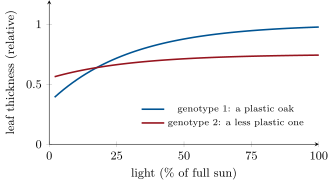
Two norms of reaction. Each genotype makes thicker leaves in more light; the slope of the curve — the plasticity — is itself a heritable trait, and the two genotypes differ in it.

উদাহরণ

Example 15.11 (Cues that lie)

Plasticity is only as good as the cue. A seedling under a neighbour’s far-red shade elongates — correctly, if the neighbour is a seedling it can overtop; fatally, if it is a tree, since the reserves spent on stem are lost to root and leaf. Crops planted densely shade each other, elongate, and lodge; breeders have selected wheats and rices that ignore the far-red signal. A warm week in February brings out leaves that a March frost kills; the plants that survive are those that also count the cold (Chapter 14). Every plastic response is a bet on the cue’s honesty, and the norm of reaction is shaped by how often, in the lineage’s past, the cue told the truth.

প্রসঙ্গসহ পড়ো →