University Biology — Year 2 · Bachelor Year 2
13Plant Vegetative Development: Meristems and Growth
An oak that was a seedling when the cathedral was built is still adding a ring of wood every year, still opening new leaves every spring, still pushing new root tips through the soil. No animal does this; a horse stops growing at four. The difference is that a plant keeps, at the tip of every shoot and every root and in a thin cylinder inside every trunk, small populations of embryonic cells — the meristems — that never stop dividing, and that build the plant’s body outward and upward for as long as it lives. This chapter looks at how the two apical meristems are organised and controlled, how a plant cell grows, how hormones decide the shape of a shoot, and how a trunk thickens.
13.1 Meristems
Definition 13.1 (Meristems and the two kinds of growth)
A meristem is a population of small, undifferentiated, dividing cells that persists throughout the plant’s life and from which all its tissues derive. The shoot apical meristem (SAM) at the tip of each shoot makes leaves, stem and, in season, flowers; the root apical meristem (RAM) behind each root tip makes the root; together they drive primary growth, the lengthening of the plant. The lateral meristems — the vascular cambium and the cork cambium, thin cylinders inside stems and roots — drive secondary growth, the thickening that makes wood and bark. Plant growth is therefore indeterminate: the meristems can go on indefinitely, and the plant is a modular organism, repeating the unit leaf–node–internode–bud as long as conditions allow. Every axillary bud is a dormant SAM, so a plant carries thousands of reserve growing points.
Proposition 13.2 (The shoot apex)
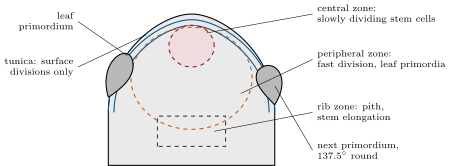
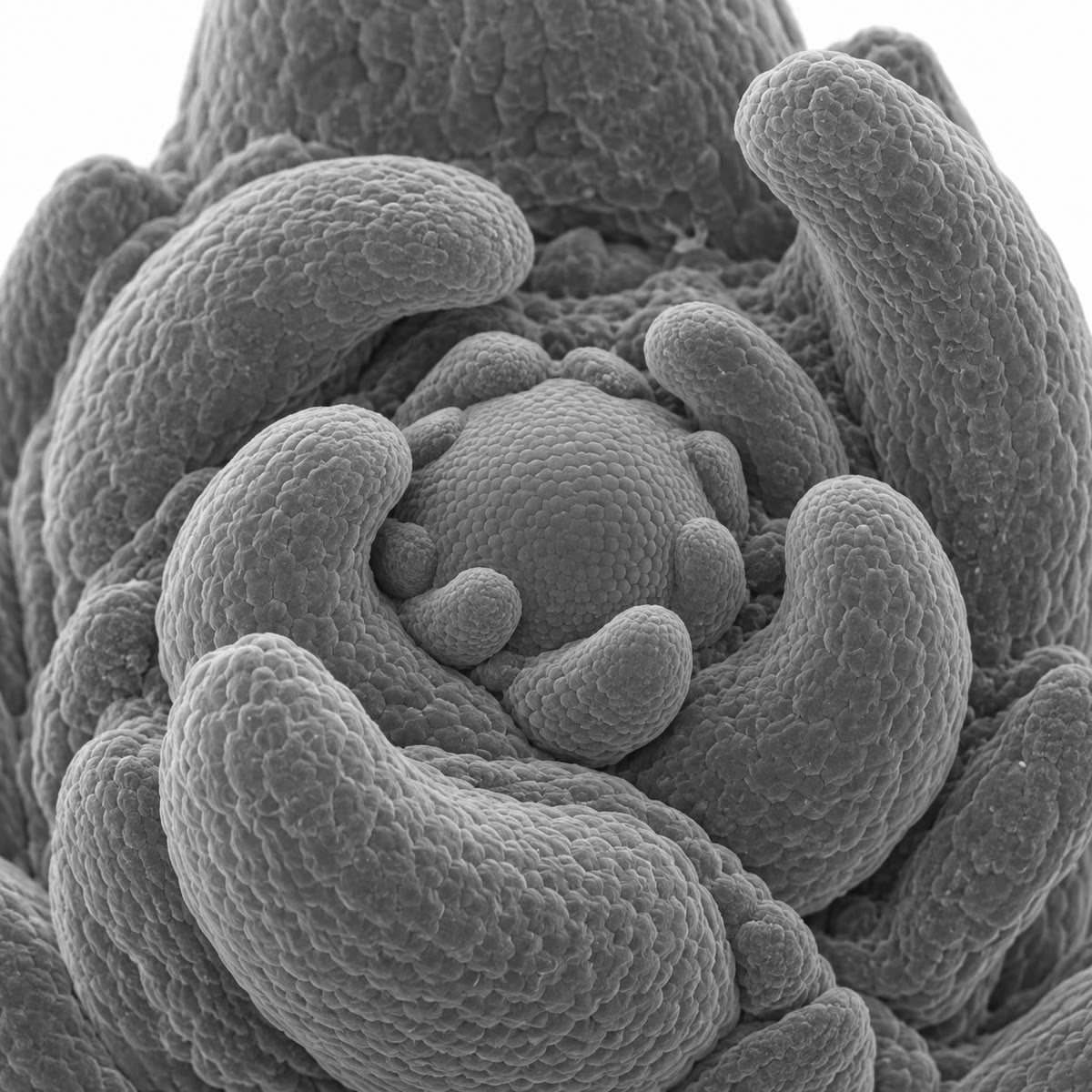
The SAM is a dome a tenth of a millimetre across, of a few hundred cells. Its outer one or two layers (the tunica) divide only in the plane of the surface and give the epidermis; the mass below (the corpus) divides in all planes. At the summit a central zone of slowly dividing stem cells feeds a peripheral zone of faster-dividing cells, where leaf primordia arise as bulges at regular intervals of time (the plastochron, hours to days) and at regular angles around the dome (the phyllotaxis: opposite, whorled, or spiral at the golden angle of , which places each new leaf in the largest gap left by the others). Below, a rib zone makes the pith and lengthens the stem. A primordium forms where the hormone auxin accumulates in the surface layer, and as it grows it drains auxin from its surroundings, which is why the next primordium arises as far from it as possible: the pattern is self-organising.
Proposition 13.3 (Keeping the stem cells: a feedback loop)
The size of the stem-cell pool is held constant by a loop between two genes. Cells just beneath the central zone express the transcription factor WUSCHEL (WUS), whose product moves up into the overlying cells and keeps them as stem cells; the stem cells in turn secrete a small peptide, CLAVATA3 (CLV3), that diffuses down, binds a receptor kinase (CLV1) in the WUS-expressing cells and represses WUS. More stem cells means more CLV3, less WUS, fewer stem cells; fewer stem cells means less CLV3, more WUS, more stem cells. The pool is thus a regulated quantity, like the gonadotropins of Chapter 9, and the same logic — a signal from the regulated population repressing the factor that makes it — holds the root meristem too.
Evidence. Arabidopsis clavata mutants (Clark, Meyerowitz, 1990s) have meristems that swell to many times the normal size, with extra leaves, extra floral organs and fasciated (flattened, ribbon-like) stems: the brake is gone. wuschel mutants make a meristem that stops after a few leaves and then forms new ones, each of which stops in turn: the accelerator is gone. In the double mutant the wuschel phenotype prevails, placing WUS downstream of CLV; and CLV3 peptide applied to a wild-type apex represses WUS within hours. ∎
Proposition 13.4 (The root apex)
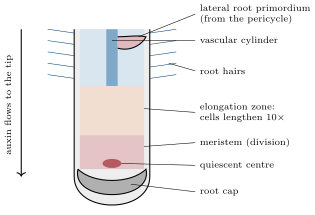
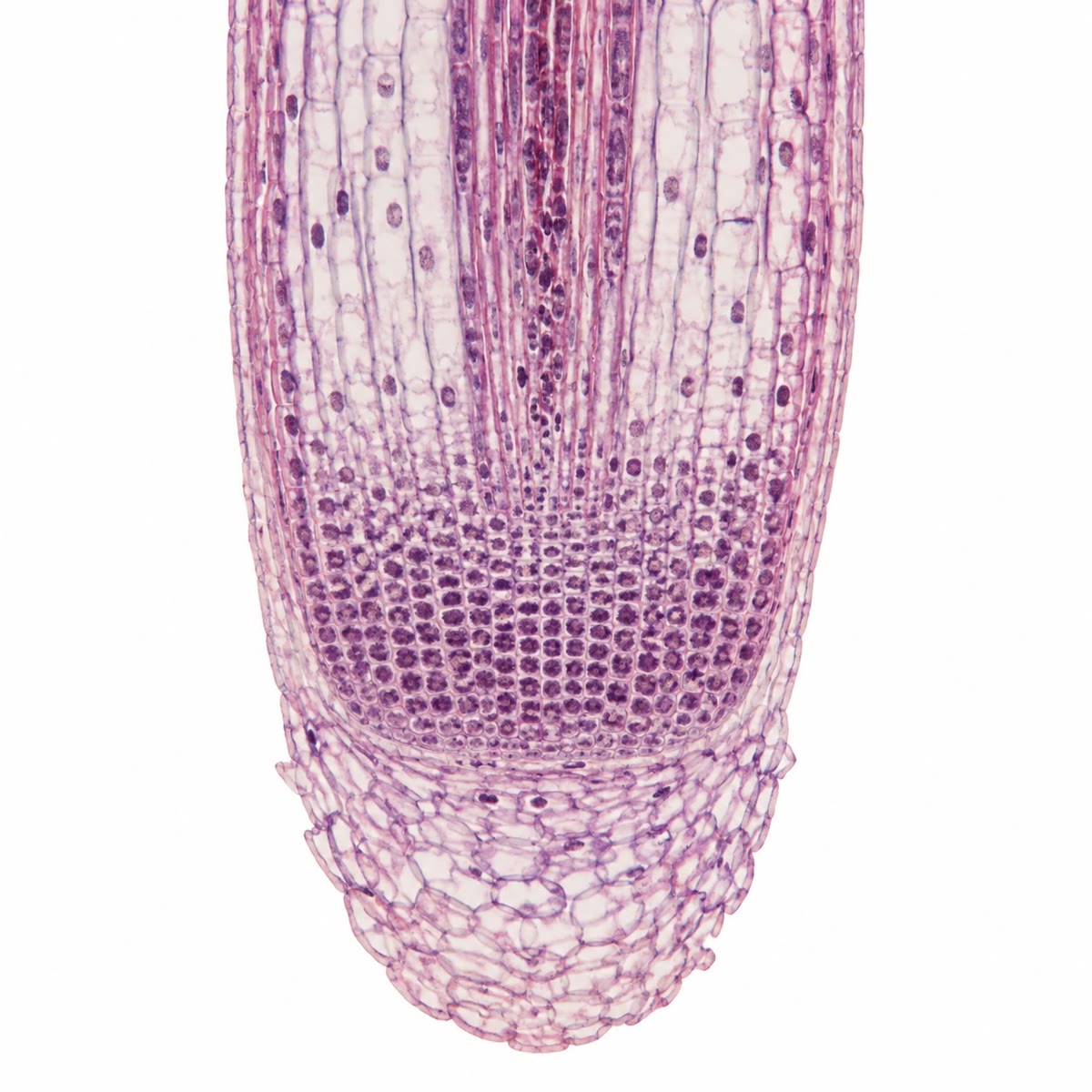
A root grows from a meristem sheltered behind a root cap, whose cells are sloughed off as the tip pushes through the soil and which secretes a lubricating mucilage and senses gravity (starch grains that settle in its cells). At the centre of the meristem a quiescent centre of a few hundred cells divides only rarely; it keeps the surrounding initials — of the cap, the epidermis, the cortex and the vascular cylinder — as stem cells, much as WUS keeps the shoot’s. Behind the meristem comes the elongation zone, a few millimetres in which cells lengthen ten- to twentyfold, driving the tip forward; then the differentiation zone, where the epidermis grows root hairs and xylem and phloem mature. Lateral roots arise not at the tip but from the pericycle, deep inside the mature root, opposite the xylem poles, and push out through the cortex. Auxin, made in the shoot and carried down, accumulates at the tip and organises the whole arrangement; the quiescent centre sits at its maximum.
13.2 How a plant cell grows
Theorem 13.5 (Lockhart’s equation)
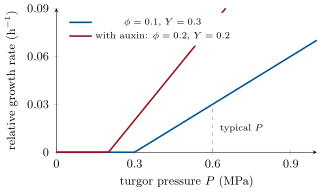
A plant cell grows by stretching its wall under the pressure of its own contents. The wall yields irreversibly only above a threshold turgor , and then at a rate proportional to the excess: the relative growth rate of a cell of length is
where is the turgor pressure and the wall’s extensibility. Growth is therefore controlled from two sides: by water, which sets (a wilting cell stops growing), and by the wall, which sets and — and it is the wall that hormones act on. Auxin makes cells pump protons into the wall; the acid activates expansins, proteins that loosen the bonds between cellulose fibrils and the matrix, raising and lowering within minutes (acid growth). With , and , a cell lengthens by an hour and doubles in a day; in a root’s elongation zone, where the rates are several times higher, a cell lengthens tenfold in a few hours.
Proof. The wall is a viscoplastic material: below the yield stress it deforms elastically and recovers, above it flows at a rate proportional to the excess stress. The stress in the wall is proportional to the turgor pressure (for a cylinder of radius and wall thickness , the hoop stress is ), so the plastic strain rate is proportional to with a constant that absorbs the geometry and the wall’s material properties. The strain rate is by definition . Numerically, , and doubles when , . ∎
Example 13.6 (Where the water comes from)
As the wall yields, the turgor would fall and growth stop, were water not entering to keep pace: the growing cell is a leak that refills itself. The water comes from the xylem, down a small gradient of water potential, and its rate of entry is set by the membrane’s hydraulic conductance; growth is fastest at night, when transpiration is low and turgor high, and a maize leaf can extend between dusk and dawn. Under drought the cells make solutes (osmotic adjustment) to keep above , and when that fails the leaf stops growing days before it wilts.
13.3 Hormones and the shape of the shoot
Proposition 13.7 (Auxin and apical dominance)
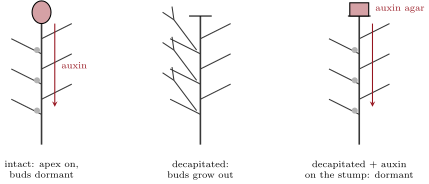
Auxin (indole-3-acetic acid) is made in the shoot apex and young leaves and carried down the stem, cell to cell, at about , by carrier proteins (PIN) set into the lower end of each cell — a polar transport that gives the plant a top-to-bottom axis. The stream of auxin descending from the apex keeps the axillary buds below it dormant (apical dominance), in part by preventing them from exporting their own auxin into the stem, in part by inducing strigolactones and repressing cytokinin. Cut off the apex and the buds nearest the cut grow out within days, making a bushy plant — which is what pruning and pinching exploit. Cytokinins, made in the root tips and carried up in the xylem, promote bud outgrowth and cell division; gibberellins lengthen internodes (dwarf peas and the semi-dwarf wheat of the Green Revolution are defective in making or sensing them); abscisic acid and ethylene brake growth under stress. The shoot’s form — tall or bushy, upright or spreading — is a negotiation among these signals, and the root-to-shoot balance is set by the auxin going down against the cytokinin coming up.
Evidence. Thimann and Skoog (1934) cut the apex from bean plants: the lateral buds grew. A block of agar containing auxin, placed on the cut stump, kept them dormant as the apex had; plain agar did not. Went (1928) had already measured auxin by the bend it produced in decapitated oat coleoptiles when placed on one side of the stump — the first bioassay of a plant hormone, and the origin of the name, from the Greek for “to grow”. The polarity of transport was shown by placing auxin agar on one end of a stem segment and finding it in a receiver block at the other end only when the segment was oriented apex-up, however the segment was turned in the gravity field. ∎
Example 13.8 (Fast signal, slow molecule)
Polar transport moves auxin in an hour; diffusion alone would take, for the same centimetre, — fourteen hours — and for the ten centimetres to a lower bud, sixty days. The pump-and-relay of the PIN carriers is what makes a hormonal signal usable over the length of a plant; the same carriers, moved to the shaded side of a stem, bend it toward the light (Chapter 15).
13.4 Secondary growth: wood and bark
Definition 13.9 (The vascular cambium and wood)
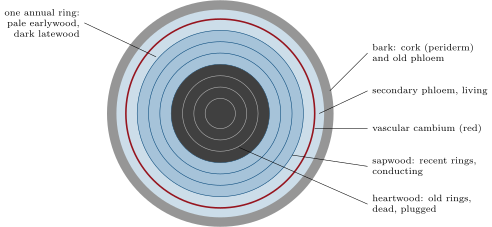
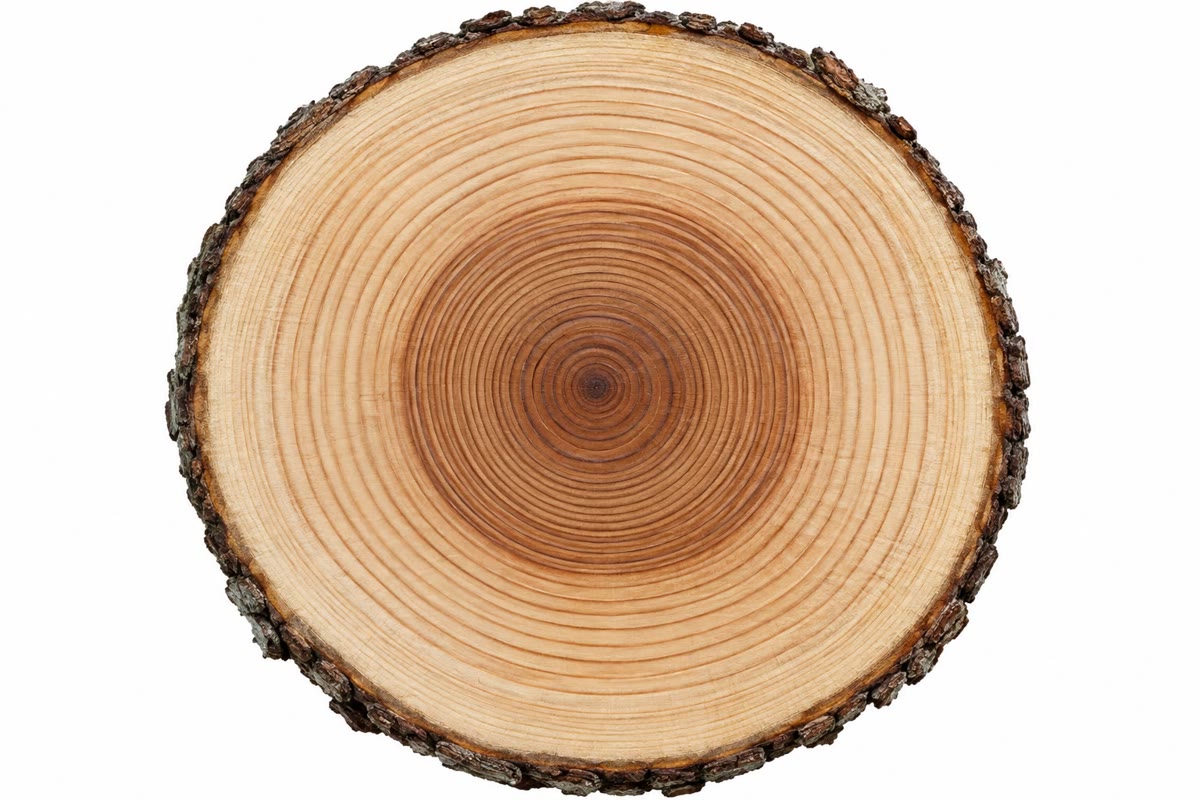
In a woody stem the strands of primary xylem and phloem are joined, in the first year, into a continuous cylinder of dividing cells, the vascular cambium. Its cells divide tangentially, adding secondary xylem — wood — to the inside and secondary phloem to the outside, so that the cambium moves outward as the trunk thickens, and adding occasional radial divisions to widen the ring. In seasonal climates the wood laid down in spring has wide, thin-walled vessels (earlywood) and that of summer narrow, thick-walled ones (latewood), so that each year leaves a visible annual ring; the rings record the tree’s age and, in their widths, the climate of each year (dendrochronology). Only the outer rings, the sapwood, conduct; the inner ones, the heartwood, are dead, plugged and darkened with resins and tannins, and serve as the tree’s skeleton. Outside the phloem a second lateral meristem, the cork cambium, makes the periderm — layers of cork cells, dead and waterproofed with suberin — which with the old phloem is the bark. A trunk is thus a thin living shell of cambium, sapwood and phloem around a dead core, under a dead skin.
Theorem 13.10 (Why an old tree adds more wood)
A trunk of radius and height whose cambium adds a ring of thickness each year gains a volume of wood
per year: for a constant ring width, the annual increment grows in proportion to the radius, and a tree of radius adds ten times the wood of one with , though its rings are no wider. A trunk of radius and height adding a year gains , about of dry wood — of carbon, drawn from the air by the crown in one season.
Proof. The wood added is a cylindrical shell of circumference , thickness and height ; its volume is to first order in (exactly ). With , , : ; at dry, , half of it carbon. ∎
13.5 Exercises
Exercise 13.1 ★
Define meristem, and name the four meristems of a woody plant with what each produces.
Solution
Solution of Exercise 13.1.
A meristem is a persistent population of undifferentiated dividing cells from which the plant’s tissues derive. Shoot apical meristem: leaves, stem, flowers; root apical meristem: the root; vascular cambium: secondary xylem (wood) and phloem; cork cambium: the periderm (cork) of the bark.
Exercise 13.2 ★
List the zones of a root tip from the cap upward, with what happens to a cell in each. Where do lateral roots come from?
Solution
Solution of Exercise 13.2.
Root cap (protection, lubrication, gravity sensing, cells sloughed off); meristem with the quiescent centre (division); elongation zone (cells lengthen ten- to twentyfold); differentiation zone (root hairs, mature xylem and phloem). Lateral roots arise from the pericycle of the mature root, opposite the xylem poles.
Exercise 13.3 ★
Describe the Thimann–Skoog experiment, its control, and its conclusion.
Solution
Solution of Exercise 13.3.
Bean plants were decapitated: the lateral buds grew out. On a second set the cut stump received an agar block containing auxin: the buds stayed dormant; on the control set, a plain agar block: the buds grew. Conclusion: auxin from the apex is what inhibits the lateral buds — apical dominance is hormonal.
Exercise 13.4 ★
A trunk section shows 60 rings, the outer 15 pale and the rest dark. Give the age of the tree, the age of its sapwood, and say which part of the trunk is alive.
Exercise 13.5 ★★
With , , compute the relative growth rate at , and , and the doubling time at each. A drought lowers to : what happens?
Solution
Solution of Exercise 13.5.
: (doubling in ), (), (). At the turgor is below the yield threshold: growth stops, before any wilting.
Exercise 13.6 ★★
Successive leaves arise at from one another. Compute the angular positions of leaves 1 to 8 (modulo ) and show that no two of the first eight lie within of each other. Why does this matter to the plant?
Solution
Solution of Exercise 13.6.
Leaves 1–8 at 0, 137.5, 275, 52.5, 190, 327.5, 105, . Sorted: 0, 52.5, 105, 137.5, 190, 242.5, 275, 327.5 — the smallest gap is . Each leaf sits in a gap of the previous ones, so the eight shade one another as little as possible and the crown fills the disc of light evenly.
Exercise 13.7 ★★
A tree tall adds rings of . Compute the wood added in the year its radius is and in the year it is , and the corresponding carbon (dry density , half carbon).
Solution
Solution of Exercise 13.7.
: at , , , of carbon; at , , , of carbon — eight times more from the same ring width.
Exercise 13.8 ★★
Predict the phenotypes of a clv3 mutant, a wus mutant, and the double mutant, and explain the order of the two genes in the loop from the double mutant.
Solution
Solution of Exercise 13.8.
clv3: no brake — enormous meristems, extra leaves and floral organs, fasciated stems. wus: no accelerator — the meristem runs out after a few leaves and is repeatedly re-founded. Double mutant: the wus phenotype, so WUS acts downstream of CLV3: CLV3’s job is to repress WUS, and without WUS there is nothing to repress.
Exercise 13.9 ★★
Auxin is transported at ; its diffusion coefficient in tissue is . How long does the signal take to reach a bud below the apex by transport, and by diffusion ()? What does polar transport buy the plant?
Solution
Solution of Exercise 13.9.
Transport: . Diffusion: , about 230 days. Polar transport makes a hormonal signal usable over the length of a plant within a day, and gives it a direction.
Exercise 13.10 ★★★
A maize root grows a day. Meristem cells are long and elongate tenfold before maturing; each cell file has about dividing cells. How many cells must each file’s meristem produce per day, and what cell-cycle time does that imply?
Solution
Solution of Exercise 13.10.
a day of mature tissue with cells of : cells per file per day. A hundred dividing cells must therefore each divide 1.5 times a day: a cycle of about .
Exercise 13.11 ★★★
The semi-dwarf wheats of the 1960s carry mutations that make the plant insensitive to gibberellin. Explain why they are short, why a short plant can yield more grain when fertilised heavily, and why the same mutation in a wild plant would be a disadvantage.
Solution
Solution of Exercise 13.11.
Gibberellin lengthens internodes; a plant that cannot respond has short internodes and a short stem. Heavy nitrogen fertiliser makes a tall wheat grow taller and heavier-headed until it falls over (lodges) and rots; a short stiff stem stands, and puts the extra carbon into grain rather than straw, so the harvest index rises. In the wild a short plant is overtopped and shaded by its neighbours and loses.
Exercise 13.12 ★★★
“An animal is built once; a plant is built all its life.” Discuss the consequences of meristematic growth for a plant’s ability to respond to its environment, to survive damage, and to live for millennia — and one cost of the strategy.
Solution
Solution of Exercise 13.12.
Meristems let a plant add organs where and when conditions favour them — leaves toward light, roots toward water — and abandon those that do not pay; every axillary bud is a spare growing point, so grazing, fire and pruning are survived by regrowth; and because the meristems are perpetually embryonic, a genet has no fixed lifespan. The cost: a plant cannot move or reorganise what it has built — an organ once placed stays where it is, and a body built by accretion must carry its dead past (the heartwood) with it.
13.6 Problem: A Tree in Numbers
Problem 13.1
Weekend problem — a young tree followed for a year: the leaves its apex makes, the growth of an internode by Lockhart’s law, the wood its cambium lays down and the carbon that costs, and the response of its buds to pruning, ending on the leaves per year, the internode’s hourly growth and the year’s wood
A young lime tree has growing shoot tips; each apex initiates a leaf every days during a -day season, at intervals. A growing internode is long, its cells have , ; turgor is by day and by night ( each). The trunk is tall with a radius of ; the cambium adds a year; dry wood is and half carbon. The crown carries of leaves fixing a net of carbon per square metre per day for days.
Part I — Leaves.
- How many leaves does one apex make in a season? The whole tree?
- Compute the angular positions of leaves 1 to 5 on one shoot.
- After how many leaves does a leaf fall within of leaf 1? (Try multiples of .)
- What does the golden angle achieve for the plant, and which hormone’s transport produces it?
- If each leaf has an area of , what leaf area does the tree build in a season? Compare with the it carries in midsummer.
- The tree is deciduous. What fraction of its leaf area does it rebuild each spring, and where does the carbon for the first leaves come from?
- A clv3 mutation triples the size of every apex. What would change in the answers to questions 1 and 5, and what would the shoots look like?
Part II — An internode.
- Compute the relative growth rate by day and by night.
- Compute the length added in one day and one night, starting from .
- Over four such days, what is the internode’s length? (Treat growth as compounding, with the mean rate.)
- A gibberellin treatment lowers to . Recompute the day and night rates.
- A drought holds turgor at day and night. Compute the rate, and say what osmotic adjustment does.
- Explain why night growth exceeds day growth even though photosynthesis happens by day.
Part III — Wood.
- Compute the volume of wood added this year and its dry mass.
- Compute the carbon in it.
- Compute the carbon fixed by the crown over the season.
- What fraction of the crown’s carbon went into trunk wood? Name three other sinks.
- In twenty years, at the same ring width, what will the annual wood increment be? Why does it rise?
- Two rings of the trunk are half the width of their neighbours. Suggest two causes and how a dendrochronologist would tell them apart.
Part IV — Buds and pruning.
- The gardener cuts back every shoot tip. Predict the response of the axillary buds and the shape of the tree in a month.
- How would an auxin paste on each cut alter the response?
- A hedge is clipped six times a year. Explain, with apical dominance, why it becomes dense.
- A tree coppiced to a stump regrows a dozen shoots. Where do they come from, and why can a plant survive the loss of every shoot when an animal cannot survive the loss of its head?
- Cytokinin from the roots rises after the roots are watered. Predict the effect on bud outgrowth.
- State the result: leaves per apex and per tree per season, the internode’s day and night growth rates, and the year’s wood and carbon.
Solution
Solution of Problem 13.1.
1. leaves per apex; for the tree. 2. 0, 137.5, 275, 52.5 and . 3. ; ; : the 22nd leaf is the first within of the first. 4. Each new leaf sits in the widest gap, so leaves shade one another least; it is auxin, whose polar transport (PIN carriers) drains the surroundings of each primordium, that sets the spacing. 5. : the whole crown is this season’s leaves. 6. All of it; the first leaves are built from starch stored in the wood and roots the previous year. 7. A tripled apex makes primordia faster — two or three per plastochron — so leaves and leaf area could triple, but the shoots would be fasciated, with ribbon-like stems and disordered phyllotaxis, and much of the extra leaf would shade itself. 8. Day: ; night: . 9. Day: , added; night: , added. 10. Mean rate over : . 11. Day: ; night: . 12. , a quarter of the normal day rate. Osmotic adjustment raises the cell’s solute content so that, at the same water potential, turgor rises back above the threshold. 13. By day transpiration lowers the water potential of the leaf and turgor with it, so is small; at night turgor is restored. Growth is limited by water, not by sugar, hour by hour. 14. ; dry. 15. of carbon. 16. of carbon. 17. . Other sinks: the leaves themselves, roots, branches and twigs, the respiration of every living cell (about half of what is fixed), reserves, flowers and seeds. 18. Radius : , twice this year’s — the circumference the cambium works along has doubled (and the tree will be taller). 19. A dry or cold year; or a defoliation by insects, frost or fire. A climate cause narrows the same rings in every tree of the region and correlates with weather records; damage affects one tree or stand, and frost or fire leaves anatomical scars in the ring. 20. The buds nearest each cut grow out within days into several shoots; in a month the tree is bushier and denser, with more but shorter shoots. 21. Auxin on the cut replaces the apex’s signal: the buds stay dormant and no branching follows. 22. Every clipping removes the apices and releases the buds below; six times a year, each release adds a tier of short shoots, and the surface fills with them. 23. From dormant axillary buds on the stump and adventitious buds formed by the cambium; each bud is a complete meristem able to rebuild the shoot system, whereas an animal’s head is a single, non-replaceable organiser with no reserve copies. 24. More cytokinin reaching the buds promotes their outgrowth — watering a pruned plant makes it branch more. 25. 50 leaves per apex, per tree; internode rates by day and by night; the year’s wood , dry, of carbon.