全部书籍

专业

应用 关于 Coach 登录 开始阅读

书籍暂未推出简体中文版——当前显示英文版。

Biology · 术语表

什么是 Phylogeny, clade, homology?

Definition 24.1 University Biology — Year 2 · 第 24 章 — Phylogenetic Trees and the Molecular Clock

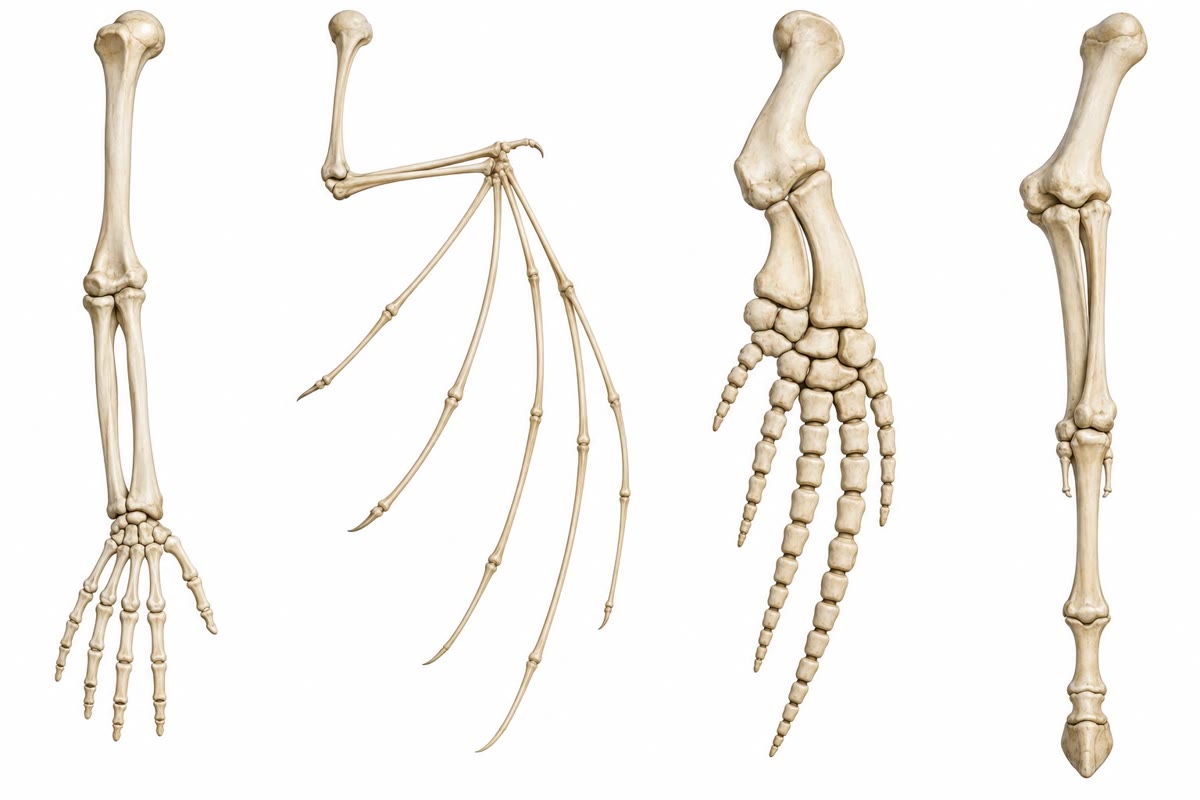
A phylogeny is a tree whose tips are the species (or genes, or individuals) compared, whose internal nodes are their common ancestors, and whose root is the oldest ancestor of all. Its branching order alone carries the history: nodes may be rotated freely, and only the nesting matters. A clade or monophyletic group is an ancestor with all its descendants (birds; mammals; birds and crocodiles together); a paraphyletic group is an ancestor with some descendants left out (“reptiles” without birds, “fish” without tetrapods, “prokaryotes”); a polyphyletic group joins descendants of different ancestors by a resemblance they evolved separately (“warm-blooded animals”). A character shared by two species because their ancestor had it is a homology (the bones of the bat’s wing and the whale’s flipper); one they evolved independently is an analogy or homoplasy (the wings of bats and of birds as wings, the camera eyes of vertebrates and octopuses). Only homologies record history, and among them only the derived states shared by a group — its synapomorphies, Hennig’s word — define a clade: feathers define birds, the ancestral state “no feathers” defines nothing.
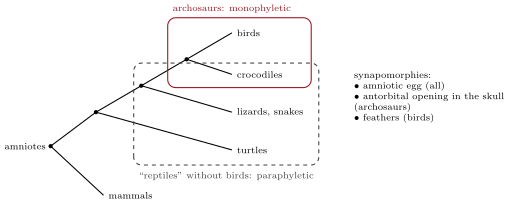
Reading a tree. Birds nest inside the reptiles: crocodiles are closer to birds than to lizards. The named group “reptiles” is an ancestor with one line of descendants removed — a paraphyletic grade, not a clade.
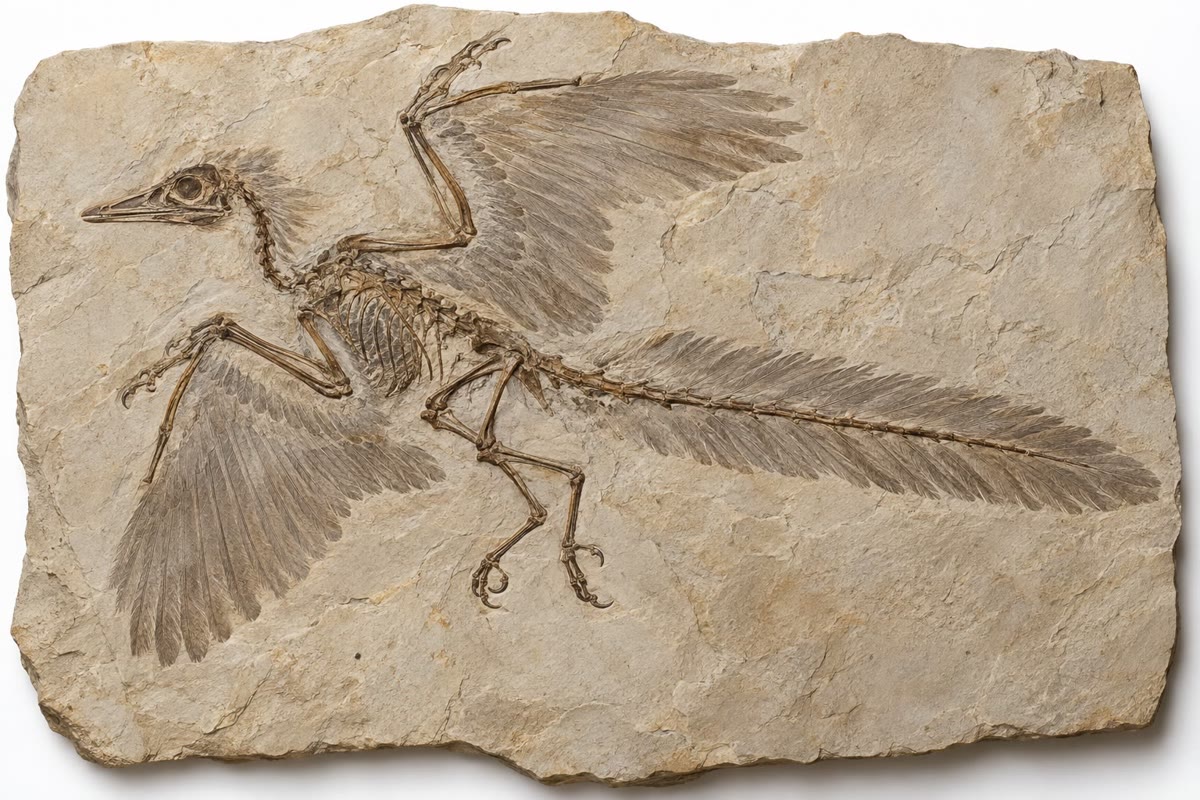
Homology and its record. Left: the same bones — humerus, radius and ulna, wrist, five digits — in an arm, a wing, a flipper and a leg. Right: Archaeopteryx, with the teeth, clawed fingers and long bony tail of a small dinosaur and the feathers of a bird. Homology and its record. Left: the same bones — humerus, radius and ulna, wrist, five digits — in an arm, a wing, a flipper and a leg. Right: Archaeopteryx, with the teeth, clawed fingers and long bony tail of a small dinosaur and the feathers of a bird.
Homology and its record. Left: the same bones — humerus, radius and ulna, wrist, five digits — in an arm, a wing, a flipper and a leg. Right: Archaeopteryx, with the teeth, clawed fingers and long bony tail of a small dinosaur and the feathers of a bird.
在原文中阅读 →