 Coach
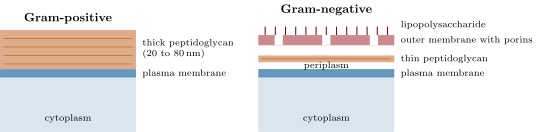
CoachA prokaryote (the bacteria and the archaea, two domains as distinct from each other as either is from us) is a cell without a nucleus or membrane-bound organelles: a single circular chromosome in a nucleoid, often with small extra circles called plasmids, ribosomes free in a cytoplasm of , a plasma membrane that carries the respiratory or photosynthetic chains, and a rigid cell wall that resists the turgor of a cytoplasm several bars above its surroundings. Shapes are few and named: coccus (sphere), bacillus (rod), spirillum and spirochaete (helices), vibrio (comma); cells may stay in pairs, chains, tetrads or clusters after dividing.
Examples
Example 1.10 (Cyanobacteria and the heterocyst)
Cyanobacteria are the bacteria that photosynthesise as plants do, splitting water and releasing oxygen on stacked internal membranes (the thylakoids, which the chloroplast inherited from them). Many grow as filaments of cells sharing a sheath. In Anabaena, when combined nitrogen runs out, every tenth cell or so becomes a heterocyst: it dismantles its oxygen-producing photosystem, thickens its wall against oxygen, and fixes atmospheric nitrogen with an enzyme that oxygen would destroy, exporting glutamine to its neighbours in exchange for sugar. A filament of Anabaena is a first sketch of a division of labour between cells.