 Coach
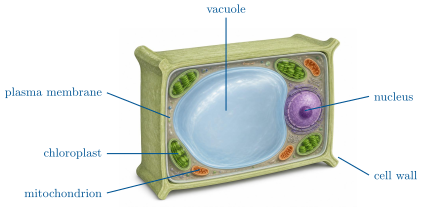
CoachA cell whose DNA is enclosed in a nucleus is a eukaryotic cell: animals, plants, fungi and many single-celled organisms are eukaryotes. A prokaryotic cell has no nucleus and no membrane-bound organelles: its DNA lies free in the cytoplasm, its size is around , and it is surrounded by a wall of its own kind. Bacteria are prokaryotes.
Examples
Example 2.10 (Reading a bacterium)
An electron micrograph of the gut bacterium Escherichia coli shows a rod long and wide: a wall, a membrane just inside it, a granular cytoplasm packed with ribosomes, and a paler central region where the single circular DNA molecule lies. No nucleus, no mitochondria. Yet the cell feeds, grows and divides every twenty minutes in a rich broth: everything the cell theory demands, in a thousandth of the volume of a cheek cell.