 Coach
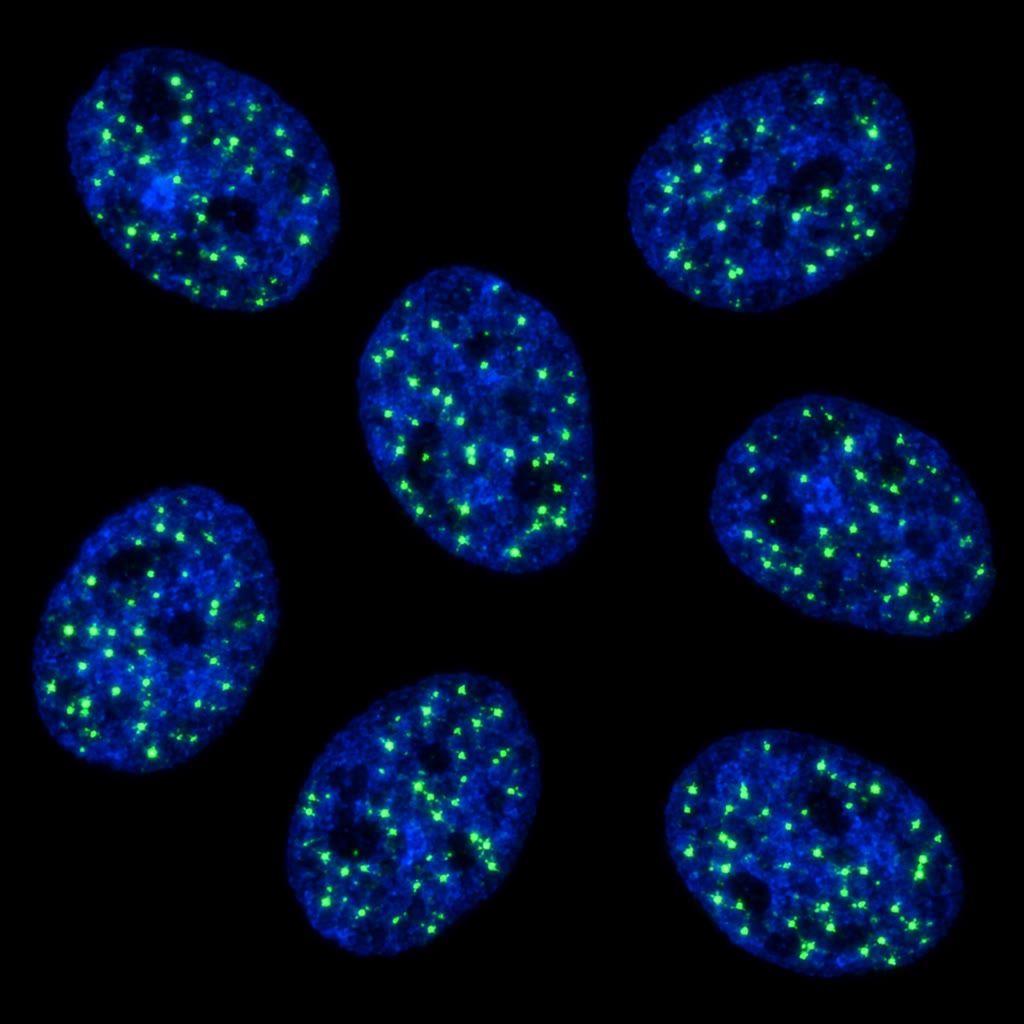
CoachEukaryotes signal damage through two kinases: ATM, recruited by the MRN complex to double-strand breaks, and ATR, recruited to the single-stranded DNA of stalled forks. They phosphorylate hundreds of targets. Within minutes histone H2AX is phosphorylated (-H2AX) over megabases around each break, forming a focus that recruits repair proteins and can be counted under the microscope, one focus per break. The kinases Chk1 and Chk2 halt the cell cycle — the checkpoints of Chapter 10 — by inactivating the phosphatases that would drive entry into S or M; and the transcription factor p53, stabilised by phosphorylation, induces the cyclin-dependent kinase inhibitor p21 (a durable arrest in G1), repair genes, and, if the damage is heavy or persists, the apoptotic genes that kill the cell. The response buys time for repair, and when repair fails removes the cell rather than let it divide with a broken genome.
Examples
Example 3.13 (Synthetic lethality: BRCA and PARP)
Women who inherit one defective copy of BRCA1 or BRCA2 have a lifetime risk of breast cancer of ; the tumours arise in cells that have lost the second copy and can no longer do homologous recombination. Such cells repair their double-strand breaks by end joining alone and accumulate rearrangements. They also acquire a specific weakness. Single-strand breaks, some a day, are repaired by a route that needs the enzyme PARP; when PARP is inhibited by a drug, single-strand breaks persist to S phase, where a fork converts each into a double-strand break with only one end — repairable only by recombination. A normal cell, with one good BRCA allele, copes; the tumour cell dies. Two defects, each harmless alone, are lethal together: the drug kills by synthetic lethality, and spares the patient’s other cells.