 Coach
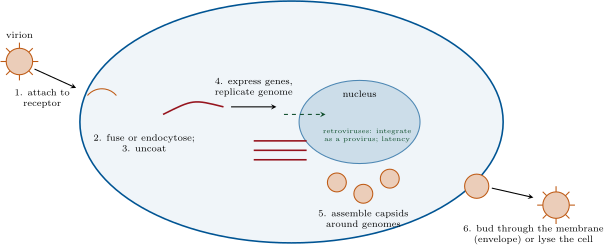
CoachEvery virus passes through the same stages. Attachment to a specific host receptor — CD4 and a chemokine receptor for HIV, ACE2 for the SARS coronaviruses, sialic acid for influenza, a lipopolysaccharide or a porin for a phage — which decides which species and which cells the virus can infect (its tropism). Entry: fusion of the envelope with the plasma membrane, or endocytosis followed by fusion from within the acid endosome, or, for a phage, injection of the genome through the wall. Uncoating, expression of the viral genes by the class-specific route, and replication of the genome, often in a factory the virus builds in the cytoplasm or nucleus. Assembly of new capsids around new genomes, driven by the self-assembly of the symmetric subunits, and release: by lysis of the cell, or by budding through a membrane, which supplies the envelope. Some viruses can instead insert their genome into the host’s and wait: the lysogeny of phage , whose repressor keeps it silent until the host is damaged; the latency of herpesviruses in neurons for a lifetime and of HIV as a provirus in resting T cells, from which it is not removed by any drug that acts on replication.
Examples
Example 13.6 (HIV before and after the equations)
Until 1995 the years of clinical latency of HIV infection — a stable viral load of – copies per millilitre and a slow fall of T cells — were read as a quiescent virus. Ho, Perelson and colleagues gave patients a protease inhibitor and fitted the decline of the viral load to the theorem: the fast phase gave (a virion half-life of about six hours), the slow phase (an infected cell lives about a day and a half). A steady load of per millilitre in of body fluid, cleared at , therefore requires the production of about virions a day, every day, for years: the “latent” period is a furious steady state of infection and death, with the T cell pool replaced daily until it fails. The mutation arithmetic of the next section then follows at once, and with it the reason single drugs failed and three did not.