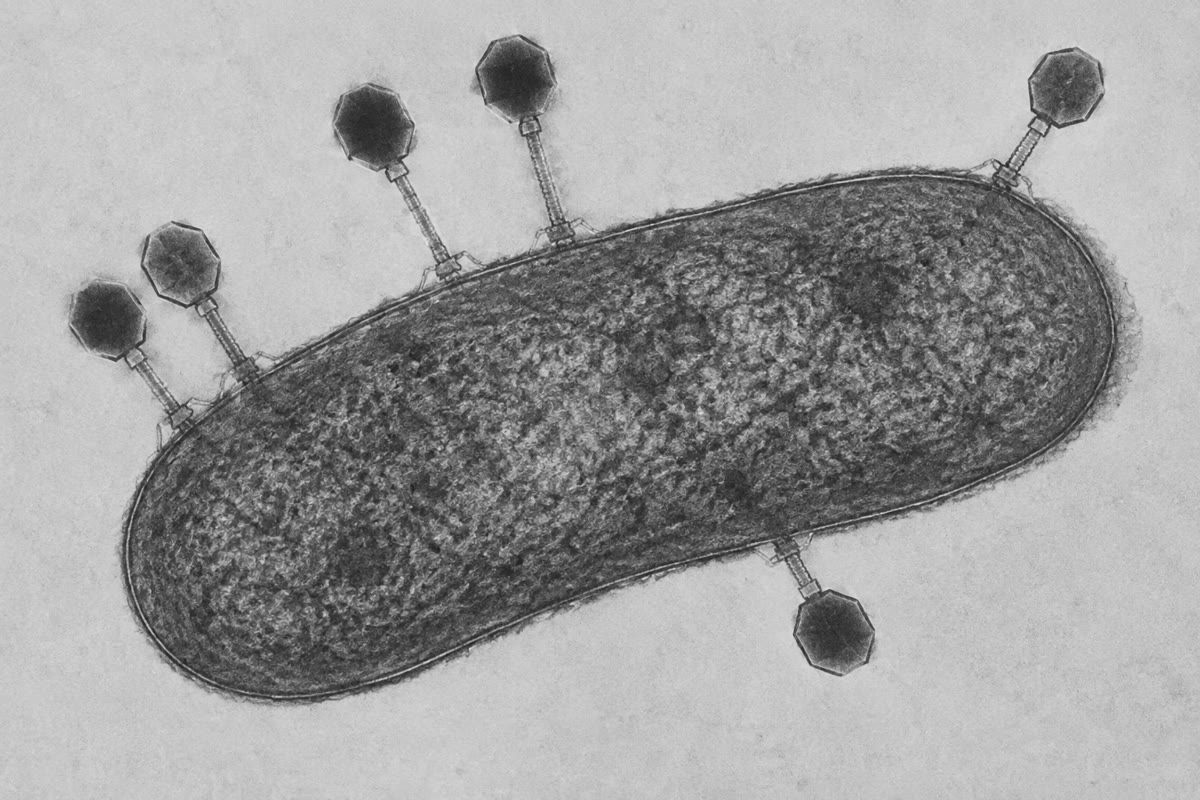
A virus is an obligate intracellular parasite consisting of a nucleic acid genome — DNA or RNA, single- or double-stranded, linear or circular, one molecule or several — packaged in a protein capsid, and in many cases wrapped in an envelope taken from a host membrane and studded with viral glycoproteins. The complete infectious particle is the virion, 20 to 300nm across for most (a few giant viruses reach a micrometre). Capsids are built from many copies of one or a few proteins arranged with helical symmetry (a rod, as in tobacco mosaic virus) or icosahedral symmetry (a shell of 60T subunits, T=1,3,4,7,…). The Baltimore classification groups viruses by the route from genome to messenger RNA: I, double-stranded DNA (herpes, pox, adenovirus, most phages); II, single-stranded DNA (parvovirus); III, double-stranded RNA (rotavirus); IV, positive-strand RNA, itself a messenger (polio, hepatitis C, the coronaviruses); V, negative-strand RNA, complementary to messenger (influenza, measles, rabies, Ebola); VI, RNA reverse-transcribed into DNA (the retroviruses, HIV); VII, DNA replicated through an RNA intermediate (hepatitis B). Every class but I must bring or encode an enzyme the cell lacks — an RNA-dependent RNA polymerase, a reverse transcriptase — and those enzymes are the targets of most antiviral drugs.
Examples
Example 13.6 (HIV before and after the equations)
Until 1995 the years of clinical latency of HIV infection — a stable viral load of 104–106 copies per millilitre and a slow fall of T cells — were read as a quiescent virus. Ho, Perelson and colleagues gave patients a protease inhibitor and fitted the decline of the viral load to the theorem: the fast phase gave c≈3d−1 (a virion half-life of about six hours), the slow phase δ≈0.5d−1 (an infected cell lives about a day and a half). A steady load of 105 per millilitre in 15L of body fluid, cleared at c, therefore requires the production of about 1010 virions a day, every day, for years: the “latent” period is a furious steady state of infection and death, with the T cell pool replaced daily until it fails. The mutation arithmetic of the next section then follows at once, and with it the reason single drugs failed and three did not.
Example 13.9 (Why HIV needed three drugs)
HIV’s reverse transcriptase errs about once in 105 nucleotides, so each 9700nt genome copied carries about 0.1 mutations, and 1010 new genomes a day carry 109 mutations among them: every one of the 3×9700≈30000 possible single point mutations arises many times every day, before any drug is given. A drug that a single mutation defeats — as one mutation defeats most reverse-transcriptase and protease inhibitors — is therefore defeated within weeks, which is what happened to AZT in 1987. Two independent mutations arise together at 10−10 per genome, about once a day; three at 10−15, once in a thousand days — and a patient on three drugs whose load has fallen a thousandfold produces 107 genomes a day, so the triple mutant never appears. That, and the theorem’s demonstration that the virus was replicating at full speed, made combination therapy from 1996 the treatment that turned AIDS into a chronic condition.
 Coach
Coach