Coach
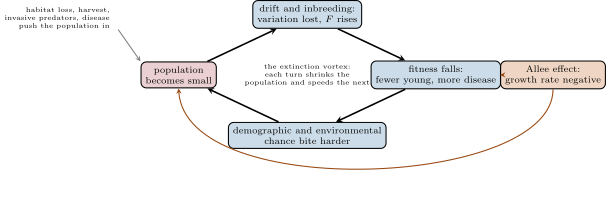
CoachA large population declines when its death rate exceeds its birth rate; a small one can vanish without any change in either. Demographic stochasticity is the chance that, among a few individuals, more happen to die than are born, or all the survivors are male: it matters below a few dozen. Environmental stochasticity — a bad winter, a drought, a disease — strikes every individual at once, and a population of a few hundred that a large one would ride out can be wiped out; catastrophes are its tail. The Allee effect makes the per-capita growth rate fall at low density — mates cannot be found, colonial breeders cannot nest, herds cannot defend their young, the passenger pigeon’s flocks could not saturate the predators that took their squabs — so that below a threshold density the population declines toward zero on its own. And below a few hundred, the genetic processes of the next section reduce fitness generation by generation. These feed one another: a smaller population loses variation, becomes less fertile, grows smaller, is likelier to be hit by chance, and loses more — the extinction vortex (Gilpin and Soulé, 1986). A minimum viable population is the size above which the probability of extinction over a stated horizon (say in a century) is acceptable; it depends on the species’ biology and on how variable its environment is, and is usually in the thousands.