
সব বই

পেশাদার

1 Markets I: The Ecosystem and Exchange-Traded Marketsবাজার অনলাইন 2 Markets II: Rates, FX and Creditবাজার অনলাইন 3 Markets III: Commodities, Energy and Cryptoবাজার অনলাইন 4 Quantitative Methodsপদ্ধতি অনলাইন 5 Derivatives and Volatilityডেরিভেটিভস অনলাইন 6 Rates, Credit, XVA and Riskসুদহার, ঋণ ও ঝুঁকি অনলাইন 7 Research Craft: Predictors, Backtests, Measurement, Portfoliosগবেষণা অনলাইন 8 Strategies I: Equities and Futuresকৌশল অনলাইন 9 Strategies II: Volatility, Relative Value, Macro and the Bank Desksকৌশল অনলাইন 10 Microstructure and Executionএক্সিকিউশন অনলাইন 11 Market Making and High-Frequency Tradingমার্কেট মেকিং অনলাইন 12 Machine Learning for Marketsমেশিন লার্নিং অনলাইন 13 Low-Latency Softwareপ্রযুক্তি অনলাইন 14 Networks, Hardware and Trading Infrastructureপ্রযুক্তি অনলাইন 15 Research, Data and Risk Platformsপ্রযুক্তি অনলাইন 16 The Desk and the Firmপ্রতিষ্ঠান অনলাইন 17 The Industry: Firms, Roles and Careersক্যারিয়ার অনলাইন 18 Interviews I: Maths, Probability and Speedক্যারিয়ার অনলাইন 19 Interviews II: Markets, Trading Games and the Final Roundক্যারিয়ার অনলাইন 20 Interviews III: Codeক্যারিয়ার অনলাইন
অ্যাপ পরিচিতি Coach সাইন ইন পড়া শুরু করো

বইগুলো এখনো বাংলা ভাষায় পাওয়া যায় না — ইংরেজি সংস্করণ দেখানো হচ্ছে।

Biology · পরিভাষা

The segmentation hierarchy কী?

Definition 23.1 University Biology — Year 3 · অধ্যায় 23 — Developmental Genetics and Evolution of Form

The Drosophila embryo develops for its first thirteen nuclear divisions as a syncytial blastoderm, a single cell whose nuclei share one cytoplasm, so that proteins diffuse freely from where they are made. Four gradients laid down by the mother’s cells set the axes: bicoid mRNA is tethered at the anterior pole and its protein diffuses back to form an exponential gradient from head to tail; nanos mRNA at the posterior pole makes the mirror gradient; hunchback and caudal mRNAs are uniform, but Bicoid protein represses caudal translation and Nanos represses hunchback, so their proteins form gradients too. These maternal-effect products, whose mutant phenotype depends on the mother’s genotype and not the embryo’s, switch on the gap genes (hunchback, Krüppel, knirps, giant) in broad bands, each responding to a range of Bicoid concentration and repressing its neighbours; the gap proteins, in combination, switch on the pair-rule genes (even-skipped, fushi tarazu, hairy) in seven stripes each, alternating; and the pair-rule proteins switch on the segment polarity genes (engrailed, wingless, hedgehog) in fourteen stripes, one per segment, which fix each segment’s front and back and are maintained, after the cells form, by signalling between them. Three hours, four tiers, from a single gradient to fourteen segments — and the mutant names record the screen: hunchback lacks the thorax, Krüppel (“cripple”) the middle, fushi tarazu (“not enough segments”) every other segment, hedgehog has a lawn of bristles.
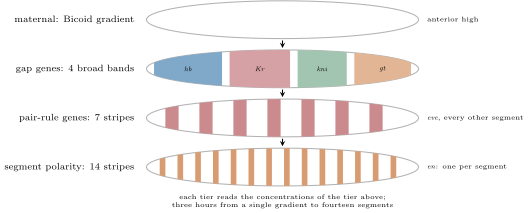
The segmentation hierarchy. A maternal gradient is read into four gap-gene bands; the gap proteins, in combination, into seven pair-rule stripes; those into fourteen segment-polarity stripes. Each stripe is a boundary drawn where a concentration crosses a threshold.
প্রসঙ্গসহ পড়ো →