
All books

Professional

Apps About Coach Log in Start reading

Chemistry · Glossary

What is Beckmann rearrangement?

Definition 27.17 University Chemistry — Year 3 · Chapter 27 — Radicals, Carbenes and Rearrangements

The Beckmann rearrangement turns an oxime, in strong acid, into an amide: the hydroxy group, activated as a leaving group, departs while the group anti to it migrates from carbon to nitrogen; water adds to the nitrilium ion formed, and tautomerisation gives the amide.
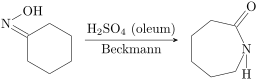
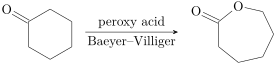
Two ring expansions of cyclohexanone. Top: its oxime rearranges in oleum to caprolactam (azepan-2-one), the monomer of nylon-6, nitrogen entering the ring. Bottom: a peroxy acid inserts an oxygen atom next to the carbonyl group, giving -caprolactone (oxepan-2-one). Two ring expansions of cyclohexanone. Top: its oxime rearranges in oleum to caprolactam (azepan-2-one), the monomer of nylon-6, nitrogen entering the ring. Bottom: a peroxy acid inserts an oxygen atom next to the carbonyl group, giving -caprolactone (oxepan-2-one).
Two ring expansions of cyclohexanone. Top: its oxime rearranges in oleum to caprolactam (azepan-2-one), the monomer of nylon-6, nitrogen entering the ring. Bottom: a peroxy acid inserts an oxygen atom next to the carbonyl group, giving ε\varepsilon-caprolactone (oxepan-2-one).
Read in context →