All books

Professional

Apps About Coach Log in Start reading

Chemistry · Glossary

What is Bond energy?

Definition 37.6 School Chemistry — Grades 1 to 12 · Chapter 37 — The Energy of Reactions: Combustion and Bond Energies

The bond energy of a covalent bond is the energy needed to break one mole of such bonds, the molecules and atoms being gases. Tables give average values, measured over many molecules, in kJ/mol\mathrm{kJ}/\mathrm{mol}.

bondkJ/mol\mathrm{kJ}/\mathrm{mol}bondkJ/mol\mathrm{kJ}/\mathrm{mol}bondkJ/mol\mathrm{kJ}/\mathrm{mol}
H−H\ce{H-H}436C−C\ce{C-C}345O=O\ce{O=O}498
C−H\ce{C-H}415C=C\ce{C=C}611N≡N\ce{N#N}946
N−H\ce{N-H}390C−O\ce{C-O}350Cl−Cl\ce{Cl-Cl}243
O−H\ce{O-H}464C=O\ce{C=O}741H−Cl\ce{H-Cl}432
Average bond energies. Breaking a bond always costs energy; forming it gives the same energy back.
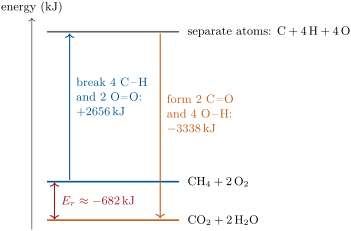
The combustion of methane as two imaginary steps, with average bond energies: breaking every bond, then forming the new ones. The estimate, -682\, kJ per mole of methane, is exothermic.
The combustion of methane as two imaginary steps, with average bond energies: breaking every bond, then forming the new ones. The estimate, −682 kJ-682\,\mathrm{kJ} per mole of methane, is exothermic.
Read in context →