School Chemistry — Grades 1 to 12 · Grades 1–12
37The Energy of Reactions: Combustion and Bond Energies
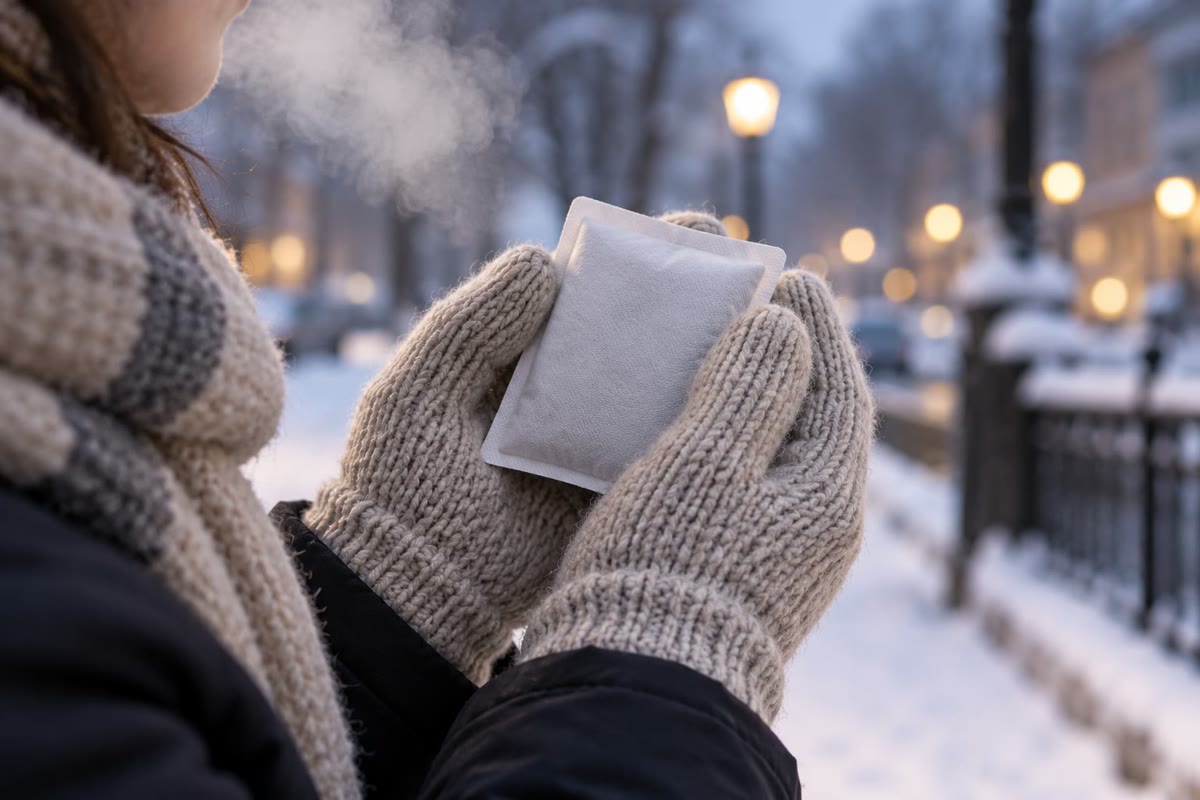
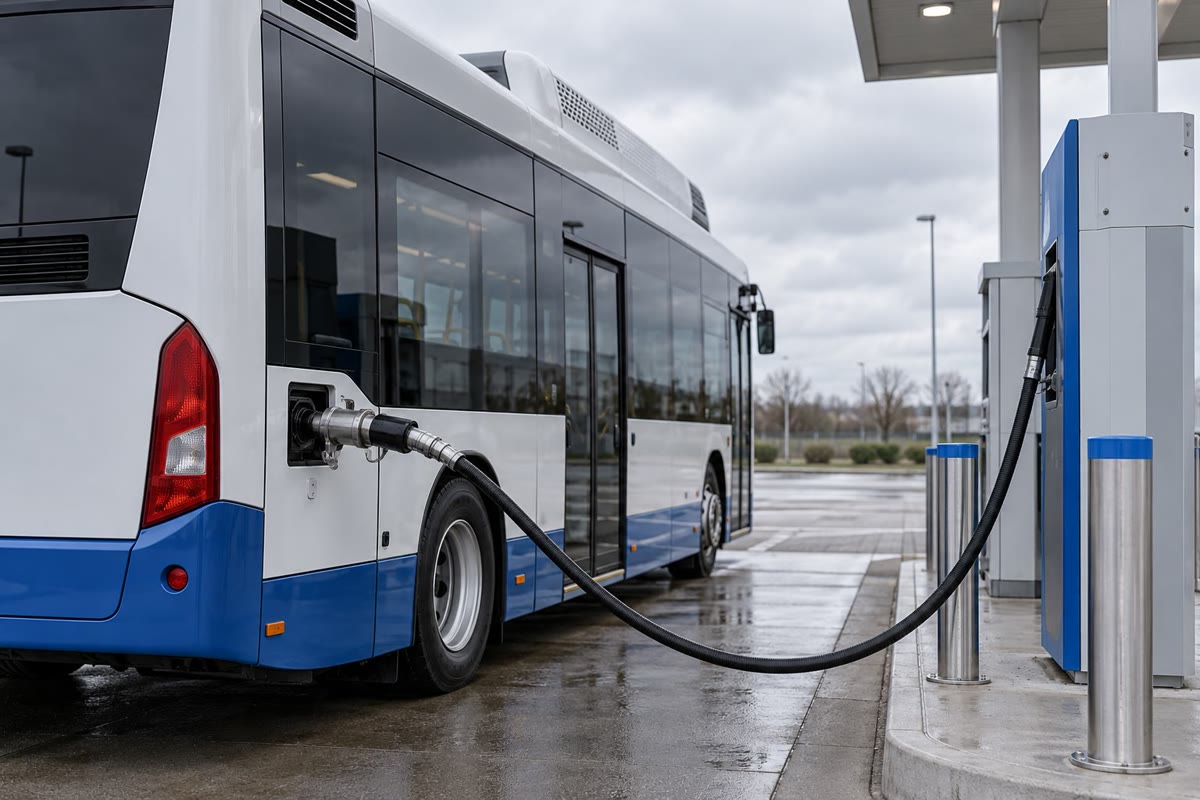
Break the seal of a hand warmer and, a minute later, it is too hot to hold for long; squeeze a cold pack and it chills a sprained ankle; a city bus runs all day on hydrogen and leaves only water vapour behind it. Chemical transformations do not only turn substances into others: they release energy, or take it in. Where does that energy come from, and how much of it can a fuel give?
You already know
In a complete combustion, a fuel made of carbon and hydrogen burns in dioxygen to give carbon dioxide and water (Chapter 14). A covalent bond is a shared pair of electrons; Lewis structures show every bond of a molecule (Chapter 24). The amount of substance is counted in moles (Chapter 25).
37.1 Exothermic and endothermic transformations
Definition 37.1 (Exothermic, endothermic)
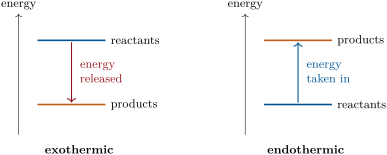
A transformation is exothermic if it releases energy to its surroundings, usually as heat: the surroundings warm up. It is endothermic if it takes in energy from its surroundings: they cool down, or the transformation needs heating to go on.
Example 37.2 (Warm and cold)
Combustions are exothermic, and so is the slow reaction of iron powder with the dioxygen of the air inside a hand warmer. The dissolving of ammonium nitrate in water, used in cold packs, is endothermic; so is the decomposition of limestone into quicklime and carbon dioxide, which takes place only in a very hot kiln.
37.2 The energy released by a combustion
Definition 37.3 (Molar energy of combustion)
The molar energy of combustion of a fuel is the energy released by the complete combustion of one mole of it, in , the water formed being liquid.
Proposition 37.4 (Energy released by moles)
The complete combustion of an amount of fuel releases the energy . For methane, : burning () of it releases about .
In the lab — Heating water with a spirit burner
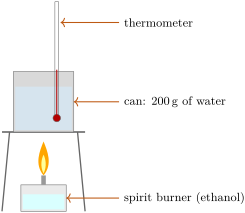
A spirit burner of ethanol is weighed, then lit under a metal can holding of water, with a thermometer in it. When the water has warmed by , the flame is put out and the burner weighed again: it has lost of ethanol. The energy taken by the water is computed with the physics formula , where is the specific heat of water. It is far below the energy the ethanol could release: much of the heat warms the air, the can and the burner, and some of the ethanol burns incompletely.
Example 37.5 (The spirit burner in numbers)
The water received , that is . The ethanol burnt, , is ; with it could release . Only of it reached the water.
37.3 Bond energies
Definition 37.6 (Bond energy)
The bond energy of a covalent bond is the energy needed to break one mole of such bonds, the molecules and atoms being gases. Tables give average values, measured over many molecules, in .
| bond | bond | bond | |||
|---|---|---|---|---|---|
| 436 | 345 | 498 | |||
| 415 | 611 | 946 | |||
| 390 | 350 | 243 | |||
| 464 | 741 | 432 |
Proposition 37.7 (Estimating a reaction energy)
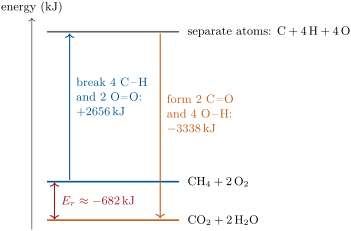
For a reaction between gases, the energy taken in, (negative if energy is released), is approximately
If , more energy is released by forming the new bonds than is needed to break the old ones: the reaction is exothermic.
Proof. Imagine the reaction in two steps: every bond of the reactants is broken, which costs the first sum and leaves separate atoms; then the bonds of the products form, which gives back the second sum. The result is only an estimate, because tables give averages over many molecules. ∎
Method 37.8 (Estimating a reaction energy from bond energies)
- Write the balanced equation and the Lewis structure of every molecule.
- Count the bonds of each kind broken in the reactants and formed in the products, with the coefficients.
- Add up the energies of the bonds broken, subtract those of the bonds formed.
- Conclude: a negative result means an exothermic reaction.
Example 37.9 (Hydrogen and chlorine)
For : one and one broken, ; two formed, . So per mole of reaction: exothermic.
Remark 37.10 (Estimate and measurement)
The measured energy released by burning one mole of methane is , larger than the estimate. Three reasons: the bonds of carbon dioxide are stronger than the average of the table; the measured value is for liquid water, and condensing the water vapour releases more energy; and average bond energies are only averages. The bond-energy method gives the sign and the order of magnitude, not the exact value.
37.4 Comparing fuels
Example 37.11 (Carbon dioxide per megajoule)
Burning one mole of methane releases and one mole of carbon dioxide, . For one megajoule, , it releases of carbon dioxide. Ethanol, with two moles of carbon dioxide per , releases per megajoule. Hydrogen releases none: its only product is water.
Safety


Ethanol is highly flammable and irritating to the eyes. A spirit burner is filled away from any flame, never refilled while hot, and used by the teacher on a heat-proof mat.
37.5 Exercises
Exercise 37.1 ★
Exothermic or endothermic: wood burning; ice melting; a cold pack being squeezed; a hand warmer heating up; a green leaf making sugar in sunlight?
Solution
Solution of Exercise 37.1.
Wood burning: exothermic. Ice melting: endothermic (it takes heat from its surroundings, though it is not a chemical reaction). Cold pack: endothermic. Hand warmer: exothermic. Making sugar in sunlight: endothermic (the energy comes from light).
Exercise 37.2 ★
What energy does the complete combustion of of methane release?
Solution
Solution of Exercise 37.2.
, about .
Exercise 37.3 ★
On the energy diagram of an exothermic reaction, which holds more energy, the reactants or the products? Where does the difference go?
Solution
Solution of Exercise 37.3.
The reactants. The difference is released to the surroundings, mostly as heat.
Exercise 37.4 ★
What energy does the complete combustion of of ethanol release?
Solution
Solution of Exercise 37.4.
; , about .
Exercise 37.5 ★
What is a bond energy? Why does breaking a bond always cost energy?
Exercise 37.6 ★★
Estimate, with bond energies, the energy of the reaction , all gases. Is it exothermic?
Exercise 37.7 ★★
Estimate the energy of the combustion of ethanol, , with bond energies (draw the Lewis structure of ethanol first), and compare with the measured .
Solution
Solution of Exercise 37.7.
Ethanol has 5 , 1 , 1 and 1 . Broken: . Formed: . , about a quarter smaller in size than the measured .
Exercise 37.8 ★★
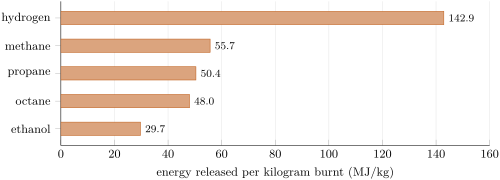
Compute the energy released per kilogram of propane () and of methane. Compare with the bar chart.
Solution
Solution of Exercise 37.8.
Propane: . Methane: . Both as on the chart.
Exercise 37.9 ★★
A gas cooker heats of water () from to . What energy does the water receive? What mass of methane is burnt if all the energy reached the water? If only half of it did?
Solution
Solution of Exercise 37.9.
; , that is of methane; with half the energy lost, .
Exercise 37.10 ★★
Using the bar chart, rank the fuels by energy per kilogram. What mass of hydrogen gives the same energy as of octane?
Solution
Solution of Exercise 37.10.
Hydrogen > methane > propane > octane > ethanol. of hydrogen.
Exercise 37.11 ★★
Estimate the energy of , all gases. Exothermic or endothermic?
Exercise 37.12 ★★★
In a spirit-burner experiment, of water warm by while of ethanol burn. Compute the energy received by the water, the energy the ethanol could release, and the efficiency of the heating. Name three causes of the losses.
Solution
Solution of Exercise 37.12.
Water: . Ethanol: , which could release . Efficiency . Losses: heat carried away by the air, heat warming the can and the stand, incomplete combustion (soot), some ethanol evaporating unburnt.
Exercise 37.13 ★★★
Octane releases and propane . Write their combustion equations and compute the mass of carbon dioxide each releases per megajoule. Compare with methane, .
Solution
Solution of Exercise 37.13.
: 8 moles of carbon dioxide, , per , so per megajoule. : per , so per megajoule. Methane, with , releases the least.
Exercise 37.14 ★★★
For both methane and ethanol, the bond-energy estimate is smaller than the measured energy released. Give the reasons, and explain why the estimate is still useful.
Solution
Solution of Exercise 37.14.
The table gives average bond energies, while the bonds of carbon dioxide are stronger than average; the measured values are for liquid water, whose condensation releases more energy than the gas reaction; and the method treats every bond as independent of its neighbours. The estimate is still useful: it gives the right sign (exothermic) and the right order of magnitude without any measurement.
Exercise 37.15 ★★★
Estimate the energy of , all gases. Why must energy be supplied (for example as electricity) to make hydrogen from water? Explain why hydrogen is called a way of storing energy rather than a source of energy.
Solution
Solution of Exercise 37.15.
Broken: ; formed: ; : endothermic, so energy must be supplied. Burning the hydrogen later gives this energy back: hydrogen stores energy produced elsewhere, it does not create any.
37.6 Problem: Which Fuel for the City Bus?
Problem 37.1
Weekend problem — methane, ethanol, octane or hydrogen: which gives the most energy per kilogram, and how much carbon dioxide per megajoule?
A city compares four fuels for its buses: methane (natural gas), ethanol, octane (for petrol) and hydrogen. The energies released by the complete combustion of one mole are: methane , ethanol , octane , hydrogen , the water being formed liquid.
Part I — Combustion equations.
- Write the equation of the complete combustion of methane.
- Of ethanol, .
- Of octane, .
- Of hydrogen.
- Which fuel releases no carbon dioxide?
Part II — Energy per kilogram.
- Compute the molar masses of the four fuels.
- Compute the energy released per kilogram for each, in .
- Rank the fuels.
- Hydrogen wins by far. Why is it still difficult to carry on a bus? (Think of its state at room temperature.)
Part III — Estimating with bond energies.
- Draw the Lewis structures of the molecules of the combustion of methane, and count the bonds broken and formed.
- Compute the energy needed to break the bonds.
- Compute the energy released by forming the new bonds.
- Deduce the estimate of , and compare with the measured value: relative difference?
- Give two reasons for the difference.
Part IV — Carbon dioxide per megajoule.
- What amount of methane must burn to release ?
- What mass of carbon dioxide does it release?
- Same question for ethanol and octane.
- Which carbon fuel releases the least carbon dioxide for the same energy? Why (compare the numbers of C and H atoms)?
- Hydrogen releases none when it burns. On what does its true benefit for the climate depend?
- State the final answer: what mass of carbon dioxide does methane release per megajoule?
Solution
Solution of Problem 37.1.
1. .
2. .
3. .
4. .
5. Hydrogen.
6. , , , .
7. In per , then : methane , ; ethanol , ; octane , ; hydrogen , .
8. Hydrogen > methane > octane > ethanol.
9. Hydrogen is a very light gas: a kilogram of it fills a huge volume at normal pressure, so it must be squeezed into heavy high-pressure tanks.
10. Methane: 4 ; dioxygen: 2 broken. Carbon dioxide: 2 ; water: formed.
11. .
12. .
13. , against measured: about too small in size.
14. Average bond energies (the of carbon dioxide is stronger than average); liquid water in the measurement, gases in the estimate.
15. .
16. .
17. Ethanol: , giving of carbon dioxide, . Octane: , giving , .
18. Methane: it has the most hydrogen atoms per carbon atom (4 against 2.25 for octane), and burning hydrogen gives energy without carbon dioxide.
19. On how the hydrogen is made: from water with electricity from renewable sources, it releases almost no carbon dioxide; made from methane, it releases carbon dioxide at the factory instead of the exhaust.
20. Methane releases about of carbon dioxide per megajoule.