
All books

Professional

Apps About Coach Log in Start reading

Chemistry · Glossary

What is Exothermic, endothermic?

Also known as: exothermic · endothermic

Definition 37.1 School Chemistry — Grades 1 to 12 · Chapter 37 — The Energy of Reactions: Combustion and Bond Energies

A transformation is exothermic if it releases energy to its surroundings, usually as heat: the surroundings warm up. It is endothermic if it takes in energy from its surroundings: they cool down, or the transformation needs heating to go on.
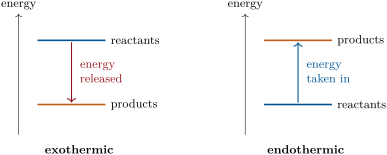
Energy diagrams. In an exothermic reaction the products hold less energy than the reactants, and the difference is released; in an endothermic one they hold more, and it must be supplied.

Examples

Example 37.2 (Warm and cold)

Combustions are exothermic, and so is the slow reaction of iron powder with the dioxygen of the air inside a hand warmer. The dissolving of ammonium nitrate in water, used in cold packs, is endothermic; so is the decomposition of limestone into quicklime and carbon dioxide, which takes place only in a very hot kiln.

Example 37.9 (Hydrogen and chlorine)

For HX2+ClX2→2 HCl\ce{H2 + Cl2 -> 2HCl}: one H−H\ce{H-H} and one Cl−Cl\ce{Cl-Cl} broken, 436+243=679 kJ436 + 243 = 679\,\mathrm{kJ}; two H−Cl\ce{H-Cl} formed, 2×432=864 kJ2 \times 432 = 864\,\mathrm{kJ}. So Er≈679−864=−185 kJE_r \approx 679 - 864 = -185\,\mathrm{kJ} per mole of reaction: exothermic.

Read in context →