
All books

Professional

Apps About Coach Log in Start reading

Chemistry · Glossary

What is Enantiomeric excess?

Also known as: enantiomeric ratio · diastereomeric excess · optical purity

Definition 28.1 University Chemistry — Year 3 · Chapter 28 — Asymmetric Synthesis

For a mixture of enantiomers in amounts nR≥nSn_R \ge n_S, the enantiomeric excess is ee=(nR−nS)/(nR+nS)\mathrm{ee} = (n_R - n_S)/(n_R + n_S) and the enantiomeric ratio er=nR/nS\mathrm{er} = n_R/n_S; for diastereomers, the diastereomeric excess de is defined in the same way. The optical purity is the ratio of the specific rotation of a sample to that of the pure enantiomer.
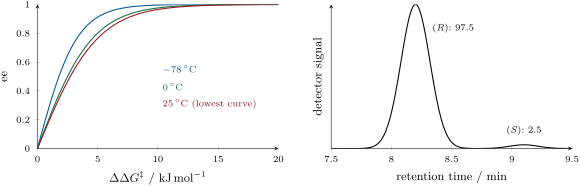
Left: enantiomeric excess against the difference in Gibbs energy of activation of the two competing paths, at three temperatures: the same G gives a higher ee at low temperature. Right: a chiral HPLC chromatogram, peak areas 97.5 and 2.5 (model): ee 95 %.
Left: enantiomeric excess against the difference in Gibbs energy of activation of the two competing paths, at three temperatures: the same ΔΔG‡\Delta\Delta G^\ddagger gives a higher ee at low temperature. Right: a chiral HPLC chromatogram, peak areas 97.5 and 2.5 (model): ee 95 %.
Read in context →